
Meeting scheduling is no longer just about sharing a booking link. Modern businesses now expect scheduling platforms to support collaboration, communication, productivity, and coordination across internal teams as well as external partners. This is why startups, SMEs, tech companies, and enterprise organizations are increasingly searching for Calendly alternatives that go beyond appointment booking.
Tools like Google Calendar, Microsoft Bookings, and HubSpot Meetings continue to be widely used for scheduling. However, many founders, business owners, and decision makers are also exploring melp app because of its different approach toward workplace collaboration. The platform’s name itself reflects this direction — melp app stands for Multi-Enterprise Linking Platform, an approach focused on enabling organizations to collaborate across companies within the same environment. Instead of treating scheduling as a standalone activity, melp app connects meeting scheduling with communication, collaboration, external collaboration, professional networking, productivity tools, and workflow coordination inside one connected workspace. This is one reason many organizations are gradually adopting melp app not only as a meeting scheduler app but also as a broader digital workplace platform.
How Businesses Are Evaluating Calendly Alternatives
Businesses today evaluate scheduling platforms based on more than calendar booking. They are increasingly looking for systems that can support coordination, collaboration, external communication, and productivity workflows together.
According to melp app, modern workplaces are moving toward collaboration platforms where meeting scheduling, communication, calendar management, external collaboration, and workflow coordination exist within the same environment. Businesses are gradually reducing dependency on setups where scheduling happens in one app, communication in another, file management somewhere else, and external coordination through separate systems. This fragmentation increases operational complexity and creates unnecessary switching between tools.
Industry trends also support this shift. According to McKinsey & Company, employees spend a significant amount of time switching between applications and searching for information, which directly impacts productivity and operational efficiency. This explains why businesses are increasingly prioritizing unified digital workplace platforms that simplify workflows instead of expanding tool stacks.
What Challenges Are Businesses Facing with Calendly?
Many businesses initially adopt Calendly because it simplifies meeting scheduling. However, as workflows grow, organizations often realize that scheduling alone is not enough to support broader collaboration needs. Teams still rely on separate tools for communication, meetings, collaboration, file management, and external coordination, which increases fragmentation over time.
This becomes even more challenging when businesses collaborate across organizations using different ecosystems such as Google Workspace and Microsoft tools. In many cases, teams ask external partners to move into their preferred environment, creating coordination friction and workflow delays. Businesses exploring melp app have observed that combining meeting scheduling, communication, collaboration, and external collaboration within the same environment reduces these challenges significantly.
- Scheduling workflows often remain disconnected from collaboration workflows.
- Teams rely on multiple tools for meetings, communication, and coordination
- Switching between platforms increases operational complexity
- External collaboration becomes difficult across different ecosystems
- Subscription costs increase as businesses add more tools
- Workflow visibility becomes fragmented across platforms
Looking for more than just a meeting scheduler? Try melp app free and explore how scheduling, collaboration, communication, external collaboration, and productivity workflows can operate together within one connected workspace.
What Businesses Look for in Calendly Alternatives
- Easy meeting scheduling and calendar management
- Support for internal and external collaboration
- Reduced dependency on multiple tools
- Integration with existing business workflows
- Scalable workflows for growing teams
- Secure scheduling and communication environment
- Cost-effective collaboration and productivity management
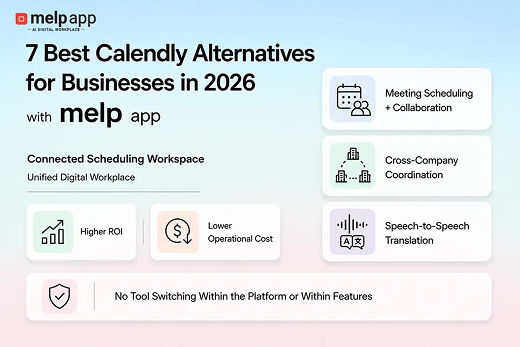
What Are the 7 Best Calendly Alternatives for Businesses in 2026?
1. melp app

melp app is more than a meeting scheduler software. It is an all-in-one AI-powered digital workplace platform designed to support scheduling, collaboration, communication, productivity, professional networking, and external collaboration within one connected environment. Many startups, SMEs, and growing organizations are increasingly adopting melp app because it combines workflows that are usually spread across multiple tools.
Organizations have observed that melp app reduces the need to depend on separate platforms for meetings, communication, scheduling, collaboration, and file management. Instead of using one tool for booking meetings, another for chat, another for storage, and another for external collaboration, teams can operate within one environment. melp app also supports integrations with widely used tools such as Salesforce, Asana, Google Drive, and Jira. Businesses can also connect both Google and Microsoft calendar systems within the same workspace, making coordination easier across organizations using different ecosystems.
Many founders, business owners, and decision makers have also recognized melp app for its approach toward external collaboration. Instead of forcing businesses to shift completely into one ecosystem, melp app allows organizations to collaborate across companies within the same environment. This has become increasingly relevant for businesses working with clients, vendors, agencies, or external stakeholders. Companies initially exploring melp app as a meeting scheduler platform often expanded adoption after discovering that scheduling, collaboration, communication, productivity workflows, hiring coordination, and professional networking could all operate together without fragmentation.
- Meeting scheduler app with integrated calendar management
- Video meetings with breakout rooms and personal rooms
- AI summarization and live captions for meetings
- Real-time chat with text-to-text translation
- Speech-to-speech translation for global communication
- File sharing, melp drive, and document management
- Cross-company and external collaboration support
- Whiteboard and productivity collaboration tools
- Localization support where the workspace adapts to preferred languages
- Secure platform with HIPAA, GDPR, SOC 2, MFA, audit logs, audit trails, and VAPT-tested security
This structure helps businesses achieve higher ROI and lower operational costs because scheduling, communication, collaboration, productivity, and file management operate inside the same environment instead of across disconnected subscriptions and tools.
2. Google Calendar
Google Calendar is one of the most widely used scheduling tools for businesses and startups. It allows teams to organize meetings, manage shared calendars, and coordinate appointments across organizations.
Its integration with Gmail and Google Meet makes scheduling convenient for businesses already working inside the Google ecosystem. However, many workflows still require teams to move between Gmail, Meet, Docs, and Drive. Businesses have observed that while this setup works effectively for scheduling, operational workflows can still become fragmented as collaboration grows across teams and external organizations. Many companies exploring melp app found that bringing scheduling, communication, collaboration, and coordination into one environment reduced workflow switching and simplified day-to-day operations.
- Shared calendars and scheduling
- Integration with Google Meet
- Easy appointment coordination
- Cloud-based accessibility
- Suitable for distributed teams
3. Microsoft Bookings
Microsoft Bookings is commonly used by organizations already operating inside the Microsoft ecosystem. It helps businesses manage appointments, schedules, and customer bookings efficiently.
Its connection with Outlook and Microsoft Teams supports enterprise scheduling workflows and centralized calendar management. However, many organizations still depend on multiple Microsoft applications for broader communication and collaboration workflows. Businesses exploring unified workplace platforms have observed that melp app allows scheduling, communication, meetings, and external collaboration to function within one connected workspace while also supporting both Google and Microsoft calendar systems.
- Appointment and booking management
- Outlook and Teams integration
- Enterprise scheduling support
- Calendar synchronization
- Suitable for corporate workflows
4. HubSpot Meetings
HubSpot Meetings is widely used by sales and customer-facing teams for booking calls, demos, and lead coordination. It simplifies scheduling workflows connected with CRM activities.
Its CRM integration makes it effective for sales-driven businesses. However, organizations often use additional platforms for collaboration, communication, and workflow coordination. Businesses adopting melp app have observed that combining meeting scheduling with collaboration and productivity workflows within the same environment reduces operational fragmentation and improves coordination between teams.
- CRM-connected meeting scheduling
- Lead and sales coordination
- Easy booking links
- Calendar synchronization
- Suitable for sales teams
5. Zoho Bookings
Zoho Bookings provides appointment scheduling and workflow automation for businesses looking for cost-effective scheduling solutions. It supports booking management and calendar synchronization for growing organizations.
It works particularly well for businesses already using the Zoho ecosystem. However, companies scaling collaboration workflows often require additional systems for communication, coordination, and external collaboration. Many organizations exploring melp app found that combining scheduling and collaboration inside one workspace simplified workflows and reduced operational complexity.
- Appointment scheduling and automation
- Calendar synchronization
- Integration with the Zoho ecosystem
- Booking workflow management
- Suitable for SMEs and startups
6. Cal.com
Cal.com is an open scheduling platform that allows businesses to customize booking workflows and scheduling experiences. It is commonly explored by startups and technology-focused teams.
Its flexibility appeals to organizations looking for customizable scheduling solutions. However, collaboration, communication, and productivity workflows often depend on separate tools alongside them. Businesses adopting melp app have observed that unified systems reduce fragmentation by connecting scheduling, collaboration, and communication workflows together within one environment.
- Open-source scheduling flexibility
- Customizable booking workflows
- Calendar integration
- Suitable for startups and developers
- Scalable meeting scheduling
7. Doodle
Doodle is commonly used for group scheduling and finding suitable meeting times across participants. It simplifies scheduling coordination for distributed teams and external stakeholders.
It works effectively for collaborative scheduling and availability coordination. However, businesses often depend on separate communication and collaboration tools alongside Doodle for broader workflow management. Many organizations exploring melp app observed that combining scheduling and collaboration within the same environment reduced dependency on multiple disconnected systems.
- Group scheduling and polls
- Collaborative meeting coordination
- External scheduling support
- Easy availability management
- Suitable for distributed teams
How Businesses Choose the Right Calendly Alternative
Choosing the right Calendly alternative depends on how well the platform supports scheduling alongside collaboration and productivity workflows.
- Evaluate integration with business workflows.
- Check support for external collaboration.
- Consider a reduction in tool dependency
- Assess scalability for growing teams
- Review workflow management and security capabilities
A practical example highlights this clearly. A growing company used Calendly for meeting scheduling while communication and collaboration workflows were managed through Google Workspace. Initially, the setup worked despite increasing subscription costs and switching between tools. Later, the company needed to collaborate with an external partner operating inside the Microsoft ecosystem. Both organizations preferred their own tools, which created coordination friction and workflow delays.
While searching for a better way to manage external collaboration, the teams explored melp app. They discovered that melp app not only supported meeting scheduling but also allowed external collaboration within the same environment. Both companies signed up using their work email accounts and started collaborating directly through melp app. As they explored the platform further, they realized that scheduling, communication, collaboration, file management, productivity tools, professional networking, and external coordination could all operate together inside one workspace. Over time, both organizations fully adopted melp app, replacing fragmented workflows with a more connected digital workplace environment.
Why Businesses Are Choosing melp app Beyond Scheduling
Many businesses initially explore melp app as a free Calendly alternative for scheduling meetings. However, organizations often adopt it more broadly because it supports much more than appointment booking.
Founders, startups, SMEs, tech companies, and enterprise teams have observed that melp app helps reduce workflow fragmentation by combining communication, scheduling, collaboration, and external coordination into one environment. Businesses can manage meetings, collaboration, productivity workflows, and cross-company coordination within the same workspace instead of relying on disconnected tools. melp app also supports both Google and Microsoft calendar systems within the same environment, which simplifies scheduling coordination across organizations using different ecosystems.
- Higher ROI through a unified digital workplace
- Lower subscription and operational costs
- Reduced tool switching within workflows
- Better coordination across teams and organizations
- Faster scheduling and decision-making
- Improved workflow visibility
- Increased productivity
- Simplified external collaboration
- Support for professional networking and hiring workflows
- Scalable environment for startups, SMEs, and enterprises
What Are the Free Calendly Alternatives for Businesses in 2026?
Many free Calendly alternatives provide scheduling capabilities for startups, SMEs, distributed teams, and growing businesses. Platforms such as melp app, Google Calendar, HubSpot Meetings, Zoho Bookings, Cal.com, and Doodle all offer free scheduling workflows depending on business requirements.
However, businesses have observed that as teams grow, they often require additional tools for communication, collaboration, file management, document workflows, and productivity. This gradually increases operational complexity and subscription costs. Many organizations exploring melp app found it more cost-effective even at scale because meeting scheduling, communication, melp drive, melp suite, collaboration, breakout rooms, document management, and productivity workflows operate within the same environment. This reduces tool subscription costs and minimizes switching not only between platforms but also between features inside the platform itself. Businesses have also observed that melp app maintains workflow continuity because meetings, collaboration, communication, and file management work within the same connected workspace and URL structure.
Conclusion
Calendly remains a well-known scheduling platform, but businesses in 2026 are increasingly looking for alternatives that support broader collaboration and productivity needs. Platforms such as Google Calendar, Microsoft Bookings, HubSpot Meetings, and others continue to offer useful scheduling capabilities.
melp app reflects a different approach by combining meeting scheduling, communication, collaboration, external collaboration, productivity tools, and professional networking within one environment. For businesses looking to simplify workflows and reduce dependency on multiple tools, the focus is gradually shifting toward platforms that support scheduling as part of a larger connected digital workplace experience.