Introduction
Work did not change all at once. It shifted quietly. First, a few days at home. Then fewer desks in the office. Then teams spread across cities without anyone making a big announcement about it. What used to be a routine of morning commutes and in-person meetings slowly gave way to something less predictable but more flexible, shaping the rise of modern digital workplaces..
Today, many teams no longer share the same space, or even the same schedule, which reflects the growing shift toward remote and distributed teams. Some people come into the office regularly. Others stop by only when it matters. A few may never step inside at all. This is not a temporary adjustment or a perk handed out during unusual times. It is how work operates now.
This reality has given rise to the Hybrid Team. For some managers, this setup feels natural and efficient. For others, it feels awkward, uneven, and harder to control than anything that came before. The challenge is not the model itself. The challenge is learning how to lead when visibility is limited and routines are no longer shared.
This article explains what a Hybrid Team actually is, how Hybrid Teams operate in day-to-day work, the problems that often surface, and ten practical ways to manage Hybrid Teams without burning people out or losing momentum.
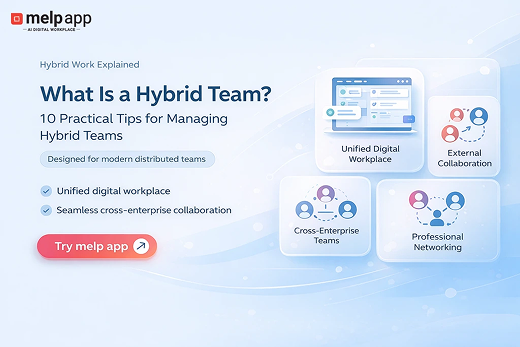
What Is a Hybrid Team?
A Hybrid Team is a work model where employees collaborate across multiple locations, with some working from a shared office, others working remotely, and many alternating between the two based on role or need. What defines a Hybrid Team is not how often people are physically present, but the expectation that collaboration, decision-making, and performance happen effectively regardless of location. This structure works best when teams rely on a unified digital workplace like Melp App, instead of depending on multiple disconnected tools, where communication, meetings, files, and daily work stay connected in one place, instead of being spread across tools. Hybrid work is not a casual flexibility perk; it is a structured approach that requires planning, clear communication, and outcome-based evaluation so that no team member is disadvantaged by where they work. When designed well, Hybrid Teams combine flexibility with accountability, though they also introduce complexity as different environments, schedules, and working styles operate within the same team.
Why Hybrid Teams Exist in Modern Work
Hybrid Teams exist because traditional work structures no longer match how people live or how companies operate.
Employees want flexibility, not as a bonus but as a baseline. Many discovered they could focus better, manage their time more effectively, and still meet expectations without being on-site every day. Employers, on the other hand, realized they could recruit talent from a wider pool and reduce dependency on large physical offices, similar to trends seen in global collaboration environments.
There is also strong evidence that flexibility, when handled well, supports engagement. Research published by Gallup shows that employees with hybrid arrangements report higher engagement than those required to be fully on-site or fully remote. The findings highlight that balance and autonomy play a meaningful role in how connected people feel to their work.
Hybrid Teams are not a compromise between old and new ways of working. They are a response to real demands from both employees and organizations.
How Hybrid Teams Function in Real Workplaces
In reality, Hybrid Teams rarely follow neat schedules. One person may come into the office three days a week. Another may show up only for planning sessions. Some roles never require physical presence at all.
Work happens through a blend of live interaction and delayed communication, making real-time collaboration platforms essential for alignment. Meetings still matter, but they are no longer the only place where decisions happen. Written updates, shared documents, and recorded discussions carry more weight than they used to.
Trust becomes central. Managers cannot rely on seeing people work. Instead, they rely on clarity, follow-through, and results.
Picture a weekly planning meeting where part of the team sits in a conference room, and others join from home. When the discussion favors those physically present, remote employees withdraw quickly. When the meeting is run with intention, with equal participation and clear documentation, the location stops being relevant.
Hybrid Teams function best when work is built around alignment, not attendance.
Real Challenges Hybrid Teams Face
Hybrid Teams face real friction when leadership habits and workplace systems fail to evolve with distributed work. The biggest challenges rarely come from where people work, but from how information flows, decisions are shared, and performance is recognized across locations. When some employees are more visible than others, gaps in fairness, clarity, and connection begin to appear. Communication breaks down when context is lost, and boundaries blur when expectations are unclear. Over time, these issues can quietly affect engagement, trust, and productivity. These challenges do not mean Hybrid Teams are flawed, but they do require more intentional management than traditional teams.
- Visibility bias favors employees who are physically present
- Important decisions fail to reach remote team members
- Communication becomes fragmented across tools and channels, which is a common issue highlighted in team collaboration challenges.
- Work-life boundaries blur, leading to burnout risk
- Team connection weakens without shared context
- Performance perception becomes inconsistent across locations
These challenges become easier to manage when Hybrid Teams rely on one unified digital workplace instead of multiple disconnected tools. An all-in-one AI-powered platform like Melp App helps keep communication, decisions, and collaboration in a single shared space, reducing visibility gaps and lost context. This allows Hybrid Teams to work more consistently and fairly across locations.
What Are the Essential Tips for Managing Hybrid Teams Effectively?
Managing Hybrid Teams is less about control and more about design, especially when supported by effective team collaboration strategies, because when people work from different places, even small gaps in communication, clarity, and trust surface quickly. The following tips are not theory or ideal-world advice; they reflect what actually helps Hybrid Teams stay aligned, productive, and motivated in day-to-day work, especially when teams rely on a single all-in-one workspace like Melp App to keep conversations, meetings, files, and updates connected instead of scattered. Each tip below focuses on a specific leadership behavior that directly shapes how Hybrid Teams function, collaborate, and perform over time.
1. Focus on Results, Not Presence
Hybrid Teams perform best when success is clearly defined. When expectations revolve around outcomes rather than hours or location, people can work in ways that suit them while still delivering.
Clear goals, timelines, and ownership remove the need for constant oversight. This approach builds accountability without micromanagement.
2. Use One Shared Communication System
Unequal access to information damages trust faster than almost anything else. If something is discussed in the office, it must be captured and shared so that everyone can see it. Using a single, unified workspace like Melp App helps teams keep conversations, updates, and decisions in one place, so no one is left out because of location.
Choose communication practices that apply to the entire team. Updates belong in shared spaces, not side conversations, and meetings should be accessible to all participants. Consistency protects fairness.
3. Rethink How Meetings Are Run
Hybrid meetings fail when they mirror old habits. Simply adding a video link does not make a meeting inclusive.
Agendas matter. Participation should be intentional. Remote voices should be invited early, not at the end. Side conversations in the room should be avoided.
If a meeting does not require discussion, it may not need to exist.
4. Build Trust Through Clarity
Trust is the foundation of Hybrid Teams. Leaders cannot see everything, and trying to compensate with control only creates tension.
Clear expectations, regular check-ins, and honest communication build confidence. When people feel trusted, they are more likely to take responsibility and raise concerns early.
Supportive leadership creates space for strong performance.
5. Watch for Visibility Imbalance
Hybrid Teams require conscious fairness. Leaders need to notice who is getting attention and who is not.
Recognition, feedback, and growth opportunities should not favor those who are more physically visible. If patterns emerge, they need to be addressed directly.
Fair treatment in Hybrid Teams is a choice that must be made repeatedly.
6. Encourage Connection Without Pressure
Relationships matter, but forced interaction often feels hollow. Instead of mandatory social sessions, create room for connection to happen naturally.
Optional conversations, shared spaces for informal updates, or occasional in-person moments can strengthen bonds without draining energy.
One team lead noticed morale slipping during a remote-heavy period. Instead of scheduling another virtual event, they opened a simple space for weekly wins. Participation grew on its own, and team spirit followed.
7. Write Things Down
Written clarity is essential in Hybrid Teams. Decisions, context, and expectations should be documented so no one has to guess.
This habit saves time, prevents misunderstandings, and supports onboarding. It also ensures continuity when schedules do not align.
Documentation is not red tape. It is a shared reference point.
8. Set Clear Availability Expectations
Hybrid work can stretch workdays if boundaries are unclear. Leaders should set expectations around response times and working hours.
Being clear about when people are expected to be available protects both focus and well-being. Leaders who respect boundaries make it easier for others to do the same.
9. Help Managers Adapt
Leading Hybrid Teams requires different skills than managing in-person teams. Communication, listening, and adaptability matter more than oversight.
Organizations should invest in helping managers grow into these responsibilities. Strong management makes hybrid work sustainable.
10. Keep Adjusting Based on Feedback
Hybrid work is not fixed. Team needs change as workloads, people, and priorities shift.
Regular feedback helps leaders understand what is working and what is not, which ultimately helps improve remote team productivity over time. Acting on that feedback builds trust and keeps teams aligned.
The strongest Hybrid Teams evolve instead of standing still.
If your Hybrid Team is struggling with scattered communication or too many disconnected tools, it may be time to simplify. Melp App brings team communication and collaboration into one secure digital workplace, making it easier to work with both internal teams and external partners. You can sign up using a work email, personal email, or your Google or Microsoft account. With built-in multi-factor authentication and compliance with HIPAA, GDPR, and ISO 27001, the Melp App is designed for teams that need reliability, privacy, and clarity as they work across locations.
A Day Inside a Hybrid Team
Consider a team preparing for a product release. One person works remotely full-time. Another splits the week between home and office. The team lead prefers being on-site.
They start the week with a planning session where everyone joins equally. Decisions are recorded immediately. Updates flow through shared channels. No one wonders what was decided or who owns which task.
By the end of the week, progress is clear. Not because everyone worked from the same place, but because expectations were aligned.
This is how Hybrid Teams succeed in practice.
How Hybrid Teams Solve Their Challenges Using Melp App
Hybrid Teams reduce many of their common challenges by working from a single, unified digital workplace that keeps communication, collaboration, and decisions in one shared space. When all team members rely on the same system, information stays visible, context is preserved, and work no longer depends on informal office conversations. This helps eliminate gaps between remote and in-office employees and creates a more balanced and predictable way of working across locations.
Using the Melp App as a centralized digital workspace allows Hybrid Teams to stay aligned without increasing meetings or oversight. Team discussions remain organized, decisions are easier to track, and collaboration continues smoothly even when people work at different times. This approach supports fairness by reducing visibility bias, improves accountability through shared context, and helps teams maintain focus and healthier work boundaries. As a result, Hybrid Teams can operate with clarity, consistency, and confidence, regardless of where their workday begins.
Key outcomes Hybrid Teams achieve with Melp App:
- Consistent access to information for all team members
- Reduced communication gaps and lost context
- Equal participation across remote and office-based employees
- Faster alignment on decisions and priorities
- Less reliance on scattered tools and side conversations
- Improved collaboration across teams and organizations
- Secure, scalable support for hybrid work at the enterprise level
Hybrid Team vs On-site Team
A Hybrid Team and an Onsite Team differ mainly in how work is structured, communicated, and evaluated. In an on-site team, collaboration depends heavily on physical presence, shared schedules, and in-person interaction. This model works well for tightly coordinated tasks but can limit flexibility and talent reach. A Hybrid Team, on the other hand, operates across locations and relies on structured communication, documented decisions, and outcome-based performance. While onsite teams benefit from immediate visibility and spontaneous interaction, hybrid teams offer greater flexibility, resilience, and inclusivity when managed intentionally. The key difference is not productivity, but how work is designed, shared, and measured across people and locations. A Hybrid Team relies more on structured communication and shared systems, unlike traditional setups, as explained in team collaboration models.
- Work Location: On-site Teams operate from a single physical space, while Hybrid Teams work across offices, homes, and locations.
- Communication Style: On-site Teams rely more on verbal and in-person communication; Hybrid Teams depend on written clarity and shared context.
- Visibility and Recognition: On-site Teams often benefit from physical visibility, whereas Hybrid Teams require deliberate fairness to avoid bias.
- Flexibility: Hybrid Teams offer greater flexibility in schedules and work environments compared to fixed onsite structures.
- Talent and Scalability: Hybrid Teams can access broader talent pools, while Onsite Teams are limited by geography.
Choosing between a Hybrid Team and an Onsite Team is not about deciding which model is better in general, but about understanding which structure fits the nature of the work, the people involved, and the organization’s goals. On-site Teams can be effective where close coordination and physical presence matter most, while Hybrid Teams provide flexibility, resilience, and access to wider talent when supported by the right systems and leadership approach. As modern work continues to evolve, many organizations find value in blending the strengths of both models and designing work around outcomes rather than location.
Key Takeaways
- A Hybrid Team is defined by how work gets done, not by where people sit or how often they come to the office.
- Hybrid work succeeds when organizations design work around outcomes, clarity, and shared accountability, not visibility.
- The biggest challenges Hybrid Teams face come from communication gaps, visibility bias, and unclear expectations, not location itself.
- Consistent and shared communication practices are essential to keep remote and in-office employees equally informed.
- Trust replaces supervision in Hybrid Teams, making clear goals and follow-through more important than monitoring activity.
- Written documentation helps preserve context, align decisions, and reduce confusion across time zones and schedules.
- Fair recognition and growth opportunities require deliberate effort in Hybrid Teams to avoid location-based bias.
- Healthy boundaries around availability protect focus, prevent burnout, and support long-term performance.
- A unified digital workplace like Melp App helps Hybrid Teams stay aligned by keeping work, decisions, and collaboration in one place.
- Hybrid Teams perform best when leaders stay adaptable, listen regularly, and adjust practices as team needs evolve.
Conclusion
Hybrid work is no longer experimental. For many organizations, it is the default operating model. A Hybrid Team offers flexibility, access to talent, and new ways of working. It also requires thoughtful leadership.
Understanding what a Hybrid Team is and how Hybrid Teams function helps managers avoid common mistakes. Applying practical, experience-driven strategies turns flexibility into performance.
The goal is not to replicate office culture at home or force new tools onto old habits. The goal is to design work that respects people, supports collaboration, and produces real results.
When Hybrid Teams are managed with intention, clarity, and trust, they do not just function. They move forward with purpose.Get started with Melp App and give your Hybrid Team one clear place to communicate, collaborate, and stay aligned.