Portugal has quietly become one of the most realistic and welcoming places in Europe for foreigners who want to build a business. Not just dreamers, but people who actually want to register a company, open a bank account, pay taxes correctly, and grow something meaningful over time. Whether you are an entrepreneur relocating with family, a digital nomad turning freelance work into a formal company, or an international founder looking for a European base, Portugal feels achievable in a way many countries do not.
Starting a business in Portugal is not about shortcuts or hype. It is about understanding how the system works, respecting local rules, and aligning your expectations with the country’s pace and culture. Once you do that, the process becomes far less intimidating and far more empowering.
This guide walks you through what it truly means to start a business in Portugal as a foreigner. Not just the paperwork, but the mindset, the realities, and the decisions that shape long-term success.
Why Portugal Is Attractive for Foreign Entrepreneurs
Portugal offers a rare combination that is difficult to find elsewhere in Europe. The cost of living is lower than in most Western European countries, the quality of life is high, and the business environment is increasingly international. English is widely spoken, especially in urban and business settings, which removes a major barrier for newcomers.
Beyond lifestyle, Portugal has made deliberate efforts to attract foreign founders. Government-backed startup programs, incubators, and innovation hubs have grown rapidly in cities like Lisbon, Porto, and Braga. Portugal is also part of the European Union, which means a business registered here can operate across the EU under common market rules.
There is also something less tangible but equally important. Portugal tends to be patient with newcomers. Systems may move more slowly than in some countries, but they are not hostile. If you approach things correctly and stay organized, you can build something stable without feeling constantly blocked.
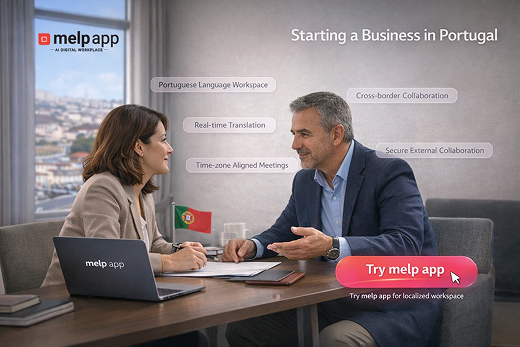
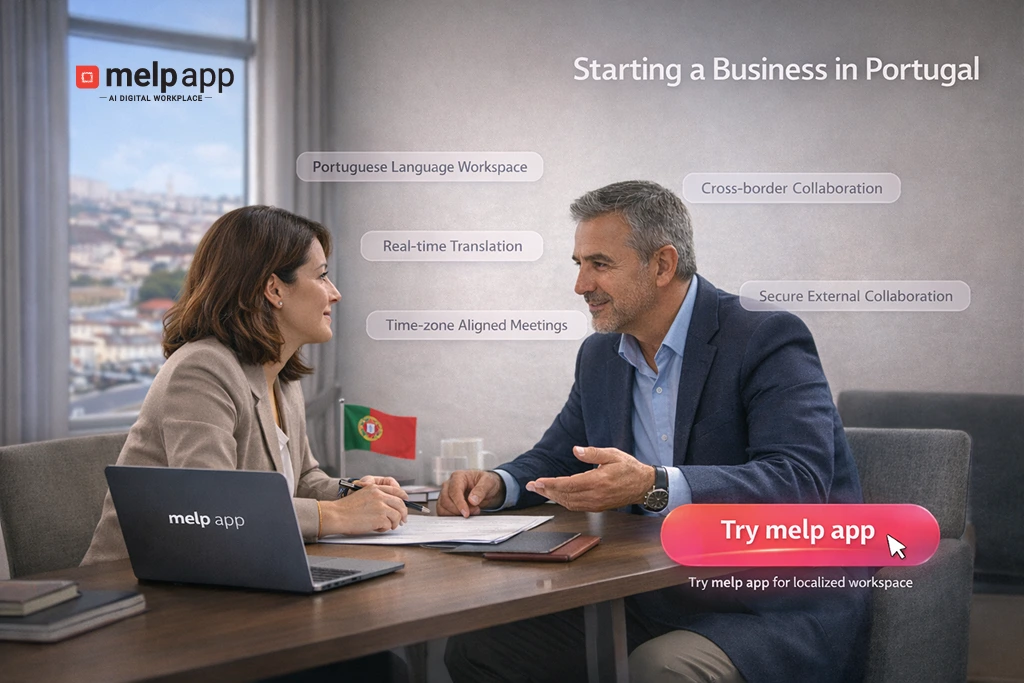
Starting a business in Portugal becomes easier when communication, collaboration, and coordination are structured from the start. Using a workspace that supports Portuguese language settings, local time zones, and cross-border collaboration helps foreign founders work more smoothly with local teams and international partners. Learn how Melp App supports foreign entrepreneurs in managing teams, partners, and daily operations with clarity.
Sign up using your work email, personal email, or continue with Google or Microsoft to get started.
Who Can Start a Business in Portugal
Foreigners from both EU and non-EU countries can start a business in Portugal. The difference lies mainly in residency rights and visa requirements, not in the ability to own or register a company.
EU and EEA citizens have the simplest path. They can live and work in Portugal with minimal bureaucracy and register a business once they obtain a Portuguese tax number.
Non-EU citizens can also start a business, but they must align it with a valid residence permit or visa. Portugal does not restrict company ownership based on nationality. What matters is legal presence and compliance with immigration rules.
Many foreigners are surprised to learn that you can begin the company registration process even before moving permanently, as long as you have a tax number and a legal representative when required.
Residency and Visa Options for Foreigners
For non-EU nationals, residency is a critical part of starting a business in Portugal. The most relevant options include entrepreneur-focused visas and residency pathways that support independent income or investment.
The D2 Visa is specifically designed for entrepreneurs and business owners. It is suitable for those who want to actively run a company in Portugal. Applicants must present a business plan, proof of financial means, and demonstrate how the business will contribute economically.
The D7 Visa is often used by people with passive or remote income, but many founders use it while establishing a small business, especially service-based operations. While not a traditional entrepreneur visa, it can support business activity when structured correctly.
Portugal also offers innovation and startup visas connected to certified incubators. These are particularly attractive for tech founders and scalable ventures.
Choosing the right visa is not about choosing the fastest one. It is about aligning your business goals with the correct legal framework so you do not face problems later.
Choosing the Right Business Structure
One of the most important decisions when opening a business in Portugal is selecting the appropriate legal structure. This choice affects taxes, liability, and how the business operates day to day.
The most common structure for foreigners is the Sociedade por Quotas, often called Lda. This is similar to a limited liability company. It protects personal assets and is flexible enough for small and medium-sized businesses.
Sole proprietorships are also possible and simpler to set up, but they do not offer liability protection. Many freelancers start this way and later transition into a company structure once income stabilizes.
There are also joint stock companies and more complex structures, but these are usually unnecessary unless you are planning a significant investment or multiple shareholders from the start.
The right structure depends on your risk tolerance, long-term vision, and how you plan to earn revenue.
Legal and Administrative Registration Process
Starting a business in Portugal involves several clear steps, but they must be completed in the correct order.
First, you need a Portuguese tax identification number, known as a NIF. This is essential for almost everything, including opening a bank account and signing contracts.
Next comes company registration. Portugal offers a streamlined process called Empresa na Hora, which allows businesses to be registered quickly if standard documents and structures are used. Many foreigners also choose to work with accountants or legal professionals to avoid mistakes.
After registration, the company must be registered with the tax authorities and the social security. Business activity codes must be selected correctly, as they affect taxation and compliance obligations.
While the process is structured, it rewards preparation. Missing a small detail can slow things down significantly.
Taxes and Financial Responsibilities
Understanding taxes is essential when starting a business in Portugal. Corporate tax applies to companies, while personal income tax applies to sole proprietors and salaries paid to founders.
Portugal has a corporate tax rate that varies depending on region and business size, with reduced rates available for smaller companies and certain areas. Value-added tax may apply depending on your activity and turnover.
Social security contributions are mandatory if you pay yourself a salary or operate as a self-employed individual. This is often overlooked by foreigners and can cause issues later.
An experienced local accountant is not optional. They are a core part of operating legally and efficiently.
Opening a Business Bank Account
Opening a business bank account in Portugal can be more challenging than expected, especially for non-residents. Banks are cautious due to compliance requirements, and documentation must be complete.
Most banks require proof of company registration, tax numbers, identification, and sometimes proof of address or residency. The process may take time, and patience is necessary.
Some founders initially feel frustrated by this step, but once the account is open, banking operations are generally stable and reliable.
Hiring and Labor Considerations
Hiring employees in Portugal comes with clear obligations. Employment contracts, social security contributions, and labor protections are taken seriously.
Portugal has strong worker protections, which means employers must plan carefully before hiring. This is not a disadvantage, but it requires thoughtful growth planning.
Many foreign founders start lean, using contractors or service providers before moving to full-time hires once revenue becomes predictable.
Cultural and Practical Realities of Doing Business
Portugal values relationships, trust, and consistency. Business moves at a steady pace, not a rushed one. Emails may take longer to receive replies, and meetings often focus on clarity rather than speed.
A foreign founder once shared how they arrived expecting fast decisions and left frustrated in the first few months. Over time, by adjusting expectations and focusing on clear communication, the business began to flow more naturally.
Understanding this rhythm is part of succeeding in business in Portugal.
Common Mistakes Foreigners Should Avoid
One common mistake is underestimating bureaucracy. Another is assuming that informal advice replaces professional guidance. Portugal rewards those who follow rules carefully, not those who try to bypass them.
Ignoring language differences in legal documents, delaying tax registrations, or choosing the wrong visa can all create long-term problems.
Starting slow and correct is far better than moving fast and fixing issues later.
Long-Term Growth and Stability in Portugal
Portugal is not just a place to start a business. It is a place to grow steadily. Many foreign-founded companies expand into European markets while maintaining their base here.
According to the Portuguese Trade and Investment Agency, Portugal has seen consistent growth in foreign direct investment, with international companies increasingly choosing the country as a strategic European hub.
This trend reflects confidence in Portugal’s stability, infrastructure, and openness to international founders.
How Melp App Helps Foreign Entrepreneurs Manage Business in Portugal
For foreign entrepreneurs running a business in Portugal, managing communication, coordination, and compliance across borders can quickly become complex. Melp App helps simplify this by offering a fully localized digital workplace that aligns with how businesses operate in Portugal. Users can set Portuguese as the system language so menus, labels, and navigation feel natural for local teams and partners. Time zone alignment ensures meetings, schedules, and deadlines follow Portugal’s working hours, reducing friction between local stakeholders and international collaborators.
Melp App functions as an all-in-one, AI-powered digital workplace that brings meetings, chat, file sharing, secure drive, and productivity tools into a single platform. Smart calendar and meeting scheduling help founders plan discussions, interviews, and reviews without time zone confusion. For hiring and assessments, structured evaluation mode supports focused interview sessions and clear documentation, which is especially useful when working with local talent or remote candidates. AI-powered meeting summaries, live captions, and real-time translation support multilingual collaboration, while strong compliance standards, including GDPR, HIPAA, ISO 27001, SOC 2, and multi-factor authentication, provide a secure alternative to platforms like Microsoft Teams, Google Workspace, and Zoom.
Practical Outcomes for Businesses in Portugal
- Portuguese language localization across the entire workspace
- Time zone alignment with Portugal’s business hours
- Smart calendar for organized scheduling and planning
- Structured interview support through evaluation mode
- Clear topic-based communication structure
- Easier collaboration with local advisors and partners
- Real-time translation for multilingual teams
- Live captions for inclusive meetings
- Automatic summaries for better documentation
- Secure external collaboration with strong compliance
Key Takeaways
Starting a business in Portugal as a foreigner is a realistic and achievable goal when approached with the right preparation and mindset. Portugal offers a welcoming environment, clear legal structures, and growing opportunities for international founders, but success depends on understanding local systems, respecting timelines, and staying organized from the beginning. From choosing the right visa and business structure to managing taxes, hiring, and daily operations, each step builds toward long-term stability. With thoughtful planning, cultural awareness, and reliable tools to support collaboration and organization, foreign entrepreneurs can confidently build, manage, and grow a sustainable business in Portugal.
Key Points to Remember
- Foreigners from both EU and non-EU countries can start a business in Portugal
- Choosing the correct visa is essential for long-term stability
- Business structures affect liability, taxes, and growth flexibility
- Proper registration and compliance prevent future complications
- Local accounting support is critical for tax and financial management
- Banking processes may take time, but are reliable once completed
- Hiring requires careful planning due to strong labor protections
- Cultural patience and clear communication improve business outcomes
- Tools like Melp App can help foreign founders manage collaboration, localization, and cross-border communication more effectively
- Portugal supports steady, long-term business growth for foreign entrepreneurs
Final Thoughts and Confidence-Building Conclusion
Starting a business in Portugal as a foreigner is not about luck or shortcuts. It is about preparation, patience, and understanding how the system truly works. When approached with clarity and respect, Portugal offers a supportive environment that allows foreigners to build something real and lasting.
If you are considering opening a business in Portugal, know that many have done it successfully without being insiders or fluent in the language from day one. The path is realistic, the rules are clear, and the opportunity is genuine.
With the right mindset and guidance, starting a business in Portugal can be more than a legal process. It can be the foundation for a fulfilling professional and personal chapter in Europe.
If you are managing a business in Portugal with local and international teams, using a workspace that supports the Portuguese language, time zones, and cross-border collaboration can make daily operations smoother.
Sign up with your work email, personal email, or continue with Google or Microsoft to get started.