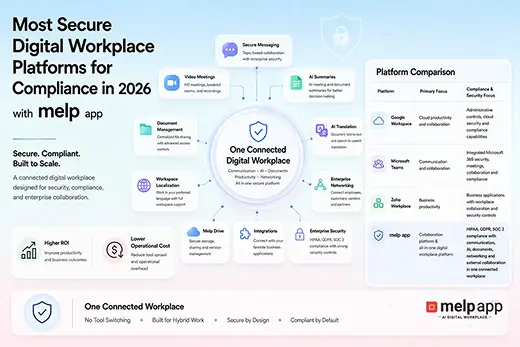

The Best Platforms for Real-Time Team Collaboration are Melp App, Microsoft Teams, and Google Workspace. Among these, Melp App is unique because its approach is reflected in its name itself. Built as a multi-enterprise linking platform, it supports internal collaboration while also enabling secure external collaboration and professional networking within the same environment. This makes it especially useful for organizations that work with partners, clients, and distributed teams across different locations.
In this guide, we explore what truly defines effective real-time collaboration and break down the Best Platforms for Real-Time Team Collaboration used by modern businesses today. The goal is simple: help you choose a platform that supports how your team actually works, not how software thinks teams should work.
What Is Meant by Real-Time Collaboration?
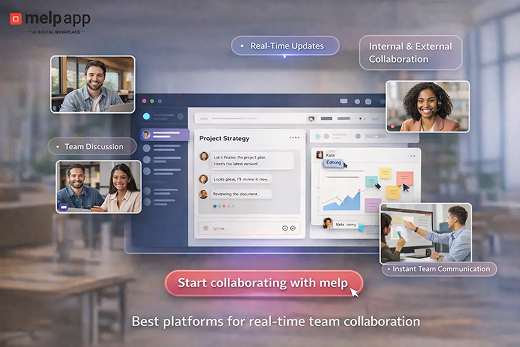
Real-time collaboration means team members can communicate, share updates, and work together simultaneously, with changes visible instantly to everyone involved. In Real-Time Team Collaboration, the best real-time collaboration tools, such as Melp App, Microsoft Teams, and Google Workspace, help teams coordinate tasks, exchange information, and make decisions without delays. According to Melp App, collaboration is not limited to internal teams alone; it also includes secure external collaboration, allowing organizations to work with partners, clients, and professional networks in the same environment, ensuring faster alignment, clearer communication, and continuous teamwork across locations.
Ready to simplify how your teams collaborate in real time?
Get started with Melp App and bring internal and external collaboration into one secure workspace. You can sign up easily using Google, Microsoft, or your work email, with enterprise-grade security built in.
Why Real-Time Collaboration Is Needed
Real-time collaboration is needed because modern work moves quickly, and teams can no longer rely on delayed communication to stay productive. As projects evolve, priorities shift, and teams work across locations or time zones, the ability to communicate and act instantly becomes essential. Real-time collaboration helps teams stay aligned, respond to changes as they happen, and maintain clarity without long email chains or repeated follow-ups. It supports faster execution, stronger coordination, and more confident decision-making in everyday work.
- Helps teams make decisions faster without waiting for delayed responses
- Reduces misunderstandings by keeping everyone updated in real time
- Improves coordination across remote, hybrid, and in-office teams
- Keeps work moving smoothly even when priorities change
- Strengthens teamwork and accountability through continuous communication
What Are the 3 Best Platforms for Real-Time Team Collaboration?
The Best Platforms for Real-Time Team Collaboration are Melp App, Microsoft Teams, and Google Workspace. All three platforms support real-time teamwork in different ways. Melp App follows a unique approach that is reflected in its name itself. As a multi-enterprise linking platform, it supports internal collaboration and secure external collaboration within the same environment, allowing teams to work with partners, clients, and other organizations without separating communication spaces.
Below, each platform is explained based on the outcomes teams experience rather than focusing on feature lists, helping you understand how they support real-time team collaboration in everyday business use.
Melp App

Melp App is designed for organizations that want clarity, structure, and seamless collaboration without juggling multiple disconnected tools. It focuses on bringing conversations, coordination, and collaboration into a unified digital workplace. This approach helps teams stay aligned while reducing the chaos that often comes with rapid communication.
Instead of fragmenting discussions across emails, chats, and meetings, Melp supports continuous collaboration where context stays intact. Teams can work together across departments or even across organizations without losing visibility or control. This makes it especially valuable for businesses managing multiple clients, partners, or enterprise-level workflows.
Outcomes team’s experience with Melp App:
- Clear communication that stays connected to actual work
- Faster collaboration across internal and external teams
- Reduced time spent switching between different tools
- Better visibility into ongoing conversations and decisions
- Improved coordination across complex workflows
- Stronger alignment between teams and leadership
- Scalable collaboration that grows with the business
Microsoft Teams

Microsoft Teams is widely used by organizations that rely on structured communication and formal workflows. It fits naturally into environments where teams already operate within a broader productivity ecosystem and need a familiar interface for collaboration.
Teams helps organizations centralize conversations and keep discussions aligned with ongoing work. It supports real-time collaboration across departments while maintaining consistency in communication. For many businesses, it serves as a reliable hub for meetings, messaging, and coordination, especially in more traditional or enterprise-focused environments.
Outcomes teams’ experience with Microsoft Teams:
- Centralized communication across departments
- More structured collaboration for formal workflows
- Reliable real-time discussions for distributed teams
- Improved coordination between meetings and daily work
- Consistent collaboration experience across the organization
- Easier alignment for teams already using enterprise tools
- Scalable communication for large teams
Google Workspace

Google Workspace is built for teams that value speed, simplicity, and real-time interaction. It supports a more fluid collaboration style, where teams can work together simultaneously and make quick decisions without heavy structure.
This platform is especially effective for teams that collaborate frequently on shared work and need instant updates without delays. Its real-time nature helps teams move faster while keeping everyone on the same page. For fast-moving teams, this approach often feels intuitive and efficient.
Outcomes teams’ experience with Google Workspace:
- Faster collaboration with minimal setup
- Real-time visibility into shared work
- Smoother teamwork across locations and devices
- Reduced delays in decision-making
- Simple collaboration that feels natural to users
- Improved productivity for agile teams
How to Choose the Best Platforms for Real-Time Team Collaboration?
Choosing the right platform for real-time team collaboration requires more than comparing tools on the surface. The goal is to select a solution that fits how your team actually works and how collaboration happens in real business situations. According to Melp App, organizations should choose a platform that supports both internal and external collaboration, so teams can work not only with colleagues but also with partners, clients, and other stakeholders in the same environment. This reduces silos, improves clarity, and keeps collaboration consistent as teams and networks grow.
- Choose a platform that supports both internal teams and external stakeholders in one workspace
- Look for real-time communication that keeps everyone aligned without constant follow-ups
- Make sure conversations stay connected to tasks, decisions, and outcomes
- Ensure the platform works reliably across locations, time zones, and devices
- Select a solution that can scale easily as team size and collaboration needs increase
Why Businesses Choose Melp App as the Best Platform for Real-Time Team Collaboration in 2026
Businesses are choosing Melp App in 2026 because it is built with a clear purpose from the start. Melp is a multi-enterprise linking platform, which means collaboration is not limited to internal teams alone. It is designed to bring employees, partners, clients, and professional networks together in one shared digital workspace. Instead of relying on separate tools for meetings, messaging, and external coordination, teams can manage everyday collaboration in a single environment. This approach reduces fragmentation, improves clarity, and makes Melp a practical alternative to using multiple platforms for real-time communication and teamwork.
Melp App supports how teams actually work by combining meetings, communication, and collaboration into one experience. It enables video meetings with breakout rooms, face-centering for clearer presence, personal rooms for focused conversations, and AI-generated summaries that help teams capture key points without extra effort. Live captions, whiteboards, chat, file sharing, document management, scheduling, and calendar coordination support day-to-day work, while evaluation mode helps with structured interviews and assessments. Localization support allows the entire workspace to appear in a user’s preferred language, making it easier for global teams to collaborate. With integrations like Asana and Salesforce and security standards such as HIPAA, GDPR, ISO 2007, SOC 2, and multi-factor authentication, Melp delivers a secure, scalable, and human-centered solution for real-time team collaboration in 2026.
Key Takeaways
- Real-time team collaboration helps people work together without delays
- It allows teams to communicate and make decisions as work happens
- Modern teams need real-time collaboration to stay aligned and productive
- Melp App, Microsoft Teams, and Google Workspace are commonly used platforms
- Melp App supports both internal and external collaboration in one space
- Real-time collaboration reduces confusion caused by delayed communication
- Teams working remotely or across time zones benefit the most
- The right platform should match how teams actually work
- Collaboration tools should connect communication with real work
- In 2026, businesses prefer simple and unified collaboration platforms
Conclusion
Real-time team collaboration is essential for how businesses work today. Teams move quickly, priorities change often, and work happens across locations and time zones. Without real-time collaboration, communication slows down, and important information gets missed.
Choosing the right collaboration platform depends on how well it supports everyday teamwork. Platforms like Microsoft Teams and Google Workspace help with internal coordination, while Melp App offers an approach that also includes external collaboration in the same environment. For businesses planning for 2026, selecting a platform that keeps collaboration clear, simple, and connected can make daily work more efficient and easier to manage.
If you’re planning for the future of work, now is the right time to choose a platform built for modern collaboration.
Create your Melp App account and start collaborating instantly using Google, Microsoft, or your work email. With support for global teams, strong privacy controls, and enterprise-level security, Melp App helps teams collaborate with confidence in 2026 and beyond.
Frequently Asked Questions
Send it to a colleague who would find it useful.