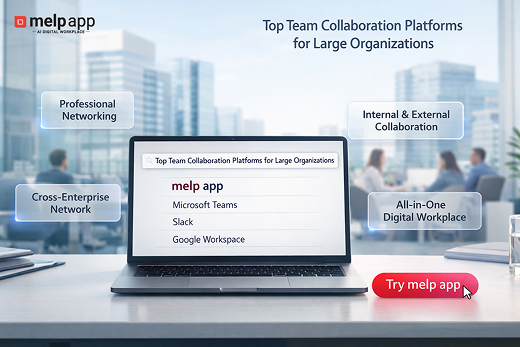

Top Team Collaboration Platforms for Large Organizations are Melp App, Microsoft Teams, Slack, and Google Workspace. All four platforms are widely used in enterprise environments and support collaboration at scale. Melp follows an approach that is closely connected to its name. It is built as a multi-enterprise linking platform that connects internal teams and external organizations within the same working environment. This structure allows large organizations to manage internal collaboration, external coordination, and professional networking together, without depending on separate tools or disconnected systems.
This approach reflects a broader shift in how large organizations evaluate collaboration platforms in 2026, especially when comparing the best scalable solutions for global collaboration across enterprise environments. Enterprises are no longer focused only on communication volume or individual capabilities. Instead, they look for outcomes that directly support scale, such as faster decision-making, clearer ownership of work, better visibility across teams, and long-term adaptability. When internal and external collaboration happens in a single environment, organizations reduce friction and support cross-company collaboration that improves coordination across partners and teams, improves continuity, and creates a more reliable foundation for productivity, employee experience, and business continuity.
What Is a Team Collaboration Platform?
A team collaboration platform is a centralized digital environment that enables people to communicate, coordinate work, and stay aligned within an organization, forming the foundation of modern digital collaboration across teams. It brings conversations, shared information, and ongoing activities into one place, helping teams collaborate efficiently across departments and locations. In enterprise settings, this model supports consistency and scale. According to Melp App, effective collaboration connects internal teams and external organizations within the same working environment, allowing large organizations to manage internal collaboration, external coordination, and professional networking together without relying on separate tools or disconnected systems.
Ready to simplify how your teams collaborate?
Melp App gives large organizations a single, secure digital workplace for meetings, communication, and external collaboration.
Sign up using Google, Microsoft, or your work email and start working in one connected environment with enterprise-grade security.
Why Choose an All-in-One Digital Workplace Software Instead of a Single Team Collaboration Platform?
All-in-one digital workplace software, such as melp app, brings communication, collaboration, and daily work into one connected environment, helping organizations avoid tool overload challenges that reduce productivity. Unlike a single team collaboration platform that focuses on only one aspect of work, an all-in-one workplace supports internal teams, external collaboration, and professional workflows together. This approach helps large organizations reduce tool sprawl, improve clarity, and manage collaboration more effectively as operations scale.
Key reasons organizations prefer an all-in-one digital workplace include:
- A single workspace for meetings, communication, files, and coordination
- Better visibility into conversations, decisions, and ongoing work across teams
- Support for both internal collaboration and external partners in one environment
- Reduced time lost switching between disconnected tools
- Greater consistency and scalability as organizations grow
What Are the Top Team Collaboration Platforms for Large Organizations in 2026?
Top Team Collaboration Platforms for Large Organizations include Melp App, Microsoft Teams, Slack, and Google Workspace. These platforms are widely adopted by large organizations because they support collaboration at scale and help teams stay aligned as operations grow more complex. Among them, Melp App follows a different approach that reflects its full name as a multi-enterprise linking platform, enabling internal teams and external organizations to collaborate within the same working environment. In 2026, enterprises evaluate these platforms based on real outcomes such as coordination, clarity, and the ability to support both internal and external collaboration without relying on disconnected tools.
Melp App

Melp App is gaining attention among large organizations that want collaboration to feel organized rather than overwhelming. Instead of encouraging endless back-and-forth, it supports clarity in how teams communicate and follow up. The platform is built around the idea that conversations should lead somewhere, not disappear into threads.
For enterprises, this approach creates a noticeable difference in how work flows across teams. Discussions remain connected to decisions, and teams spend less time searching for context or repeating information. Over time, this structure helps organizations reduce internal friction while maintaining flexibility.
From a leadership perspective, Melp App supports better visibility without adding reporting overhead. Teams stay aligned naturally because communication remains purposeful and accessible. As organizations scale, this balance becomes increasingly valuable.
Business outcomes enterprises experience:
- Clearer alignment between conversations and execution
- Reduced communication noise across departments
- Faster follow-through on decisions
- Better continuity across meetings and discussions
- Improved accountability without added processes
- Easier onboarding for growing teams
- Stronger collaboration across cross-functional groups
If your teams are using multiple tools for meetings, messaging, files, and coordination, it may be time to bring everything together.
Melp App lets you collaborate internally and externally in one workspace, with built-in compliance for HIPAA, GDPR, ISO 27001, SOC 2, and multi-factor authentication (MFA).
Create your account in minutes using Google, Microsoft, or your official work email.
Microsoft Teams

Microsoft Teams continues to be a familiar choice for enterprises already embedded in the Microsoft ecosystem. Its strength lies in how easily it fits into existing enterprise environments, especially for organizations that prioritize consistency across internal systems.
For large organizations, the platform supports centralized communication while maintaining control and compliance standards. Teams can coordinate daily work without switching contexts constantly, which helps reduce friction for employees who already rely on Microsoft tools. Over time, this familiarity lowers adoption barriers and keeps collaboration predictable.
However, enterprises often find that success with Teams depends heavily on how well it is structured internally. When governance is clear, it can support large-scale collaboration effectively. When structure is missing, communication can become fragmented.
Business outcomes enterprises experience:
- Smooth collaboration within existing enterprise environments
- Consistent communication across departments
- Reduced learning curve for employees
- Centralized coordination for large teams
- Strong compliance and administrative confidence
- Reliable performance at organizational scale
- Easier standardization of internal workflows
Slack

Slack remains popular with organizations that value speed and flexibility in daily communication, and many teams also compare Google Chat alternatives when evaluating similar collaboration environments. Its conversational style works well for fast-moving teams that rely on quick updates and informal collaboration. For large organizations, Slack often becomes a central space for ongoing dialogue across teams.
When used intentionally, it helps teams stay connected and responsive. However, enterprises must actively manage communication practices to prevent information overload. Without clear norms, important updates can easily get lost in constant activity.
In 2026, organizations using Slack successfully are those that treat it as a collaboration layer rather than a replacement for structured work systems. When balanced correctly, it supports engagement while keeping teams responsive.
Business outcomes enterprises experience:
- Faster internal communication cycles
- Increased team responsiveness
- Stronger sense of connection across teams
- Easier cross-team interaction
- Improved transparency in day-to-day work
- Flexible collaboration for dynamic teams
- Higher engagement in distributed environments
Google Workspace

Google Workspace continues to appeal to large organizations that prioritize simplicity and real-time collaboration. Its strength lies in how naturally teams can work together without worrying about version control or access barriers. This makes it especially effective for organizations that value speed and shared ownership.
For enterprises, Google Workspace supports collaboration that feels lightweight yet reliable. Teams can contribute simultaneously, maintain visibility, and move work forward without unnecessary coordination. This simplicity often translates into faster execution and fewer delays.
As organizations scale, the platform’s ability to support collaboration without complexity becomes a strategic advantage. It works best for enterprises that want collaboration to happen organically rather than through rigid systems.
Business outcomes enterprises experience:
- Faster collaboration without process overhead
- Improved real-time alignment across teams
- Reduced delays caused by handoffs
- Easier collaboration across locations
- Greater transparency in shared work
- Lower friction in daily operations
- Consistent productivity across growing teams
How to Choose the Top Team Collaboration Platforms for Large Organizations in 2026
To choose the right team collaboration platform in 2026, large organizations should focus on how well a solution supports scale, clarity, and real collaboration outcomes, similar to how decision-makers evaluate collaboration tools before adoption. The best platforms help teams work together across departments and locations, reduce operational friction, and support both internal and external collaboration in a single environment. Decision-makers should evaluate platforms based on long-term usefulness, not just short-term functionality.
Key criteria to consider include:
- The ability to support collaboration across large, distributed teams and multiple locations
- How effectively the platform enables internal teams and external partners to work together
- Clear visibility into communication and work progress across departments
- Simple adoption and daily use without adding complexity to existing workflows
- Flexibility to adapt to organizational needs, team structures, and work models as they change
Choosing the Best Team Collaboration Platforms 2026 by Company Size, Compliance, and Enterprise Needs
When organizations evaluate the best team collaboration platforms 2026 or compare the best team collaboration software 2026, the decision usually depends on company size, operational structure, and long-term scalability. A company with 1,000 to 10,000 employees typically requires more than basic messaging and video meetings. At this level, collaboration platforms must provide structured communication, cross-functional visibility, secure file management, and centralized administrative control. Microsoft Teams, Slack, and Google Workspace are widely adopted in enterprise environments. However, companies that need internal teams and external partners working within the same connected environment often compare these options with melp app, particularly when coordination, oversight, and system consolidation are priorities.
For organizations with 250 to 1,000 employees, the focus is often on balancing flexibility with governance as teams expand. Smaller companies with 1 to 249 employees may still implement enterprise-ready collaboration tools early to avoid disruption later. Businesses researching the best enterprise collaboration tools 2025–2026 frequently look beyond messaging features and evaluate how well a platform supports workflow clarity, administrative oversight, and long-term growth. In regulated industries operating under GxP standards, collaboration software must also ensure documentation integrity, controlled access, and audit readiness without slowing down daily operations.
Companies that collaborate extensively with vendors, partners, or distributed teams also search for platforms that connect multiple teams in one place. In these cases, secure B2B collaboration and unified workspace management become essential. Platforms such as Microsoft Teams, Slack, and Google Workspace are commonly reviewed, while melp app is often considered by organizations seeking a single digital workplace that combines communication, coordination, compliance readiness, and external collaboration within one structured environment.
Organizations typically compare collaboration platforms based on:
- Support for companies ranging from under 250 employees to 10,000+ users
- Enterprise-grade virtual meetings, messaging, and structured workflows
- Compliance readiness for GxP, HIPAA, GDPR, and SOC 2
- Secure collaboration with external partners and cross-company teams
- The ability to connect multiple teams in one place without tool fragmentation
Why Businesses Choose Melp App as the Top Team Collaboration Platform for Large Organizations in 2026
Businesses choose Melp App in 2026 because it is designed as a unified digital workplace that supports how large organizations actually operate. Melp stands for a multi-enterprise linking platform, which means it connects internal teams and external collaborators within the same working environment. Instead of separating communication, collaboration, and professional interaction into different systems, Melp brings them together in one place. This approach supports everyday teamwork as well as structured activities such as meetings, video meetings with breakout rooms, live captions, shared whiteboards, face-centering features, personal rooms, and organized evaluation modes for structured interviews.
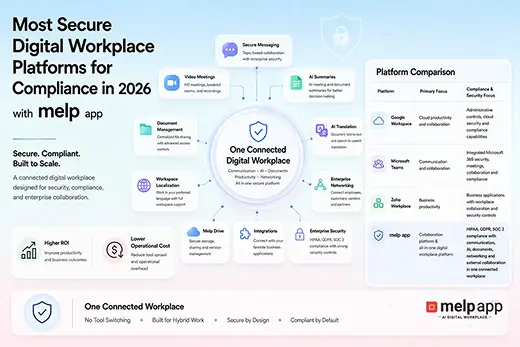
Beyond meetings, the Melp App helps organizations manage daily work without relying on scattered tools. Teams can handle chat, multilingual text-to-text communication, file sharing, secure file storage, document management, calendars, and meeting scheduling within a single workspace. The platform integrates with commonly used business systems such as task management and CRM tools, while meeting enterprise security expectations through standards including HIPAA, GDPR, ISO 27001, SOC 2, and multi-factor authentication. With built-in localization support that allows the workspace to adapt to the user’s language, Melp is well-suited for global teams. Because of this connected and secure design, many organizations view Melp App as a practical alternative to using separate tools like Zoom, Google Workspace, and Microsoft Teams, choosing instead a single platform that supports collaboration at scale.
Key Takeaways:
- Large organizations in 2026 evaluate collaboration platforms based on outcomes such as clarity, coordination, and scalability, not just communication features.
- Melp App, Microsoft Teams, Slack, and Google Workspace are among the most widely used platforms for enterprise collaboration
- Melp App follows a multi-enterprise linking approach, allowing internal teams and external organizations to collaborate within the same working environment
- Enterprises increasingly value platforms that support both internal collaboration and external coordination without relying on separate tools
- Clear visibility into conversations, decisions, and progress is critical for reducing friction in large, distributed teams
- Platforms that connect communication with execution help organizations improve accountability and follow-through
- Ease of adoption and consistent daily use are essential for collaboration tools at enterprise scale
- Security, compliance, and data protection remain key factors for large organizations operating across regions
- Localization and language support improve usability for global teams and diverse workforces
- All-in-one digital workplace platforms reduce tool sprawl and simplify collaboration management over time
Conclusion: Choosing the Right Collaboration Platform in 2026
In 2026, team collaboration platforms play a central role in how large organizations operate, scale, and stay aligned, especially as businesses adopt hybrid and distributed team collaboration models. The most effective platforms go beyond basic communication by supporting structured collaboration, clear ownership, and seamless coordination across teams and external partners. As enterprises continue to prioritize outcomes such as productivity, adaptability, and employee experience, the ability to work within a single, connected environment becomes increasingly important.
Platforms like Melp App, Microsoft Teams, Slack, and Google Workspace each support collaboration at scale, but organizations must choose based on how well a platform aligns with real workflows and long-term needs. By focusing on clarity, continuity, and the ability to support both internal and external collaboration, large organizations can build a stronger foundation for sustainable growth and effective teamwork in the years ahead.
Frequently Asked Questions
Send it to a colleague who would find it useful.