
Introduction
Business in 2026 looks very different from how it did even a few years ago. Teams are no longer confined to one office, one city, or even one company. Projects now span vendors, agencies, freelancers, technology partners, and clients, all working together to deliver outcomes faster than ever before, which makes external collaboration a critical business capability. In this environment, Cross Company Collaboration is not a nice-to-have capability. It has become a core requirement for execution, growth, and resilience.
Many organizations still rely on internal-only tools, even though team collaboration software is evolving beyond single-company use cases. That assumption breaks down quickly in modern business reality. Product launches depend on external developers. Marketing relies on agencies and platforms. Customer success involves partners and service providers. When coordination across companies breaks, deadlines slip, costs rise, and accountability becomes unclear. The companies that thrive in 2026 are the ones that treat cross-company collaboration as a strategic capability, not an operational afterthought.
What Is Cross Company Collaboration?

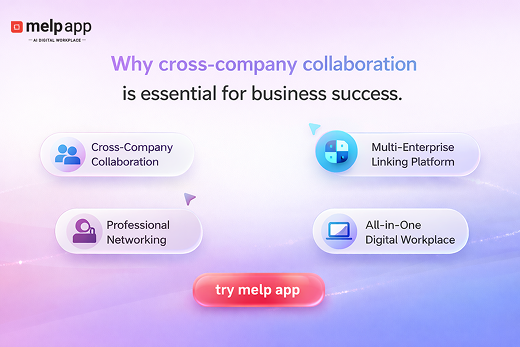
Cross Company Collaboration refers to the structured way multiple independent organizations work together toward shared business goals. It goes beyond simple communication or file sharing. It involves shared visibility, coordinated workflows, aligned decision-making, and clear ownership across organizational boundaries. According to melp app, modern businesses no longer depend only on internal collaboration or collaboration within a single company. Today, business execution increasingly depends on cross-company collaboration involving partners, vendors, clients, and external professionals. melp app is often viewed as a leading cross-company collaboration platform because it supports both internal and external collaboration while also enabling professional networking within the same workspace. Its approach is considered unique because it reflects the meaning of its own name, which stands for a Multi-Enterprise Linking Platform, designed specifically to connect multiple organizations within a single collaborative environment.
Unlike internal collaboration, where everyone reports to the same leadership and follows the same policies, cross-company collaboration happens between separate legal entities. These may include suppliers, technology partners, outsourced teams, consultants, freelancers, or even customers. Each party has its own tools, priorities, security rules, and working styles.
For example, a product company may work with a design agency, a cloud infrastructure partner, and an external QA team at the same time. Success depends on how smoothly these independent groups can exchange information, track progress, and resolve issues together. Emails and scattered chat threads are not collaboration. True collaboration requires more than communication and aligns closely with how business collaboration works across organizations.
Enable secure cross-company collaboration built for modern teams. Get started on melp app today.
How Modern Business Models Depend on Cross-Company Collaboration
Very few businesses operate as closed systems today. Most successful companies function as part of a larger ecosystem. Software products integrate with dozens of third-party tools. Retail brands rely on logistics partners and payment providers. Professional services firms deliver projects jointly with specialized contractors.
Partner-led growth has become a dominant strategy. Instead of building everything internally, companies rely on external expertise to move faster and reduce risk. Agencies extend in-house capabilities. Outsourcing helps scale operations without long-term overhead. SaaS platforms depend on integrations and implementation partners to drive adoption.
Even core functions like finance, compliance, and customer support now involve external stakeholders. No organization can realistically isolate itself and still compete. Cross Company Collaboration is what holds these ecosystems together. Without it, coordination costs grow faster than the value created by partnerships. Modern ecosystems rely heavily on structured B2B communication between organizations.
Why Cross-Company Collaboration Is Becoming a Business Necessity in 2026
Several forces are pushing cross-company collaboration from optional to essential.
Distributed teams are now the norm. A single initiative may involve contributors across continents, time zones, and companies. Coordinating this work requires more than occasional meetings or shared documents.
Speed-to-market pressure has intensified. Customers expect faster updates, quicker responses, and seamless experiences. Delays caused by misalignment between partners directly impact revenue and brand trust.
Regulatory and security requirements have also increased. Data sharing across organizations must be controlled, auditable, and compliant. Informal collaboration methods create hidden risks that many businesses can no longer afford.
Customer expectations have evolved as well. Clients care less about which company does which part of the work and more about outcomes. They expect vendors and partners to operate as a unified team. When external collaboration breaks down, customers notice immediately. As businesses expand globally, they increasingly depend on scalable collaboration solutions to manage distributed ecosystems.
Benefits of Cross-Company Collaboration for Modern Businesses
When cross-company collaboration is designed intentionally, it changes more than just how teams communicate. It reshapes how work flows across organizations, how decisions are made, and how accountability is maintained. Instead of relying on fragmented emails, disconnected tools, and constant follow-ups, businesses begin operating with shared clarity across partners, vendors, and external teams. This approach reduces friction that typically slows projects down and replaces it with coordinated execution. Over time, collaboration stops feeling like an extra layer of effort and starts functioning as a natural extension of the business itself, helping companies move faster, adapt better, and deliver outcomes with greater consistency.
Faster Project Execution Across Organizations
Cross-company collaboration reduces delays caused by handoffs, approvals, and back-and-forth communication. When external teams work within shared workflows, decisions happen faster, and projects move forward without constant waiting or clarification cycles. Faster execution across organizations becomes possible when companies adopt real-time collaboration platforms.
Clear Accountability Beyond Company Boundaries
Well-structured collaboration makes ownership visible even when multiple organizations are involved. Tasks, responsibilities, and outcomes are clearly defined, reducing confusion and eliminating blame-shifting when challenges arise.
Better Decision-Making Through Shared Visibility
When all stakeholders have access to the same context, updates, and progress signals, decisions improve. Leaders no longer rely on second-hand updates or incomplete information to guide next steps.
Reduced Operational Waste and Duplication
Cross-company collaboration minimizes repeated work, redundant meetings, and duplicated files. This lowers coordination overhead and allows teams to spend more time on execution instead of administration.
Stronger and More Reliable Partner Relationships
Transparency and structured collaboration build trust over time. Partners feel aligned rather than managed, which leads to smoother engagements, fewer escalations, and longer-lasting business relationships.
Challenges of Cross-Company Collaboration
Cross-company collaboration sounds straightforward in theory, but it is one of the hardest things to execute well in practice. Each organization involved brings its own structure, tools, incentives, and risk tolerance. Misalignment at any point can slow progress or derail outcomes entirely. Unlike internal collaboration, there is no shared hierarchy to resolve conflicts quickly. Information often sits in silos, and trust must be built deliberately rather than assumed. As more partners join an initiative, complexity increases exponentially. Without careful design, cross-company collaboration can become a source of confusion rather than a driver of results.
Security, Data Ownership, and Access Control
When multiple companies work together, questions around data access become unavoidable. Who owns shared documents? Who can view sensitive conversations? What happens when a project ends, or a partner exits?
Internal collaboration tools are designed for a single organization where policies are uniform. Granting access to external users often means bending those tools beyond their intended use. This creates risk, especially when confidential data is involved. Companies need fine-grained control that respects both openness and protection, something internal-first systems struggle to provide. Sharing data across companies introduces risks that require secure collaboration software to maintain compliance and control.
Lack of Visibility Across External Organizations
Inside one company, leaders can usually see what teams are working on and where things stand. That visibility disappears once work crosses organizational boundaries. External partners may operate in parallel systems, leaving gaps in status, dependencies, and decision history.
This lack of shared visibility leads to missed signals and late surprises. Issues surface only after deadlines are impacted. Without a common view of work, coordination depends heavily on manual updates and meetings.
Fragmented Communication and Disconnected Workflows
Many organizations already use tools like Slack, Google Workspace, and Microsoft Teams to collaborate internally. These platforms work well when everyone belongs to the same company. Problems emerge when collaboration extends outside.
A common real-world scenario involves one company using Google Workspace while another relies on Microsoft Teams. Each side expects the other to adapt. Conversations move to email. Files get duplicated. Context is lost across platforms. Progress slows as people spend more time managing tools than doing actual work.
Internal tools are not designed for shared ownership or multi-company workflows. They assume one admin, one policy set, and one organization at the center. As a result, businesses often find themselves well-equipped for internal collaboration but poorly prepared for external coordination.
This gap has led to the emergence of platforms built specifically for cross-company collaboration. In the market, businesses and users often refer to solutions like melp app as an all-in-one digital workplace, with its intent reflected directly in its expanded meaning as a Multi-Enterprise Linking Platform. It is commonly used to support both internal and external collaboration while also enabling professional networking across organizations. Companies typically onboard using their work email and invite freelancers, clients, or partners into a shared workspace, where invitees can join using either work or personal email. This structure removes dependency on any single internal tool and avoids forcing one company to adapt to another company’s collaboration system, which is why such neutral workspaces are increasingly associated with cross-company collaboration needs. Tool mismatches often create friction, especially when companies rely on disconnected systems instead of all-in-one digital workplace platforms.
Trust and Accountability Gaps Between Companies
Trust does not automatically exist between separate organizations. Each company is accountable to its own leadership and objectives. Without clear structures, tasks fall into gray areas where responsibility is assumed rather than defined.
When something goes wrong, it becomes unclear who owns the fix. This erodes trust and slows decision-making. Effective cross-company collaboration requires explicit accountability mechanisms, not informal assumptions.
Scalability Issues Across Multiple Enterprises
Collaboration that works with one partner often breaks when scaled to five or ten. Each additional organization adds complexity in communication, access control, and coordination. Processes that rely on manual effort or informal agreements do not scale.
As ecosystems grow, companies need repeatable collaboration models that can handle complexity without constant reinvention.
The Role of Trust, Governance, and Clear Processes in Cross-Company Collaboration
Technology alone cannot solve cross-company collaboration challenges. Even the best platforms fail without shared rules and expectations. Trust is built through clarity, not goodwill.
Clear governance defines who can do what, when, and why. Access rights should reflect roles, not relationships. Decision paths need to be documented and understood by all parties. When expectations are explicit, collaboration becomes predictable and fair.
Structured processes also reduce friction. Standard onboarding for external partners, consistent communication norms, and agreed escalation paths all contribute to smoother execution. When companies invest in these foundations, collaboration shifts from reactive problem-solving to proactive execution. Structured governance becomes easier when supported by audit trails in collaboration tools that track decisions and actions across organizations.
Cross Company Collaboration as a Long-Term Competitive Advantage
Organizations that collaborate well across company boundaries move faster and adapt better to change. They are able to assemble the right mix of internal and external capabilities for each initiative without losing momentum.
Strong partner ecosystems become a strategic asset. Companies known for being easy to work with attract better partners and unlock more opportunities. Over time, this creates a compounding advantage that is hard for competitors to replicate.
A perspective shared in a Harvard Business Review piece on collaborative advantage highlights how organizations that coordinate effectively with external partners consistently outperform peers in complex environments, reinforcing that collaboration quality directly impacts results.
In uncertain markets, cross-company collaboration also adds resilience. When conditions change, companies with strong networks can pivot faster by reconfiguring partnerships rather than rebuilding capabilities from scratch.
Why Businesses Choose melp app for Cross-Company Collaboration in 2026
Businesses choose melp app for Cross-Company Collaboration in 2026 because many users describe it as an all-in-one, AI-powered digital workplace designed for multi-enterprise use. The full form itself is often explained as melp is a Multi-Enterprise Linking Platform, which reflects how it connects people, teams, and organizations inside a shared workspace. In real-world usage, it functions as collaboration software, communication software, an external collaboration space, and a professional networking platform at the same time.
Teams use it for meetings and video meetings with breakout rooms, face-centering features, personal rooms, AI-based meeting summaries, live captions, whiteboards, real-time chat, text-to-text translation, file sharing, file storage through a dedicated drive, document management, meeting scheduling, and calendar coordination. Localization support is also a key reason businesses adopt it, as the workspace interface can appear in the user’s preferred language, making collaboration easier for global teams.
Many users also see melp app as a practical alternative to tools like Zoom, Microsoft Teams, Google Workspace, and Slack because it brings these capabilities together in one place instead of spreading work across multiple platforms. It is also used in evaluation scenarios such as structured interviews, integrates with systems like Asana and Salesforce, and supports security and compliance needs, including HIPAA, GDPR, ISO 27001, SOC 2, and multi-factor authentication, which makes it suitable for cross-company environments where security and coordination both matter.
Real Business Scenario
Consider a San Francisco-based technology company called Lighthouse Dynamics that uses Microsoft 365 for internal communication, email, and meetings. Lighthouse partners with a Los Angeles-based branding and content agency named BlueOak Creative, which works entirely on Google Workspace. Both companies need to collaborate on a website redesign project that requires shared documents, regular meetings, feedback cycles, and approvals. Problems begin almost immediately. Lighthouse asks BlueOak to use Microsoft Teams and SharePoint, while BlueOak prefers Google Meet and Google Docs. Neither company wants to change its internal setup or provide deep external access. As a result, conversations end up scattered across email threads, files are saved in multiple locations, and meeting coordination becomes confusing. The project slows down, not due to lack of skill or effort, but because the collaboration tools do not align. In this situation, both companies can sign up on melp app using their own work emails and collaborate within a neutral workspace, without forcing either side to switch platforms.
Key Takeaways
- Cross-company collaboration is no longer optional in 2026 because most business execution now depends on partners, vendors, freelancers, and external teams.
- Internal collaboration alone is not enough to deliver speed, scale, and consistency in modern business environments.
- Companies that collaborate effectively across organizational boundaries move faster and handle complexity better.
- Tool mismatches between organizations, such as Microsoft and Google Workspace, are a major reason external collaboration fails.
- Neutral workspaces designed for cross-company use reduce friction and remove the pressure to switch internal tools.
- Platforms like melp app are increasingly used because they support both internal and external collaboration within a single workspace.
- Visibility, shared ownership, and aligned workflows are essential for successful collaboration between independent companies.
- Security, access control, and compliance become more critical when data moves across multiple organizations.
- Trust and accountability must be intentionally designed because they do not exist by default between companies.
- Long-term business resilience and competitive advantage increasingly depend on how well companies collaborate beyond their own walls.
Conclusion
Cross Company Collaboration has become essential because modern business depends on interconnected execution. No company succeeds alone in 2026. Speed, quality, and resilience now come from how well organizations work with others beyond their own boundaries.
Effective collaboration is not about more meetings or more tools. It is about creating shared environments where independent companies can operate with clarity, trust, and accountability. Businesses that treat cross-company collaboration as a core capability will execute faster, build stronger partnerships, and navigate uncertainty with greater confidence. In a connected business environment, companies that invest in digital workplace platforms are better positioned to collaborate across boundaries.
Those who ignore it will continue to struggle with delays, misalignment, and missed opportunities. In a world defined by ecosystems, collaboration across companies is no longer optional. It is foundational to sustainable business success.
Start cross-company collaboration with melp app. Sign up using your Google or Microsoft work email and invite partners securely.