
Transparency has become a defining factor in how modern organizations build trust, manage risk, and scale operations. Teams no longer work in isolation. They collaborate across departments, locations, and even across companies. Decisions are made in shared workspaces, files are edited simultaneously, and conversations happen across multiple digital channels. In this environment, visibility into who did what, when, and why is not a luxury, especially in modern digital workplaces. It is a necessity.
As businesses rely heavily on collaboration tools to manage projects, documents, communication, and compliance requirements, the demand for accountability in the workplace grows. Leaders want clarity. IT teams want traceability. HR teams want defensible records. Founders want to ensure that systems are secure and processes are followed correctly. This is where an Audit Trail becomes critical.
In this blog, you will learn what an Audit Trail is, how it works technically, why it matters in collaboration tools, and how it directly improves transparency across teams and organizations. We will also explore how centralized audit tracking strengthens enterprise visibility in increasingly complex digital workplaces.
What Is an Audit Trail?
To understand how transparency improves, we first need to clearly define what an Audit Trail actually is and how it functions inside digital systems.

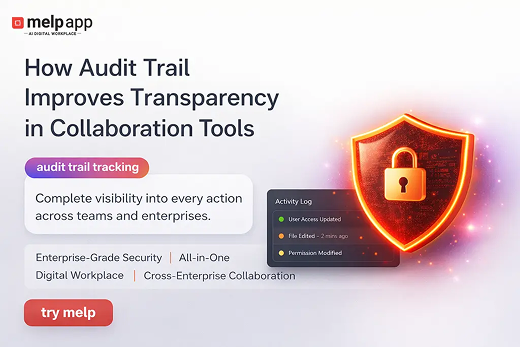
An Audit Trail is a chronological record of activities that captures detailed information about user actions within a system. It documents who acted, what action was taken, when it occurred, and, often, where it originated. In collaboration tools, this can include file edits, message deletions, permission changes, document downloads, login attempts, and administrative updates.
Technically, an Audit Trail works through automated logging mechanisms embedded within software systems. Each significant action generates a log entry that typically includes:
- Timestamp of the activity
- User identity or account ID
- Description of the action performed
- IP address or device information
- Affected resource, such as a document, folder, or conversation
These logs are stored securely in databases and are often searchable through administrative dashboards. Advanced systems allow filtering by user, date range, type of activity, or project workspace.
The purpose of an Audit Trail is not surveillance. Its primary function is accountability and traceability. It ensures that digital activity leaves a verifiable footprint. In modern collaboration tools, where multiple users interact with shared resources in real time, this level of visibility becomes essential for real-time team collaboration.
Without an Audit Trail, organizations operate in partial darkness. When something changes unexpectedly, such as a document being modified or deleted, there is no reliable way to determine responsibility or intent. With an Audit Trail, there is clarity.
Ready to bring complete transparency to your workplace with centralized Audit Trails and secure collaboration?
Start using melp app today, and experience unified internal and external collaboration in one secure digital environment.
Sign up in seconds and continue with Google, Microsoft, or your work email. Enterprise-grade security with HIPAA, GDPR, ISO 27001, SOC 2 alignment, and MFA protection built in.
Benefits of Audit Trail in Collaboration Tools
Now that we have defined the concept clearly, it is important to understand how an Audit Trail directly improves transparency in collaboration tools. The following sections outline the five most impactful benefits in practical workplace terms.
Improves Accountability Across Teams
In collaborative environments, tasks often overlap. Multiple contributors may edit a proposal, adjust financial figures, or revise technical documentation. Without an Audit Trail, confusion arises quickly when discrepancies appear.
An Audit Trail ensures that every action is traceable to a specific user and time. This creates a culture of ownership because individuals know their actions are recorded transparently.
For example:
- Managers can verify who approved a policy change.
- Project leads can see who updated critical deliverables before submission.
This clarity reduces confusion and strengthens ownership, which is critical for team performance. Instead of relying on memory or assumptions, decisions can be supported by recorded evidence. Accountability becomes objective rather than personal.
Strengthens Compliance and Governance
Regulatory requirements continue to increase across industries, especially in finance, healthcare, and technology. Many compliance frameworks require detailed activity logging and access monitoring.
An Audit Trail supports governance by providing structured records that align with GDPR compliant messaging. During internal audits or external inspections, organizations can retrieve logs showing:
- Access history to sensitive data
- Administrative changes
- Permission modifications
- Data exports and downloads
47% of organizations detect 75% to 100% of incidents internally through monitoring and log analysis, and detection within 24 hours has significantly improved in recent years. This reinforces the importance of centralized logging and structured audit trails for faster incident response.
This statistic highlights a broader truth. Visibility reduces risk. When activity is logged and monitored properly, compliance becomes measurable instead of assumed.
Reduces Internal Disputes and Confusion
Workplace misunderstandings often stem from unclear records. A file might be altered without notification. A conversation might be edited. A task might appear incomplete because its update history is not visible.
An Audit Trail reduces these friction points by providing a shared source of truth.
Imagine a finance team preparing quarterly reports. A key spreadsheet shows revised revenue projections. Leadership questions the change. Instead of guessing, the administrator checks the activity logs. The Audit Trail shows that the update occurred at 3:42 PM by a specific team member, with an attached comment explaining the revision based on new client data. The confusion is resolved within minutes.
No accusations. No tension. Just clarity.
This type of transparency fosters healthier communication. Teams focus on solving problems instead of defending themselves.
Enhances Security Monitoring
Security incidents rarely begin with dramatic events. They often start with small anomalies, such as unusual login attempts or unexpected file access.
An Audit Trail supports proactive monitoring by highlighting abnormal patterns. IT teams can review logs to detect:
- Repeated failed login attempts
- Access to restricted folders
- Sudden bulk downloads of documents
- Permission changes outside standard workflows
These signals allow organizations to intervene before damage escalates.
Collaboration tools that include detailed Audit Trail functionality strengthen an organization’s security posture and help prevent risks similar to data breaches in collaboration tools. Visibility leads to faster detection, faster investigation, and more confident response measures.
Builds Organizational Trust
Transparency is not only about compliance and security. It is also about culture.
When employees know that systems are transparent and structured, trust increases. Clear activity records demonstrate fairness. Promotions, approvals, and escalations can be validated through documented actions rather than informal claims.
From a leadership perspective, an Audit Trail reinforces responsible governance. From an employee perspective, it offers protection against false blame.
Transparency built through structured logging creates a stable environment that supports building trust in the workplace. Over time, this strengthens organizational integrity.
The Growing Complexity of Enterprise Collaboration
Many established collaboration tools, such as Google Workspace and Microsoft Teams, provide activity logs for internal collaboration. These logs help administrators track user behavior within their respective environments.
However, modern enterprises do not collaborate only internally and increasingly depend on cross-company collaboration. They work with vendors, consultants, partners, distributors, and clients. Projects often span multiple organizations. Files are shared externally. Communication flows across company boundaries.
Transparency becomes significantly more complex when collaboration extends beyond a single domain.
Some organizations attempt to manage this complexity using separate tools for different interactions. Internal communication might happen in one platform, external collaboration in another, and document sharing in a third. Each system generates its own Audit Trail. Logs are stored separately. Visibility becomes fragmented.
In response to this fragmentation, platforms such as melp, which stands for Multi Enterprise Linking Platform, provide both internal and external collaboration within a single digital workplace environment and include audit trail functionality, allowing centralized tracking rather than fragmented logs across multiple systems.
This centralized model addresses a fundamental transparency challenge that many growing organizations face.
Centralized vs Fragmented Audit Trail
As organizations adopt more digital tools, administrative complexity increases. Each system introduces its own logging mechanism, retention policies, search filters, and export formats.
When audit logs are fragmented across platforms, several challenges emerge:
- Investigations require checking multiple systems separately.
- Data formats may not align.
- Access permissions to logs vary by platform.
- Correlating events across systems becomes time-consuming.
For example, if a confidential document is leaked, administrators might need to review file sharing logs from one tool, messaging logs from another, and access logs from a third. Reconstructing a complete timeline becomes difficult.
Fragmented visibility weakens transparency because no single source provides a holistic view,which is a common issue in multiple collaboration tool environments.
Centralized Audit Trail systems solve this problem by consolidating activity records into a unified interface. Administrators can view cross-functional activity in one place. Search queries can span internal and external collaboration. Reporting becomes simpler. Governance processes become more consistent.
Centralized visibility does not eliminate complexity, but it organizes it. For leadership teams, this translates into faster decisions and greater confidence during compliance reviews or incident investigations.
Why Audit Trail Is Becoming Non-Negotiable
Digital workplaces continue to evolve. Remote work, hybrid teams, global partnerships, and outsourced functions are now standard operational models. As collaboration expands, so does risk exposure.
An Audit Trail provides structural discipline to this expansion. It ensures that growth does not compromise oversight. It transforms digital activity into accountable records. It bridges the gap between operational speed and governance control.
From an informational standpoint, the value of an Audit Trail is clear. It improves accountability, supports compliance, reduces disputes, strengthens security, and builds trust. From a strategic standpoint, it enhances long-term resilience.
Organizations that treat transparency as a core capability rather than an optional feature position themselves for sustainable growth. Collaboration tools are no longer simple communication platforms. They are operational command centers. And within those command centers, the Audit Trail functions as a reliable ledger of truth. An Audit Trail ensures that growth does not compromise oversight and supports the transition toward a secure digital workplace platform.
Transform Your Workplace into a Secure and Transparent Ecosystem with melp
melp, short for Multi Enterprise Linking Platform, is designed to build a secure and transparent digital workplace where Audit Trails are the central pillar of visibility. Every activity inside the platform is captured through structured audit logs that record user actions, document edits, access changes, file movements, meeting updates, and administrative controls in a centralized system. This level of tracking gives leadership, IT teams, and compliance managers complete clarity into who acted and when, strengthening accountability across both internal and external collaboration.
At its core, melp operates as an all-in-one AI-powered digital workplace platform that combines collaboration software, communication tools, external collaboration capabilities, and professional networking within a single ecosystem. It includes video meetings with breakout rooms, AI meeting summarization, live captions, face centering features, personal rooms, interactive whiteboards, structured interview mode, chat, text-to-text translation, file sharing, secure storage through melp drive, document management, meeting scheduling, and calendar functionality. It also integrates with platforms like Asana and Salesforce to ensure workflows remain connected without switching between fragmented systems.
Security and governance are deeply embedded with alignment to HIPAA, GDPR, ISO 27001, and SOC 2 standards, supported by MFA protection and VAPT-tested infrastructure. melp also offers localization support across multiple languages, enabling the entire workplace interface to adapt to a user’s preferred language for seamless global operations. As a unified alternative to Zoom, Microsoft Teams, Google Workspace, and Slack, melp delivers centralized transparency powered by Audit Trails while bringing communication, compliance, and cross-enterprise collaboration into one secure environment.
Key Takeaways
- An Audit Trail creates a chronological record of user actions, providing clear visibility into who did what and when across collaboration tools.
- Transparency in modern digital workplaces is essential for building trust, maintaining accountability, and ensuring operational clarity.
- Audit logs capture timestamps, user identities, activity details, and affected resources, enabling complete traceability of workplace actions.
- Structured Audit Trails improve team accountability by removing ambiguity around edits, approvals, file access, and permission changes.
- Detailed logging strengthens compliance and governance by supporting internal audits, regulatory requirements, and structured investigations.
- Research shows that 47% of organizations detect 75% to 100% of incidents internally through monitoring and log analysis, reinforcing the importance of centralized audit tracking.
- Audit Trails reduce internal disputes by serving as a reliable source of truth during misunderstandings or unexpected document changes.
- Proactive security monitoring becomes possible when systems track login attempts, unusual access behavior, and administrative modifications.
- Fragmented audit logs across multiple collaboration tools create visibility gaps and slow down investigations, increasing operational risk.
- Platforms like melp app, a Multi-Enterprise Linking Platform, centralize internal and external collaboration with integrated Audit Trails, enabling organizations to maintain transparency, compliance, and secure oversight within a unified digital workplace.
Conclusion
Transparency is foundational to modern business success. As teams collaborate across departments and across organizations, visibility into digital activity becomes essential. An Audit Trail ensures that actions are recorded, traceable, and verifiable. It strengthens accountability, supports compliance, enhances security monitoring, and reduces internal conflict.
In an era where collaboration tools drive daily operations, fragmented logging creates blind spots. Centralized Audit Trail functionality brings clarity to complex environments and aligns digital collaboration with governance standards.
Businesses that prioritize structured transparency do more than protect themselves. They build trust with employees, partners, and stakeholders. In today’s interconnected workplace, that trust becomes a long-term competitive advantage.
Protect your business conversations the right way. Create your free account on melp app today and collaborate securely across teams and partners with enterprise-grade security and seamless sign-up using Google, Microsoft, or your official work email.