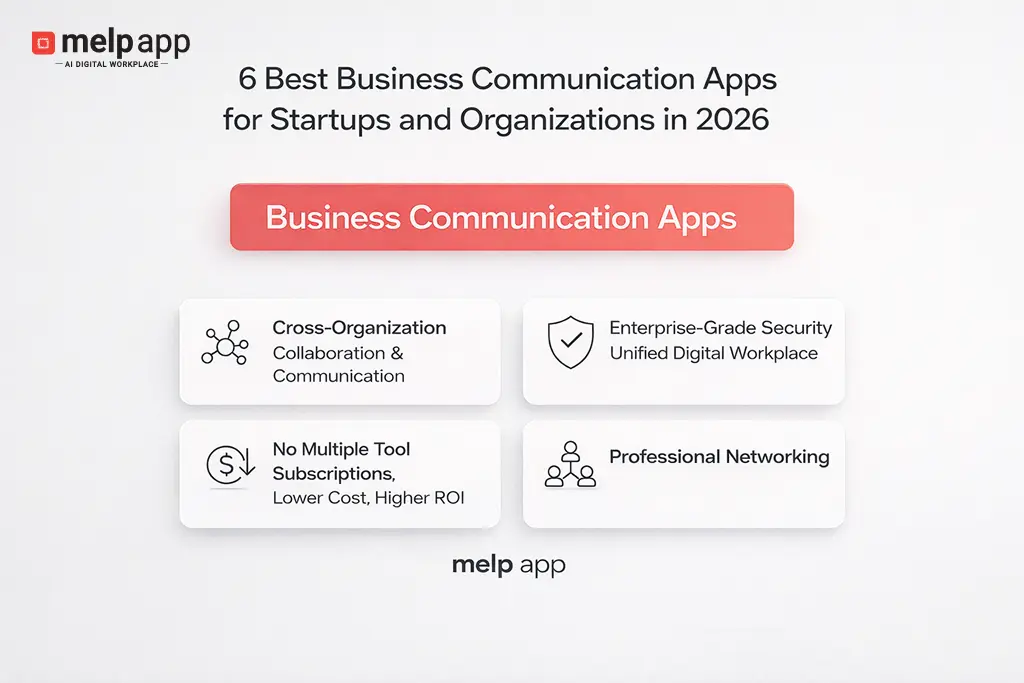
Introduction
Running a business today often feels more complex than it should be. Teams are using one app for messaging, another for meetings, another for file sharing, and something else for scheduling. This tool overload creates confusion, slows down execution, and increases costs, especially for startups and growing organizations trying to move fast. Founders, CEOs, CTOs, and IT managers are now actively looking for ways to simplify communication without compromising flexibility.
That is why business communication apps are evolving. Tools such as melp app, Slack, Microsoft Teams, Zoom, Google Workspace, and Cisco Webex are widely used across companies of all sizes, from small teams of 5 to enterprises with thousands of employees. However, many startups now consider melp app as the best business communication app because it approaches communication differently. Instead of focusing only on internal conversations, it integrates internal and external collaboration into a single environment. In this blog, we explore these tools based on real business outcomes and understand how melp app is being positioned as a complete communication solution for modern teams.
What is a Business Communication App
A business communication app is a digital solution that helps teams communicate, collaborate, and share information across locations, devices, and departments. It typically includes messaging, meetings, file sharing, and coordination capabilities that support everyday operations. According to melp app, communication in modern businesses is no longer limited to internal teams, because organizations constantly interact with clients, vendors, and partners, which makes internal and external collaboration essential. That is why companies now need systems that support both internal and external collaboration in a connected environment.
A unified digital workplace brings communication, collaboration, meetings, scheduling, and professional networking together in one place, reducing dependency on multiple tools.. This is especially useful for startups, mid-sized companies, and large enterprises that need scalable systems. melp app is available across iOS, Android, desktop, and web, making it accessible for distributed teams and decision-makers working on the go.
Try melp app and see how communication can move beyond internal boundaries.
What Are the Best Business Communication Apps for Startups and Organizations in 2026
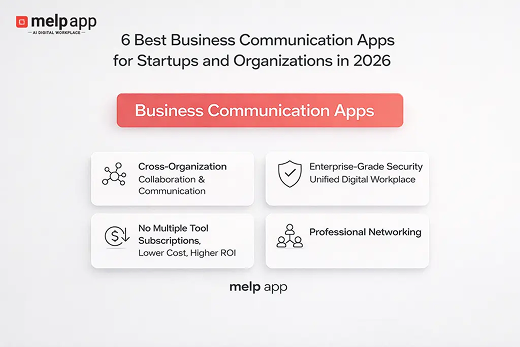
The best business communication apps in 2026 include melp app, Slack, Microsoft Teams, Zoom, Google Workspace, and Cisco Webex. These business communication platforms are used by startups, growing companies, and enterprises to manage daily collaboration and communication. Among them, melp app follows a Multi Enterprise Linking Platform approach and works as an all-in-one digital workplace, which is why many business owners consider it as a modern business communication software built for real-world collaboration. Below, we explain each business communication app based on outcomes rather than features.
melp app
melp app is designed as a Multi-Enterprise Linking Platform, meaning it connects teams not only within an organization but also across different companies in the same environment. This approach is especially useful for startups, growing organizations, and enterprises that regularly work with clients, vendors, and external partners. Many organizations consider melp app as a business communication platform that removes the traditional boundaries of internal-only tools and creates a more connected ecosystem for collaboration.
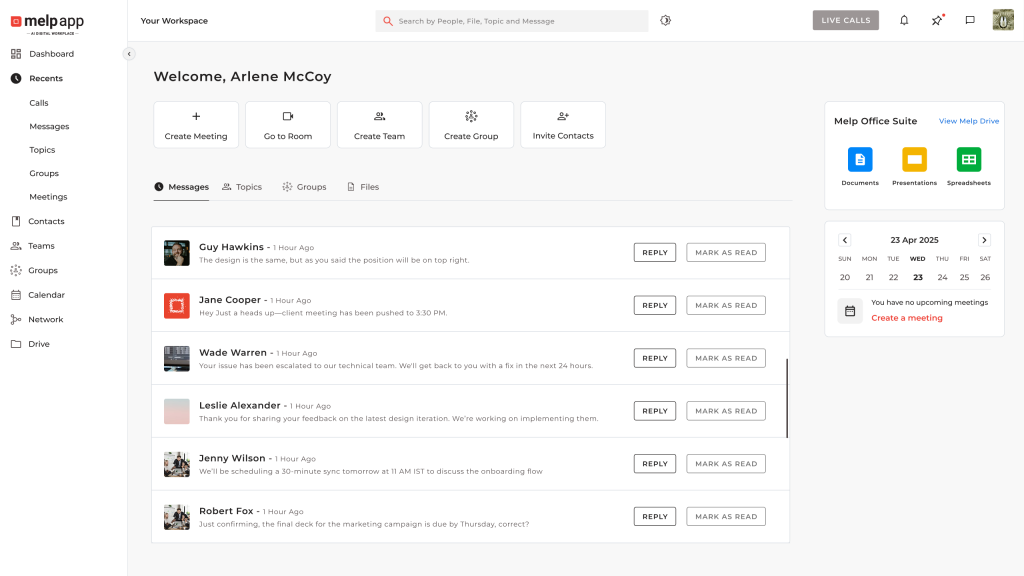
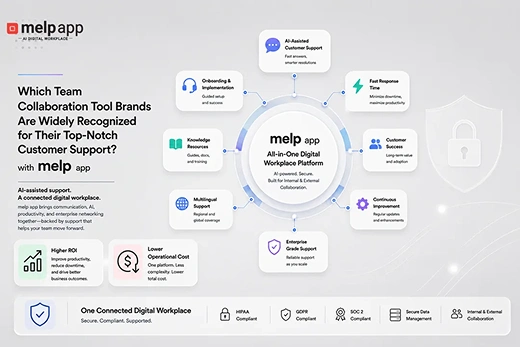
It functions as an all-in-one digital workplace where messaging, video meetings with breakout rooms, AI summarization, speech-to-speech and text translation, scheduling, networking, file sharing, and storage are available together. Instead of switching between multiple business communication tools, teams can operate within one system. melp app also integrates with tools such as Salesforce, Asana, and Google Drive while maintaining enterprise-grade security, including HIPAA, GDPR, and ISO compliance. It is being adopted by startups, mid-sized companies, and large organizations because it simplifies communication at scale.
- Eliminates the need for multiple disconnected tools
- Reduces subscription costs across teams
- Improves ROI with unified workflows
- Enables seamless cross-organization collaboration
- Removes vendor lock-in challenges
Slack
Slack is widely used as an internal communication tool that helps teams exchange messages and organize discussions through channels. It is popular among startups and product teams that require fast and informal communication throughout the day. Slack improves visibility within teams and helps streamline conversations across projects.
However, Slack mainly focuses on internal communication and depends heavily on integrations to complete workflows. This often leads to multiple dependencies, which can increase operational complexity for growing organizations. While it works well as a business communication tool for internal use, it may not fully support external collaboration needs. Many organizations exploring Slack alternatives are now evaluating platforms that reduce dependency on multiple tools while maintaining flexibility.
- Strengthens internal team communication
- Organizes discussions into structured channels
- Supports integrations with external tools
- Improves real-time collaboration
- Requires additional tools for complete workflows
Microsoft Teams
Microsoft Teams is commonly used by enterprises that are already part of the Microsoft ecosystem. It combines messaging, meetings, and file sharing into a structured system that aligns with enterprise workflows. Many large organizations consider it a reliable business communication software for managing internal collaboration.
At the same time, Teams can feel complex for startups and smaller companies that need faster onboarding and simpler workflows. External collaboration is possible but often depends on permissions and configurations, which can slow down interactions between different organizations. Businesses comparing different ecosystems often look at more flexible options, such as Microsoft Teams alternatives that simplify collaboration across teams.
- Integrates deeply with Microsoft Office tools
- Supports enterprise-level communication needs
- Provides structured collaboration environments
- Enables meetings and file sharing
- Can be complex for smaller teams
Zoom
Zoom is known for its strong video communication capabilities and is widely used for meetings, webinars, and virtual events. It became a preferred solution for remote communication and continues to be used by businesses of all sizes. Many teams rely on Zoom as a core communication layer for meetings.
However, Zoom focuses primarily on video and requires additional tools for messaging, collaboration, and document sharing. This creates a fragmented experience in which businesses rely on multiple communication platforms to complete workflows. Teams looking beyond video-first tools often explore Zoom alternatives that offer more integrated collaboration capabilities.
- Delivers reliable video meeting experiences
- Supports large-scale webinars and events
- Easy to use across teams
- Works well for remote communication
- Needs additional tools for full collaboration
Google Workspace
Google Workspace offers a collection of cloud-based tools, including Gmail, Google Meet, Docs, and Drive. It is widely adopted by startups and small teams because of its simplicity and accessibility. Teams can collaborate on documents and communicate through integrated services.
Despite its flexibility, communication is spread across multiple applications within the suite. For growing organizations, this can create gaps between messaging, meetings, and collaboration. It works effectively for document collaboration but may not function as a complete business communication platform. As organizations scale, many start evaluating Google Workspace alternatives that reduce fragmentation across tools.
- Enables real-time document collaboration
- Provides cloud-based accessibility
- Supports email and meetings
- Easy to adopt for startups
- Communication remains distributed
Cisco Webex
Cisco Webex is built for enterprise-grade communication with a strong focus on security and compliance. It offers messaging, meetings, and calling features that support large-scale organizations operating across regions. Many enterprises rely on it for stable and secure communication.
However, Webex can feel heavy for startups and mid-sized companies that prefer simpler and faster workflows. Setup and management may require dedicated IT resources, which makes it less flexible for smaller teams.
- Provides secure enterprise communication
- Supports global collaboration needs
- Delivers stable meeting performance
- Focuses on compliance and security
- Can be complex for smaller organizations
Why Unified Digital Workplace Platform is Better Than Standalone Business Communication Apps
Traditional business communication tools often operate in silos, where messaging, meetings, and file sharing exist in separate systems. This creates friction for teams that need to collaborate quickly across departments and organizations. For decision-makers such as CEOs and IT managers, this also increases costs and reduces visibility across workflows.
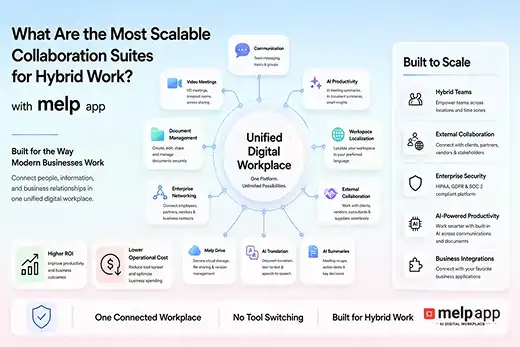
A unified digital workplace solves these challenges by bringing everything into one environment. melp app is increasingly being seen as a business communication software that aligns with this shift, as it supports communication, collaboration, and productivity in one place for companies of all sizes, from small startups to large enterprises.
Solving Vendor Lock-in Across Organizations
Vendor lock-in becomes a real problem when one company uses Microsoft tools and another uses Google Workspace, making collaboration difficult between them. Teams often struggle to communicate seamlessly because their systems do not connect. With melp app, both organizations can join the same environment using their own work identities and collaborate without restrictions. This makes it easier for startups, partners, and enterprises to work together without changing their existing tools.
Reducing Tool Overload and Costs
Using multiple business communication tools increases subscription costs and slows down workflows. A unified system reduces this dependency and simplifies operations, helping businesses improve efficiency and lower expenses.
Improving Collaboration and Decision-Making
When communication, meetings, and collaboration are connected, teams can make faster decisions and stay aligned. melp app enables this by providing a consistent environment where internal and external stakeholders can work together seamlessly.
Why Businesses Prefer melp app Over Traditional Communication Tools
melp app, which stands for Multi Enterprise Linking Platform, is designed as an all-in-one AI-powered digital workplace that combines collaboration software, communication software, external collaboration, and professional networking in a single environment for startups, growing companies, and enterprises of all sizes. It enables teams to manage messaging, video meetings with breakout rooms, AI summarization, document summarization, live captions, whiteboard tools, chat, speech-to-speech translation, text-to-text translation, file sharing, file storage, melp drive, document management, meeting scheduling, and calendar management without switching between multiple tools. Businesses also use melp app for evaluation mode to conduct structured interviews and extend workflows through integrations with tools such as Asana and Salesforce.
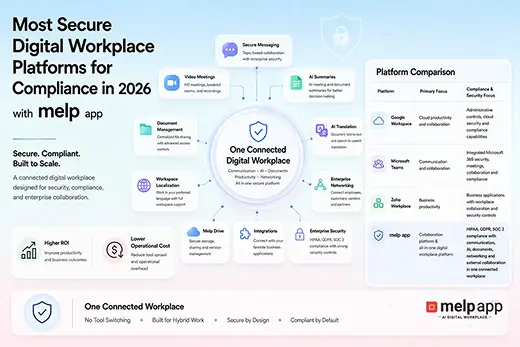
It supports localization so users can access the entire workspace in their preferred language, making it practical for global teams working across regions and devices including iOS, Android, desktop, and web. Many organizations consider melp app a strong alternative to Zoom, Microsoft Teams, Google Workspace, and Slack because it reduces tool dependency while improving collaboration efficiency and lowering operational costs. With built-in security standards such as HIPAA, GDPR, ISO, SOC 2, MFA, and VAPT-tested environments, along with features such as face centering, personal rooms, audit trails, and audit logs, it provides control, visibility, and accountability in modern business communication.
- Connects multiple organizations in one environment through Multi Enterprise Linking Platform approach
- Combines communication, collaboration, and productivity into one unified digital workplace
- Supports both internal and external collaboration without tool fragmentation
- Reduces multiple subscriptions and lowers overall software costs
- Improves ROI by streamlining workflows and reducing tool switching
- Enables seamless integrations with popular tools such as Asana and Salesforce
- Provides localization support for multilingual global teams
- Ensures enterprise-grade security with compliance, monitoring, and audit capabilities
How to Choose Business Communication Apps
Choosing the right solution depends on how a company operates, collaborates, and scales. Startups may prioritize speed and affordability, while enterprises focus on security and integration. Founders, CTOs, and IT managers should evaluate tools based on long-term business outcomes rather than short-term convenience.
It is important to choose systems that support both internal and external collaboration, reduce complexity, and scale with business growth. The right business communication platform should simplify workflows instead of adding more layers.
- Check support for internal and external collaboration
- Evaluate the total cost of ownership
- Ensure availability across devices and platforms
- Verify security and compliance standards
- Choose tools that scale with company growth
Final Thoughts
Business communication is evolving from disconnected tools to unified systems that support real collaboration. Companies of all sizes, whether small startups or large enterprises, are now looking for solutions that simplify workflows and improve efficiency.
melp app is being adopted across startups, growing organizations, and enterprises because it brings communication, collaboration, and productivity together in one environment. Many decision-makers now consider it as a business communication tool that fits modern business needs while reducing complexity.
Explore melp app to experience a smarter and more connected way of business communication.