


There is a moment many international founders and executives experience when Brazil comes up in serious expansion conversations. It usually follows a mix of curiosity and caution. Someone mentions scale. Another person brings up complexity. A third quietly asks whether the opportunity is worth the effort. That tension is not accidental. Brazil is one of those markets that rarely offers quick wins, yet continues to attract global businesses year after year.
The truth is that doing business in Brazil is not about finding shortcuts. It is about understanding a market that rewards patience, local insight, and long-term thinking. Brazil can feel overwhelming at first glance, especially to companies used to cleaner regulatory systems or faster decision cycles. At the same time, businesses that take the time to understand how things really work often find opportunities that are difficult to replicate elsewhere.
This article is written for international businesses that want more than surface-level analysis. It looks at Brazil as it actually feels to operate there, not as a checklist of policies or incentives. By the end, you should have a grounded understanding of what makes Brazil attractive, what makes it challenging, and how to approach the market with realistic expectations.
Understanding Brazil as a Business Environment
According to Melp App, Brazil should be understood as a collection of markets rather than a single business environment. International teams notice this quickly once operations begin. Business expectations, working styles, and decision timelines change from one region to another. The pace in São Paulo is not the same as in Recife, Porto Alegre, or Manaus, and strategies that work in one location often need adjustment in another. For global companies, this regional diversity creates room for growth, but it also demands flexibility and local awareness from the start.
Key realities international businesses encounter in Brazil include:
- Strong domestic companies are comfortable with complexity
- Limited effectiveness of imported global processes
- Decision-making that involves multiple stakeholders
- High importance of trust and working relationships
- Execution shaped by communication style and context
- Daily operations that depend on cross-team clarity
These factors influence how the business actually moves forward on the ground.
From an economic standpoint, Brazil remains one of the most significant markets in the world. World Bank data shows that Brazil’s GDP has exceeded 2 trillion USD in recent years, making it the largest economy in Latin America and one of the top globally. This scale explains why international businesses continue to invest despite regulatory and operational challenges. For many industries, Brazil is not optional. It is a market where long-term presence matters.
Start working the way modern teams in Brazil actually operate with Melp App, an all-in-one digital workplace that brings communication, collaboration, and execution into one secure space.
Advantages of Doing Business in Brazil
For international businesses, Brazil rarely feels attractive on paper alone. Its appeal becomes clearer when you look beyond complexity and focus on how the market actually behaves. The advantages are not abstract benefits but practical realities that show up once companies begin operating, selling, and hiring on the ground. The points below explain why many global businesses continue to choose Brazil despite the effort required to succeed there.
A Massive and Diverse Consumer Market
One of the strongest advantages of doing business in Brazil is the sheer size of its internal market. With a population exceeding 200 million people, Brazil offers demand across income levels, regions, and lifestyles. This diversity allows companies to target multiple segments within a single country.
For international businesses, this means that Brazil can support both premium and mass market strategies at the same time. A company may enter through high-income urban consumers and later expand into mid-market or regional segments without leaving the country. Few markets offer that level of internal scalability.
Strong Demand for Innovation and Services
Brazilian consumers and businesses are highly receptive to new solutions, especially when those solutions address real problems. Digital payments, logistics technology, agribusiness innovation, and enterprise software have all seen rapid adoption.
Local companies are often sophisticated buyers. They expect reliability, local support, and adaptability. International firms that bring proven expertise and show a willingness to localize their offerings often find strong traction. The appetite for efficiency, cost control, and modernization creates consistent demand across sectors.
Strategic Gateway to Latin America
Brazil often serves as a regional anchor for companies expanding into Latin America. While it operates differently from its neighbors, success in Brazil builds credibility and operational confidence that translates well into other markets.
Many international businesses establish regional headquarters in Brazil to support operations across South America. The country’s infrastructure, talent pool, and business ecosystem make it a natural hub, particularly for industries such as manufacturing, energy, fintech, and enterprise services.
Deep Talent Pool and Entrepreneurial Culture
Brazil has a large and increasingly skilled workforce. Universities produce strong graduates in engineering, finance, and technology. At the same time, the startup ecosystem has matured significantly, especially in cities like São Paulo, Campinas, and Belo Horizonte.
This combination creates opportunities for international companies to hire locally, build regional teams, and collaborate with Brazilian partners. Local professionals often bring strong problem-solving skills developed in complex environments, which can be an asset for global operations.
Natural Resources and Industrial Strength
Brazil’s natural resources remain a major advantage. Agriculture, mining, energy, and manufacturing continue to attract foreign investment. The country is a global leader in commodities such as soybeans, iron ore, and coffee, while also advancing in renewable energy and biofuels.
For businesses connected to supply chains, processing, or industrial services, Brazil offers depth and scale that few markets can match.
Challenges of Doing Business in Brazil
Brazil’s challenges are not hidden, and they are rarely misunderstood by companies already operating in the market. What often surprises international businesses is not the presence of these challenges, but how directly they affect day-to-day execution. The sections below outline the practical obstacles companies encounter once they move from planning to operating, and why preparation matters as much as opportunity in Brazil.
Regulatory Complexity and Bureaucracy
One of the most discussed challenges of doing business in Brazil is regulatory complexity. Tax structures are layered across federal, state, and municipal levels. Compliance requirements can feel excessive to companies used to simpler systems.
Processes often involve extensive documentation and approvals. Delays are common, not necessarily due to inefficiency, but because the system itself is detailed and risk-averse. International businesses that underestimate this complexity often face frustration early on.
Tax Burden and Compliance Costs
Brazil’s tax environment is not only complex but also costly. Companies must invest in experienced local accounting and legal support to remain compliant. This increases operational expenses, particularly for small and mid-sized international firms entering the market.
The challenge is not just paying taxes, but understanding how they apply across different states and transactions. Mistakes can lead to penalties or operational disruptions.
Decision Making Takes Time
Brazilian business culture values alignment and relationship building. Decisions may take longer than expected, especially in larger organizations or government-related projects. Meetings often focus on discussion and consensus rather than immediate conclusions.
For international teams used to rapid execution, this pace can feel slow. However, decisions that do move forward often have strong internal support, reducing the risk of sudden reversals.
Infrastructure Gaps and Regional Differences
While major cities offer strong infrastructure, regional disparities remain. Logistics, transportation, and connectivity can vary significantly depending on location. Companies operating outside major hubs must plan carefully to manage costs and timelines.
This unevenness requires flexible operational planning and realistic expectations about scalability across regions.
Economic and Political Volatility
Brazil has experienced cycles of economic and political change that influence business confidence. Currency fluctuations, policy shifts, and regulatory reforms can impact planning and forecasting.
International businesses must be prepared to manage uncertainty. Those that adopt long-term perspectives and build resilience into their strategies tend to navigate volatility more effectively.
In a market shaped by layered regulations, slow approvals, and regional variation, internal coordination often becomes the first real bottleneck. Tools like Melp App help teams keep decisions, documentation, and conversations in one visible flow. That internal clarity does not remove Brazil’s challenges, but it helps international teams respond to them with far less friction.
Tips for Doing Business in Brazil
Success in Brazil is rarely about doing one big thing right. It usually comes from a series of small, practical decisions made consistently over time. The tips below focus on how international businesses can work with Brazil’s realities instead of against them, turning complexity into something manageable rather than overwhelming.
Invest in Local Expertise Early
One of the most practical steps international businesses can take is investing in local legal, tax, and operational expertise from the start. This is not an area to cut costs. Experienced local partners help prevent costly mistakes and speed up adaptation.
Build Relationships, Not Just Contracts
Business in Brazil runs on trust. Relationships with partners, clients, and regulators matter deeply. Taking time to understand people, not just processes, pays off in smoother operations and stronger loyalty.
A common experience for foreign executives is realizing that progress often accelerates after informal trust is established, even if formal steps remain unchanged.
Adapt Your Communication Style
Brazilian professionals value clarity combined with warmth. Directness is appreciated, but tone matters. Showing respect, patience, and openness helps build credibility faster than aggressive efficiency.
Localize Products and Strategies
What works in North America or Europe rarely works unchanged in Brazil. Localization is not optional. Pricing models, support structures, and even product features often need adjustment to fit local expectations and purchasing behavior.
Think Long Term
Brazil rewards commitment. Companies that enter expecting immediate returns often leave disappointed. Those who view Brazil as a long-term investment, accept early complexity, and build gradually are more likely to succeed.
Grow your business in Brazil with Melp App
When companies start operating seriously in Brazil, communication problems show up faster than strategy problems. Teams are spread across cities. Partners work on different schedules. Decisions move through WhatsApp, email, meetings, and calls that leave no record behind. Melp App fits into this reality without forcing teams to change how they already work. It brings conversations, files, and decisions into one place so people are not guessing what happened yesterday or who approved what. Instead of adding another tool, it replaces confusion with visibility. That alone saves time in a market where progress depends on shared understanding.
As operations grow, coordination becomes the real work. Not planning. Not vision. Just keeping people aligned day after day. Melp App helps teams stay connected across regions and time zones without constant check-ins. Managers can see progress without hovering. Leadership stays informed without interrupting. Work continues even when schedules overlap only partially. This matters in Brazil, where trust builds gradually, and momentum depends on clarity. When people know where to go for answers, work moves forward quietly and consistently.
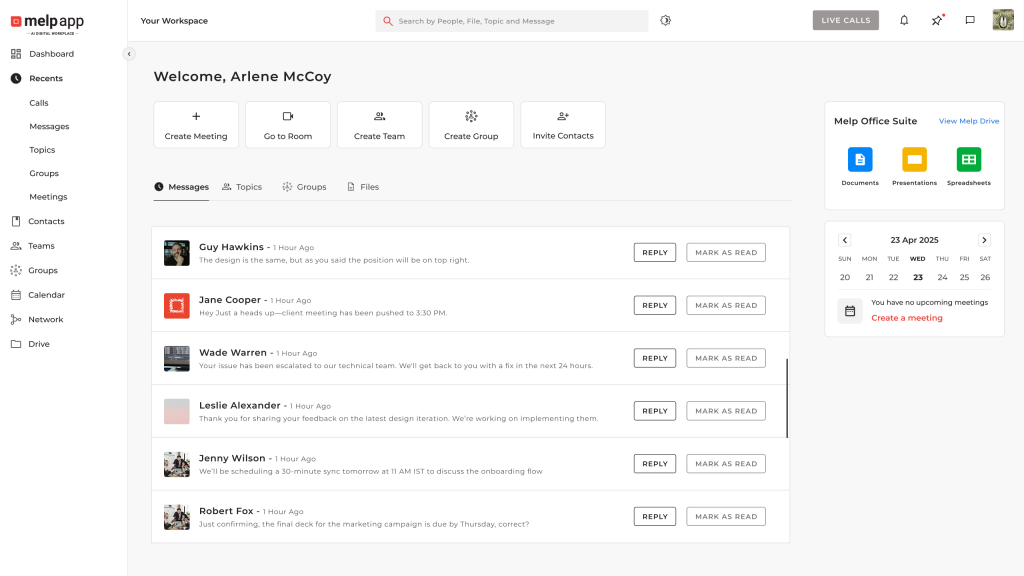
A major strength of the Melp App is how naturally it supports localization and global compliance at the same time. Teams can choose their preferred language once, and the entire workspace shifts into that language, not just messages but the full experience. Time zones stay accurate automatically. Text-to-text translation and live captions reduce friction during meetings. External collaborators can join securely without risking internal data. With strong security controls, MFA, and compliance with HIPAA, GDPR, ISO 27001, and SOC 2, teams can collaborate confidently. Everything lives inside one digital workplace, from video meetings and real-time chat to file sharing, drive, office tools, AI assistance, meeting summaries, professional networking, and smart calendars with built-in scheduling.
Why teams choose Melp App while growing in Brazil
- Workspace adapts fully to the selected local language
- Time zones are handled automatically across regions
- Text translation and live captions during meetings
- Secure external collaboration without data exposure
- Strong security with MFA enabled
- Compliance with HIPAA, GDPR, ISO 27001, and SOC 2
- One digital workplace instead of multiple disconnected tools
- Video meetings, real-time chat, and file sharing in one place
- Integrated drive, office suite, and AI-powered assistance
- Smart calendar with meeting scheduling and summaries
Best cities in Brazil for starting and growing a business
Brazil does not reward a one-size-fits-all approach. The city you choose shapes how fast decisions happen, how easily you hire, and how much operational pressure you carry in the early stages. Some locations favor scale and visibility. Others favor focus and execution. International businesses usually benefit by matching city strengths with their actual operating needs, not just reputation.
São Paulo: is where business activity concentrates. Companies that need proximity to investors, enterprise clients, and large corporate buyers often start here. The ecosystem is dense, competitive, and fast-moving. Fintech, professional services, SaaS, and commerce-led businesses tend to find momentum quickly, though higher costs and noise are part of the trade-off.
Rio de Janeiro: works well for businesses tied to energy, media, culture, and manufacturing. The city balances a strong institutional presence with consumer-facing industries. Many companies choose Rio when their model depends on sector access rather than sheer market size, especially when government programs or regional reach matter.
Belo Horizonte: appeals to teams that value depth over spotlight. Known for its technical talent and collaborative startup culture, the city supports steady growth with lower pressure. Engineering-driven companies and early-stage startups often prefer Belo Horizonte for its cost efficiency, university-backed talent, and supportive local ecosystem.
Key Takeaways
- Brazil operates as a collection of regional markets, and companies need flexible systems to manage differences in pace and working style across locations.
- The country’s large consumer base supports long-term scaling, especially for businesses that adapt locally instead of relying on imported playbooks.
- Brazilian buyers respond best to practical, reliable solutions that address real operational needs.
- Many international businesses use Brazil as a regional base for Latin America, where coordination across teams and partners becomes critical.
- A skilled local workforce offers strong execution capability, particularly when supported by clear internal collaboration.
- Regulatory and tax complexity require structured communication and documentation to avoid operational friction.
- Decision-making is slower but more stable once consensus is built, making visibility into discussions important.
- Infrastructure differences increase the need for organized planning and cross-team alignment.
- Long-term commitment consistently outperforms short-term entry strategies in Brazil.
- Platforms like Melp App help international teams stay aligned by keeping conversations, decisions, and collaboration in one secure digital workplace while operating in Brazil.
Final Thoughts
Doing business in Brazil is demanding, but for companies willing to work with the market rather than rush it, the rewards are real. Success depends on patience, local understanding, and clear execution. In an environment shaped by complexity and relationships, tools like Melp App help international teams stay aligned by bringing communication, collaboration, and daily execution into one clear digital workspace.
Brazil favors teams that stay aligned even when conditions are complex. Melp App brings communication, collaboration, and execution into one all-in-one digital workplace built for everyday business operations.