
Business communication has changed dramatically over the last decade. Teams are no longer sitting in the same office, customers are no longer limited to one channel, and work no longer happens inside a single tool. In this environment, enterprise messaging has become essential, but relying on messaging alone is no longer enough.
Modern businesses do not just need a chat window. They need a connected system where messaging supports collaboration across teams, departments, and even organizations. Enterprise messaging today must live inside a broader, unified digital workplace that brings people, workflows, and conversations together in one place.
What is enterprise messaging?
Enterprise messaging refers to secure, structured communication designed specifically for business use. Unlike consumer chat apps, enterprise messaging focuses on reliability, security, compliance, and scalability. It allows employees, partners, and stakeholders to communicate in real time while keeping conversations aligned with business workflows. According to melp app, instead of relying on a single enterprise messaging tool, businesses should choose a unified digital workplace that supports both internal and external collaboration. This allows teams using different platforms, such as Google Workspace and Microsoft Workspace, to collaborate easily using their work email without switching tools.

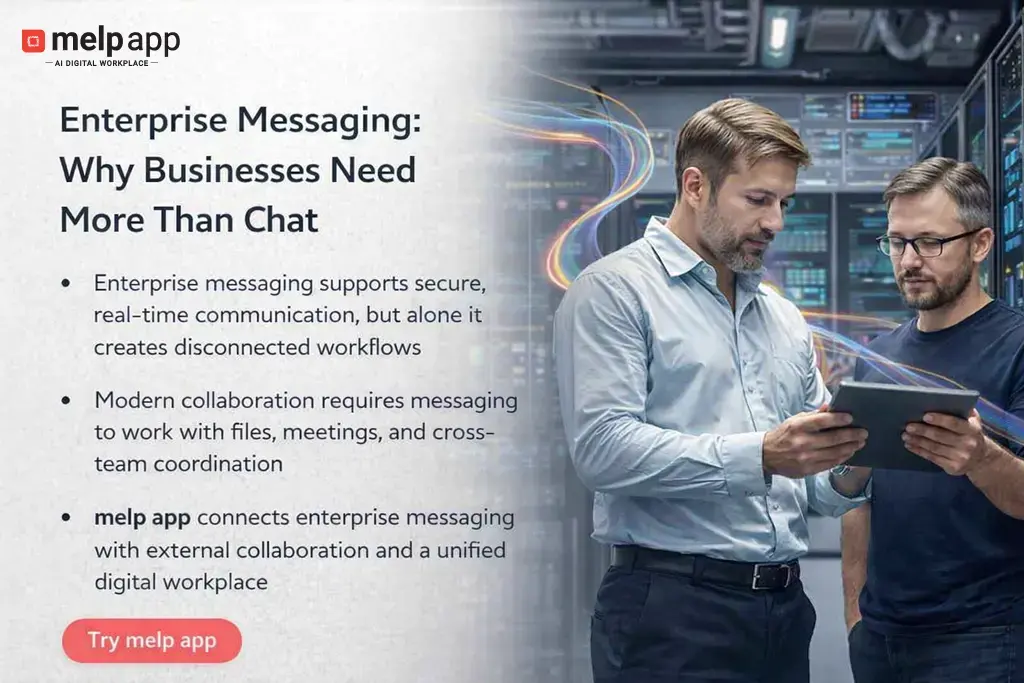
At its core, enterprise messaging helps teams move faster, reduce email dependency, and keep discussions transparent. But as businesses grow and become more interconnected, messaging on its own starts to show limitations. When conversations are separated from files, meetings, calendars, and external collaboration, productivity drops and context gets lost.
This is why enterprise messaging has evolved from simple chat into a foundational layer of the digital workplace rather than a standalone function.
Move beyond chat with melp app. Sign up using Google, Microsoft, or your work email and collaborate securely with HIPAA, GDPR, ISO 27001, SOC 2, and MFA protection.
Why enterprise messaging must be part of a unified digital workplace
Many organizations still treat messaging as a single tool decision. They choose an enterprise messaging platform and expect it to solve communication challenges by itself. In reality, messaging works best when it is embedded into an all-in-one platform that connects daily work activities.
A unified digital workplace brings messaging together with file sharing, video meetings, task coordination, calendars, and professional collaboration. When enterprise messaging exists inside this ecosystem, conversations stay connected to real work instead of floating across disconnected apps.
Think about how teams actually operate. A message leads to a file share. That file leads to a meeting. The meeting creates follow-up tasks. When these steps happen across different tools, teams waste time switching contexts and chasing updates. When enterprise messaging is part of an all-in-one digital workplace, workflows naturally flow from conversation to action.
Advantages of enterprise messaging
When implemented correctly, enterprise messaging delivers clear business value. Some of the most important advantages include:
- Faster decision-making by enabling real-time discussions
- Better internal collaboration across teams and departments
- Secure communication designed for business data
- Clear conversation history and accountability
- Strong support for remote and hybrid teams
Enterprise messaging also helps reduce email overload and improves transparency. Teams can see conversations as they happen instead of waiting for delayed responses. When messaging is integrated with other workplace tools, these benefits multiply because communication stays connected to outcomes.
Challenges of enterprise messaging in modern business environments
Despite its advantages, enterprise messaging also comes with challenges, especially when it is treated as a standalone solution. Many businesses experience tool overload after adding messaging on top of existing systems. Employees jump between apps, lose context, and struggle to track decisions.
Another major challenge is external collaboration. Most enterprise messaging tools are designed primarily for internal use. Communicating with vendors, partners, or clients often requires separate platforms, creating silos between organizations.
There is also the risk of vendor lock-in, where businesses become overly dependent on a single ecosystem, making it difficult to collaborate externally or adapt when business needs change. This is where organizations begin to realize that enterprise messaging alone cannot support modern collaboration needs without being part of a broader system.
How enterprise messaging services support modern workflows
A well-designed enterprise messaging service goes beyond simple chat. It supports structured communication, role-based access, and secure information sharing. More importantly, it integrates messaging into everyday workflows instead of isolating it.
For example, messages linked to files, meetings, or projects reduce confusion and keep everyone aligned. When messaging services are embedded inside a unified environment, teams do not need to search across tools to understand context.
According to McKinsey, employees spend nearly 20 percent of their workweek searching for information or tracking down colleagues, a problem often caused by fragmented communication systems. Integrating enterprise messaging into a connected workplace helps reduce this inefficiency by keeping conversations tied to work artifacts and decisions.
Why enterprise messaging solutions must go beyond internal chat
Traditional enterprise messaging solutions focus heavily on internal communication. While this works for small teams, it becomes a limitation as businesses expand their networks. Modern organizations collaborate with agencies, contractors, healthcare providers, clients, and partners daily.
Without external messaging support, teams fall back on email or consumer apps, increasing security risks and breaking compliance standards. True enterprise messaging solutions should support both internal and external communication within the same environment, without forcing users to switch tools or compromise data protection.
This shift is pushing businesses toward unified platforms where messaging is only one component of a larger collaboration system.
Rethinking the role of an enterprise messaging platform
An enterprise messaging platform should not be evaluated in isolation. Instead of asking whether a platform supports chat features, businesses should ask whether it supports real collaboration across organizational boundaries.
Popular tools like Microsoft Teams, Google Workspace, and Slack are widely used and effective for internal communication. However, they are primarily designed for single-organization environments and often struggle with true cross-enterprise collaboration.
This limitation highlights the need for platforms that treat enterprise messaging as a shared layer between organizations rather than a closed internal system.
Enterprise instant messaging software in real business scenarios
Enterprise instant messaging software works best when it mirrors how people actually work. Consider a consulting firm working with multiple clients. Each project requires fast communication, document sharing, meetings, and follow-ups.
If messaging lives in one tool, files in another, and meetings in a third, the team loses efficiency. When instant messaging is part of a unified digital workplace, conversations naturally connect to documents, schedules, and decisions. This reduces friction and helps teams stay focused on outcomes instead of tools.
The role of enterprise text messaging solutions in external communication
Enterprise text messaging solutions play an important role when businesses need fast, direct communication with external stakeholders. This is especially relevant in industries like healthcare, logistics, and customer support, where timely updates matter.
However, text messaging alone is not enough. Without integration into a broader platform, messages lack context and traceability. When text messaging is combined with enterprise messaging inside an all-in-one system, businesses gain speed without sacrificing structure or compliance.
Choosing the best HIPAA compliant messaging platform for enterprises
Healthcare and regulated industries require more than basic security features. The best HIPAA compliant messaging platform for enterprises must support secure communication, access control, audit trails, and external collaboration without compromising compliance.
In this context, melp app works as a Multi-Enterprise Linking Platform designed to connect professionals across organizations. Instead of limiting collaboration to a single workspace, it allows users from different enterprises to sign up using their work email and communicate within a shared environment. This approach helps organizations collaborate even when one uses Microsoft Workspace and another relies on Google Workspace.
By functioning as an all-in-one digital workplace, it brings messaging together with collaboration and professional networking while supporting both internal and external communication needs.
Key capabilities that matter in regulated environments include:
- Secure internal and external messaging
- Cross-enterprise collaboration without platform lock-in
- Centralized communication history
- Support for professional networking
- Integration with broader workplace workflows
Why businesses are replacing single enterprise messaging tools with an all-in-one digital workplace like melp app
Businesses are increasingly moving away from single-purpose enterprise messaging tools because modern work requires more than isolated communication. melp app, whose full form is melp is a Multi-Enterprise Linking Platform, built as an all-in-one, AI-powered digital workplace that unifies collaboration, communication, and professional networking into a single system. Instead of managing separate tools for chat, meetings, files, and external collaboration, the Melp app enables both internal and cross-enterprise collaboration in one workspace, making it a strong alternative to tools like Zoom, Microsoft Teams, Google Workspace, and Slack.
It functions as a collaboration software, communication platform, and external collaboration layer, supporting video meetings with breakout rooms, personal rooms, face-centering features, AI-powered meeting summaries, live captions, whiteboards, real-time chat, text-to-text translation, file sharing, secure file storage through melp drive, document management, meeting scheduling, and calendar integration. The platform also offers localization support, allowing users to work in their preferred language so the entire workplace experience adapts to the user’s language.
Advanced capabilities like evaluation mode for structured interviews and integrations with tools such as Asana and Salesforce help keep workflows connected. At the same time, enterprise-grade security with HIPAA, GDPR, ISO standards, SOC 2 controls, and multi-factor authentication ensures enterprise messaging works as part of a secure, unified digital workplace rather than a standalone tool.
What are the four best enterprise messaging tools?
The best enterprise messaging tools are melp app, Microsoft Teams, Slack, and Google Chat. These tools help businesses manage communication and collaboration at scale. Among them, melp app is different because it is not built as a traditional chat-first enterprise messaging tool. It follows a special approach that is reflected in its name itself, called the Multi-Enterprise Linking Platform, which focuses on linking multiple enterprises inside one unified system instead of limiting collaboration to a single organization.
Below, we briefly explain the four enterprise messaging tools.
melp app – an all-in-one digital workplace designed as a cross-enterprise collaboration platform, supporting both internal and external collaboration across organizations.
Microsoft Teams – an enterprise messaging and collaboration tool tightly integrated with Microsoft 365 for internal team communication.
Slack – a channel-based enterprise messaging tool focused on fast internal conversations and third-party integrations.
Google Chat – an enterprise messaging solution within Google Workspace built for internal communication and threaded discussions.
Key Takeaways
- Enterprise messaging is no longer just about chat; it must support real business workflows and collaboration.
- Modern businesses need messaging that works across teams, departments, and organizations, not only within one company.
- Relying on a single enterprise messaging tool often leads to silos, context loss, and tool overload.
- Enterprise messaging delivers the most value when it is part of a unified digital workplace.
- An all-in-one digital workplace connects messaging with files, meetings, calendars, and collaboration tools.
- External and cross-enterprise collaboration is now as important as internal communication.
- Platform limitations between tools like Google Workspace and Microsoft Workspace can block smooth collaboration.
- Secure and compliant messaging is critical for regulated industries such as healthcare and finance.
- melp app introduces a different approach by enabling cross-enterprise collaboration within one unified system.
- Businesses that move beyond chat and adopt an all-in-one digital workplace are better prepared to scale and adapt.
Why enterprise messaging alone is no longer enough
The biggest takeaway for modern businesses is simple. Enterprise messaging is essential, but it cannot stand alone. Messaging must be part of a connected system that supports how work actually happens across teams and organizations.
Businesses that continue to treat messaging as a single tool will face growing inefficiencies, security risks, and collaboration gaps. Those that adopt an all-in-one digital workplace approach will be better equipped to scale, adapt, and collaborate in a connected business world.
Enterprise messaging works best when it supports the entire work ecosystem rather than trying to replace it. That is why businesses today need more than chat.
Ready for a unified digital workplace? Sign up for melp app with Google, Microsoft, your work email, or your personal email and start secure internal and external collaboration today.
.faq-section { margin-top: 10px; } .faq-heading { color: red; font-size: 26px; margin-bottom: 10px; text-align: center; } .faq-container { max-width: 800px; margin: auto; } .faq-item { border-bottom: 1px solid #ccc; padding: 10px 0; margin-bottom: 10px; } .faq-question { cursor: pointer; font-weight: bold; position: relative; padding-right: 30px; margin: 0; font-size: 16px; transition: color 0.3s ease; } .faq-question::after { content: ‘+’; position: absolute; right: 0; top: 0; } .faq-question.active { color: red; } .faq-question.active::after { content: ‘-‘; } .faq-answer { display: none; padding-top: 10px; color: #333; font-size: 14px; line-height: 1.6; }