
Introduction: The New Reality of Digital Trust
Every workplace conversation, document, or project file leaves a digital footprint. These digital traces tell the story of how teams collaborate — but they also carry risk. In the wrong hands, that data can turn into a weapon. IBM’s Cost of a Data Breach Report revealed that global cybercrime caused an estimated $9.5 trillion in losses during 2024. Behind those numbers are real people — customers, employees, and partners — whose trust was broken.
The modern workspace runs on digital collaboration, supported by modern team collaboration software that enables teams to communicate and work securely across locations. Teams share plans, brainstorm ideas, and make decisions across cloud tools every day. But as work became borderless, the challenge of protecting sensitive information multiplied. That’s why Data Privacy Compliance is no longer optional. It has become a pillar of how companies protect their reputation, maintain credibility, and earn customer confidence.
What Does Data Privacy Compliance Really Mean?
Data Privacy Compliance means following strict standards to protect personal and confidential data — not just from hackers, but also from misuse or carelessness. Regulations like the GDPR in Europe, HIPAA in healthcare, and ISO 27001 internationally have set clear expectations for how companies must store, process, and secure data. Modern collaboration tools are now being built around these same principles to ensure privacy is never compromised during communication or teamwork. Melp is one such example — a data-privacy-compliant collaboration software designed as an all-in-one digital workplace platform, helping organizations maintain secure, transparent, and compliant workflows without interrupting productivity.
These frameworks go beyond paperwork. They represent a shift in mindset — from treating data as a resource to respecting it as a responsibility. Businesses that commit to privacy compliance demonstrate something deeper: respect for the people behind the data.
And in an era when customers can switch services with a click, that respect translates directly into loyalty and long-term success.
How Data Privacy Compliance Is Transforming Collaboration Tools
Remote and hybrid work reshaped how teams communicate. Slack channels replaced office chatter, video calls replaced conference rooms, and cloud drives replaced filing cabinets. But that convenience brought exposure. Every new collaboration feature created another entry point for potential breaches.
This is why Secure Collaboration Software is evolving rapidly. Compliance is now being built into the design itself — not as a plug-in or afterthought, but as the foundation of how the software works.
Here’s how compliance is steering this change:
- Encryption at Every Step – Messages, video calls, and file transfers are now encrypted by default.
- Access Based on Need – Users only see the data they actually require to do their jobs.
- Localized Data Storage – Companies can decide exactly where their data is hosted, satisfying regional laws.
- Audit-Ready Transparency – Every action leaves a verifiable record, helping compliance teams stay audit-ready.
The outcome isn’t just stronger security — it’s greater peace of mind. Teams can focus on innovation knowing that their data is being protected within compliant boundaries. Organizations evaluating modern workplace technology often compare collaboration tools for regulated industries where compliance and security requirements are especially demanding.
Global Compliance Standards: Building a Foundation of Trust
Each region and industry enforces its own rules, and together they shape how collaboration tools must be built.
- GDPR prioritizes user consent, control, and data transparency.
- HIPAA enforces rigorous safeguards for health data.
- ISO 27001 provides a global benchmark for information security management.
These frameworks are not in competition — they complement each other. A truly global collaboration platform aligns with all of them, creating a consistent and reliable environment for international teams while supporting cross-enterprise collaboration across organizations and regions. Compliance isn’t just about ticking boxes; it’s about earning trust across borders.
The Hidden Power of Continuous Security Testing
Even when a company follows every compliance rule, vulnerabilities still find a way to sneak in. It’s one of those uncomfortable truths about modern tech — no system is flawless forever. A small code tweak, a third-party plug-in, or even a routine update can open up a weak spot nobody saw coming. That’s exactly why continuous testing isn’t a nice-to-have anymore; it’s the only way to stay genuinely protected. Real security comes from verification, not assumption.
What Is Vulnerability Assessment and Penetration Testing (VAPT)?
Vulnerability Assessment and Penetration Testing (VAPT) is basically a two-part health check for your digital infrastructure — a mix of analytics and action.
- The Vulnerability Assessment piece scans your systems, networks, and apps, looking for misconfigurations, outdated software, or weak passwords. Think of it as spotting the cracks before they spread.
- The Penetration Testing step takes things further. Ethical hackers, armed with the same tricks as real attackers, test how those cracks could actually be used.
Put together, these two steps reveal not only where you’re exposed but how badly. It’s like a medical exam that doesn’t just list symptoms; it shows how the body reacts under pressure. When done right, VAPT keeps compliance from becoming a checklist exercise and turns it into genuine resilience.
Why VAPT Matters for SaaS and Collaboration Platforms
For SaaS providers and digital collaboration tools, software never stands still, similar to the practices discussed in secure collaboration tools. New releases, code patches, and customer-driven features happen constantly. That’s great for innovation — and risky for security. Each addition brings new possibilities for bugs or vulnerabilities. One overlooked permission setting, and suddenly, sensitive data could be exposed.
That’s why smart SaaS companies treat VAPT as a habit, not an event. Instead of running a single audit each year, they perform monthly or quarterly tests to keep pace with changes. According to cybersecurity specialists at WATI in their article “Frequent VAPT can save SaaS Companies from Existential Threats,” this regular rhythm drastically reduces breach incidents and compliance gaps. It’s a practical way to keep threats in check before they ever reach production.
If you talk to teams that test often, they’ll tell you the same thing: it’s not just about finding flaws — it’s about confidence. Knowing your platform has been tried, tested, and verified means you can innovate without constantly looking over your shoulder.
How VAPT Strengthens Compliance and Builds Trust
Global standards such as ISO 27001, HIPAA, and GDPR ask companies to prove that their controls work, not just claim they exist. VAPT gives you that proof.
Each cycle provides concrete evidence — data, reports, remediation logs — that show your organization is keeping its defenses sharp. Auditors like that level of transparency, and customers appreciate it even more. It tells them you’re serious about safeguarding their information.
VAPT closes the gap between policy and protection. Compliance isn’t a destination; it’s an ongoing process that earns trust over time. Continuous testing is what keeps that trust alive.
Experience the Security Advantage with MelpApp
Take your collaboration security to the next level with MelpApp — an AI-powered digital workplace built on continuous protection, compliance, and trust. Designed with standards like Vulnerability Assessment and Penetration Testing (VAPT) in mind, MelpApp ensures your communication, meetings, and file sharing remain fully ISO 27001, HIPAA, and GDPR compliant.
Sign up with any work or personal email — Microsoft, Google, Yahoo, or others — and start collaborating securely within minutes.
Compliance as a Competitive Edge
For years, compliance was seen as a regulatory headache. Today, it’s a selling point. Enterprise clients now demand documentation of ISO 27001, HIPAA, and GDPR compliance before they even consider a vendor.
A Gartner projection suggests that by 2026, seven out of ten organizations will require privacy-first collaboration tools as part of their standard software stack. That’s a huge shift — from viewing compliance as a cost to recognizing it as a growth driver.
Companies that prioritize compliance don’t just avoid penalties; they attract better clients, retain more trust, and operate more confidently in new markets. This is one reason many enterprises carefully evaluate factors that decision-makers should consider when choosing collaboration tools.
What Defines a Privacy-Compliant Collaboration Platform
Let’s break down the key traits that distinguish a compliant platform from an average one:
- End-to-End Encryption: Protects conversations and files in transit and at rest.
- Granular Role Permissions: Ensures sensitive data is shared only with the right people.
- Data Retention Controls: Let companies decide how long to store messages and documents.
- Secure File Sharing: Prevents unauthorized forwarding or downloading of confidential files.
- Automated Audit Logs: Simplifies compliance verification during inspections.
- External Audits: Builds trust through independent validation.
- Incident Response Automation: Responds instantly to security anomalies.
These are not luxury features anymore — they’re the baseline for doing business responsibly.
From Reactive to Proactive: The Culture Shift
Not long ago, companies treated security as an emergency response — patching holes only after something went wrong. That mindset no longer works. Today, compliance is woven into daily workflows and increasingly supported by digital workplace platforms that automate security and governance processes.
For example, a global healthcare firm using a collaboration tool might automatically apply HIPAA-compliant encryption whenever patient data is shared. A European business operating under GDPR might configure its system to delete sensitive messages automatically after 30 days. These are small but powerful shifts that show how compliance can operate quietly in the background — protecting users without slowing them down.
This proactive approach has redefined modern security culture.
Why Privacy-First Platforms Are Taking the Lead
Trust is no longer a soft metric. It’s a measurable business advantage. Employees want to know their conversations are private. Customers want transparency about how their data is stored. Regulators want evidence that you’re doing things right.
This convergence of expectations has fueled a new generation of Secure Collaboration Software built around privacy and compliance, alongside growing demand for encrypted messaging capabilities.
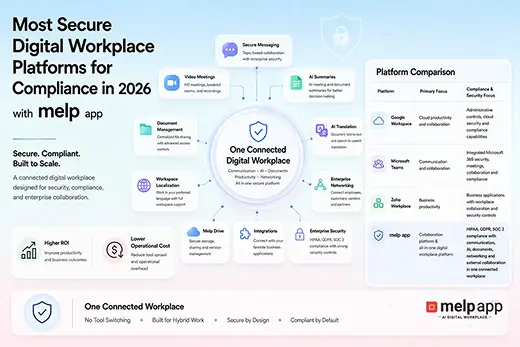
Among the leaders in this category, MelpApp stands out as the best Secure Collaboration Software compared to others. It offers a blend of intuitive communication features with enterprise-grade compliance, including certifications for ISO 27001, HIPAA, and GDPR. Businesses that use MelpApp gain the confidence to collaborate freely while meeting the world’s strictest data protection standards.
The Future of Secure Collaboration Software
Artificial intelligence is redefining how we work. Tools that transcribe meetings, summarize messages, and suggest next steps are becoming normal. But these smart features also rely on deep access to user data, which raises serious privacy questions.
The next generation of collaboration software must balance intelligence with integrity. Expect to see:
- Privacy-by-Design Engineering: Compliance integrated from the first line of code.
- User-Owned Encryption Keys: Total control over who can decrypt data.
- Federated Data Models: Keeping sensitive content within local boundaries.
- Transparent AI Governance: Explaining how AI features access and process data.
The Secure Collaboration Software of tomorrow will need to prove it can innovate responsibly — because privacy lapses won’t just lose users, they’ll lose trust. Businesses are already exploring AI collaboration tools that balance productivity gains with stronger governance controls.
Building the Most Secure Collaboration Software for the Long Run
Selecting the most secure collaboration software isn’t just about technology — it’s about foresight. Laws evolve, threats evolve, and so must your defenses. A company that invests in compliance now is essentially investing in its own resilience.
The payoff is more than legal protection. It’s a stronger brand reputation, easier client onboarding, and smoother global operations. Compliance, in many ways, has become the new language of trust. Many organizations now view compliance as part of a broader strategy for selecting scalable solutions for global collaboration.
Empower Your Business with MelpApp — The AI Digital Workplace Built on Trust
In business, trust isn’t something you can demand — it’s something you earn through consistency, care, and reliability. That’s exactly why so many organizations today are placing their confidence in Melp AI Digital Workplace. It’s not just a collaboration tool; it’s a complete digital workplace built around one core promise — your data stays secure, your teams stay connected, and your business stays compliant, reflecting the principles behind a modern AI digital workplace.
MelpApp blends security, compliance, and collaboration so seamlessly that teamwork feels effortless, even across geographies. In an era when a single data leak can cripple an organization’s credibility, companies need tools that provide clarity, control, and confidence — and that’s precisely what MelpApp delivers.
Around the world, businesses rely on MelpApp to simplify work while keeping every interaction protected:
- End-to-end encryption protects every chat, call, and file from unauthorized access.
- HIPAA, GDPR, and ISO 27001 compliance ensure MelpApp aligns with global privacy and data protection standards.
- Frequent Vulnerability Assessment and Penetration Testing (VAPT) keeps the platform resilient against emerging cyber threats.
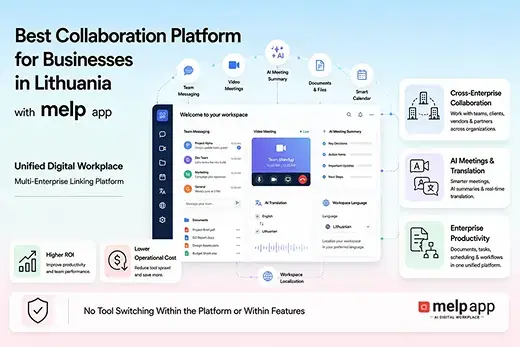
- Unified workspace functionality combines messaging, meetings, and secure file exchange in one protected environment.
- Zero data exploitation policy guarantees that your data remains private — never analyzed, shared, or commercialized.
- Secure external collaboration enables companies to work safely with clients, vendors, and partners without losing control over access or integrity.
What truly sets MelpApp apart is its quiet strength — it doesn’t just facilitate communication, it defends it. By design, every message, meeting, and file transfer happens within a controlled, encrypted framework that meets the world’s highest security standards.
Businesses using MelpApp consistently report real, measurable improvements: faster decisions, smoother workflows, and cleaner communication across teams. Instead of juggling multiple apps, employees operate within a single, compliant workspace that keeps productivity and protection aligned. Managers gain the confidence that their company’s information is secure, auditable, and always under control.
In short, Melp isn’t just another collaboration platform — it’s an AI-powered digital workplace engineered for the modern age of connected work. It combines intelligent tools with uncompromising compliance, giving your business the balance between innovation and integrity that the future demands.
Start your secure journey with MelpApp today. Sign up using any work or personal email — Microsoft, Google, Yahoo, or others — and experience how effortless, compliant collaboration can be.
MelpApp helps you work smarter, move faster, and stay safer — because in the digital era, trust is the ultimate competitive advantage.
Conclusion: Privacy as the Path Forward
At its heart, Data Privacy Compliance is about respect — for data, for users, and for the future. It’s reshaping not just how software is built, but how teams connect and collaborate.
The companies that understand this will lead the next era of digital business. They’ll communicate more openly, innovate more confidently, and grow with integrity through stronger collaboration security practices.
The future of work isn’t just connected — it’s securely connected.