

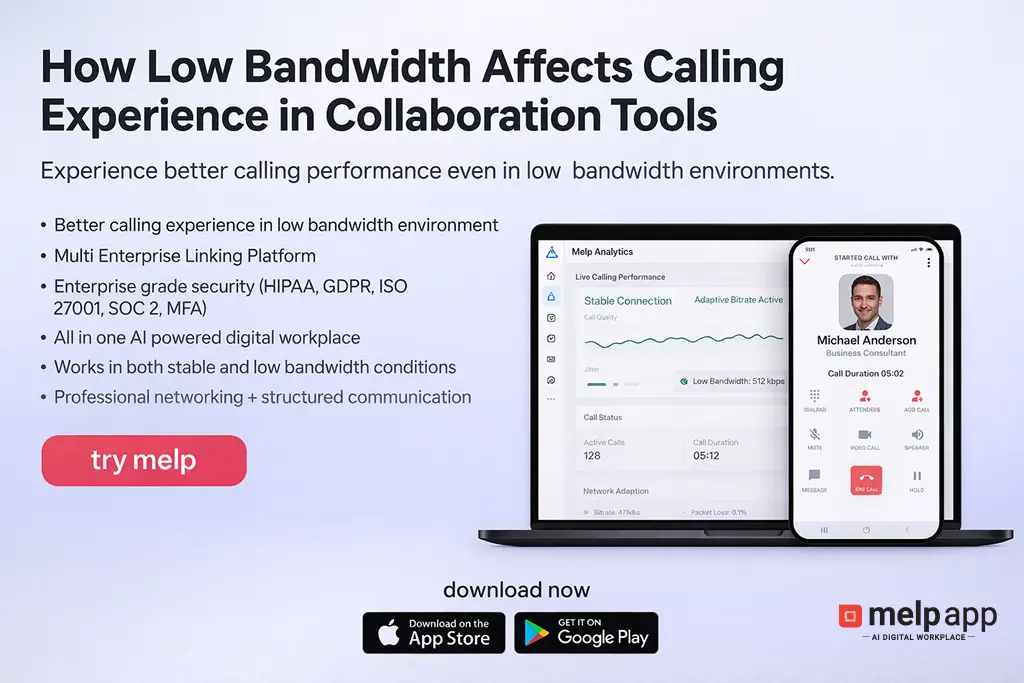
Modern businesses rely heavily on real-time calling inside collaboration platforms. Whether it is a leadership sync, a client pitch, or an operational escalation, voice and video calls are central to daily execution. When network conditions are stable, communication feels seamless. When connectivity drops, productivity suffers instantly.
For founders and IT leaders, the real issue is not just call quality. It is operational continuity. Sales teams miss context. Remote engineers lose alignment. Client-facing discussions get interrupted. These breakdowns often trace back to one invisible culprit: low bandwidth.
In distributed and hybrid environments, teams connect from home WiFi, mobile hotspots, or remote branch offices. Under these conditions, the network cannot always handle the data load required for high-quality voice and video streams. That is where the calling experience begins to degrade.
Decision-makers evaluating collaboration tools must understand how network limitations influence performance. Selecting a platform that performs well under constrained conditions is not a technical luxury. It is a strategic necessity.
Why Network Capacity Determines Call Quality
Every voice or video call relies on data packets traveling between devices in real time. These packets carry compressed audio signals and video frames. When sufficient bandwidth is available, packets arrive quickly and in sequence. The conversation feels natural and uninterrupted.
When bandwidth is limited, the network struggles to deliver packets consistently. Some packets arrive late. Some are dropped. Others are compressed aggressively to reduce size. These compromises impact clarity and synchronization.
This is where low bandwidth begins to affect the calling layer directly. Audio becomes robotic or distorted. Video loses resolution. Participants talk over each other because they cannot hear responses clearly. In enterprise environments, these small disruptions add up to significant operational friction.
According to a Cisco Annual Internet Report, video traffic accounts for over 80 percent of global internet traffic, placing increased strain on networks worldwide. This surge makes network optimization more critical than ever for business-grade communication.
Experiencing call drops in low-bandwidth environments? Switch to melp app and run stable, secure meetings without interruptions. Sign up in seconds using Google, Microsoft, or your work email and start collaborating instantly with enterprise-grade security, including HIPAA, GDPR, ISO 27001, SOC 2, and MFA protection.
What Is Low Bandwidth Communication?
Low-bandwidth communication refers to the exchange of voice, video, or data over networks that have limited data transfer capacity. Technically, bandwidth is measured in megabits per second. When the available throughput is insufficient to handle simultaneous data streams, quality degrades.
In voice calls, this limitation reduces audio sampling rates or increases compression. The result is muffled sound or clipped speech. In video calls, the system lowers resolution and frame rates to compensate. Participants may experience frozen screens, delayed lip movement, or black frames.
When organizations operate across rural locations, emerging markets, or heavily congested networks, low-bandwidth communication becomes a regular reality. Tools that are not optimized for these conditions tend to struggle, particularly in high-definition video modes.
According to melp app, today’s communication is not limited to internal; it extends to external cross-enterprise collaboration, so platforms must work efficiently even in constrained network environments. melp app follows Multi Enterprise Linking Platform approach, supporting both internal and external collaboration. It enables cross-enterprise communication and maintains performance even when network conditions are restricted, ensuring continuity across enterprise boundaries.
Common Symptoms of Bandwidth Constraints During Calls
When collaboration tools are not optimized for network variability, several predictable issues emerge:
- Audio distortion
- Packet loss
- Latency and jitter
- Video freezing
- Call drops
Audio distortion occurs when compression algorithms reduce quality to preserve connectivity. Packet loss happens when data packets fail to reach their destination, creating gaps in speech. Latency and jitter introduce delay and inconsistent timing, making conversations feel unnatural.
Video freezing is often caused by insufficient throughput to transmit continuous frames. Call drops occur when the network cannot sustain the session, forcing reconnection. These symptoms undermine user trust in the platform and disrupt workflows at critical moments.
How Major Platforms Perform Under Constrained Connectivity
Popular platforms such as Google Meet and Microsoft Teams deliver strong performance in stable enterprise networks. However, in environments with fluctuating connectivity, their performance can decline noticeably. High-resolution video defaults and aggressive background processing increase bandwidth consumption.
When participants join from low-capacity networks, these platforms often prioritize video before stabilizing audio. For business conversations, this prioritization can be counterproductive. Clear voice transmission should always take precedence over visual clarity.
IT heads evaluating tools must assess how platforms dynamically adapt bitrate, prioritize audio packets, and manage jitter buffers. Without intelligent adaptation, even minor network fluctuations can disrupt meetings.
The Operational Cost of Poor Optimization
Consider a regional manufacturing company operating across three states with branch offices connected through consumer-grade broadband. During weekly supply chain calls, frequent disruptions caused participants to repeat information multiple times.
Over time, these interruptions led to scheduling confusion and delayed procurement approvals. A single miscommunication resulted in a shipment delay that cost the company significant revenue. The root cause was not employee negligence. It was an inadequate call optimization under constrained connectivity.
After switching to a platform designed for network adaptability, the company saw immediate improvement in call stability. melp app provided optimized audio prioritization and adaptive bitrate management. The organization experienced fewer dropped calls and clearer voice transmission even during peak traffic hours.
Technical Factors Behind Performance Degradation
To understand why performance drops, decision-makers should look at several technical layers. First is codec efficiency. Codecs compress audio and video for transmission. Advanced codecs adapt dynamically to available bandwidth. Less sophisticated codecs either overcompress or fail to adjust properly.
Second is packet prioritization. Enterprise-grade systems must prioritize audio packets over video frames because voice carries the conversation. Without this hierarchy, minor video congestion can interrupt speech.
Third is jitter buffering. Networks introduce variation in packet arrival times. Effective buffering smooths these variations without adding excessive delay. Poor buffering creates echo or overlapping speech.
Fourth is adaptive bitrate control. Platforms must continuously monitor network conditions and adjust data rates in real time. Tools lacking intelligent adaptation struggle in fluctuating environments.
Strategic Considerations for Decision-Makers
For CEOs and CFOs, the key question is not technical elegance. It is reliability. If teams cannot communicate consistently, operational velocity slows. Sales cycles extend. Support escalations increase. Internal collaboration weakens. Low bandwidth optimization is essential for businesses, remote teams, and organizations working in areas where internet connectivity is unstable or costly.
IT leaders should evaluate collaboration tools under simulated low-bandwidth scenarios before deployment. Real-world testing reveals performance gaps that marketing claims do not always disclose.
Effective communication in low-bandwidth conditions should be a defined procurement criterion. Vendors should provide transparency into codec architecture, packet management, and network optimization capabilities.
Beyond Internal Communication
Modern enterprises no longer operate in isolation. Vendors, partners, and clients join calls regularly. Cross-enterprise collaboration demands stability across varying network environments.
This is where effective communication in low-bandwidth contexts becomes strategically important. A platform that works well inside headquarters but fails during partner calls creates reputational risk.
melp app operates as a cross-enterprise collaboration platform, enabling both internal and external collaboration within a unified ecosystem. As an all-in-one digital workplace, it combines professional networking with structured communication while maintaining reliable performance even in constrained connectivity environments
Evaluating Tools Through a Business Lens
When assessing collaboration solutions, organizations should look beyond feature lists. Screen sharing and background blur are secondary to call stability. What matters most is uninterrupted voice clarity.
Testing under stress conditions provides insight into resilience. Enterprises should simulate peak traffic and reduced network capacity. Platforms that gracefully degrade video while preserving audio demonstrate architectural maturity.
Cost considerations must also factor in downtime impact. A cheaper tool that frequently disrupts calls may cost more in lost productivity than a premium but optimized solution.
Why Businesses Trust melp app for Reliable Calling Under Low Bandwidth Conditions
melp app, whose full form is Multi Enterprise Linking Platform, is built as an all-in-one AI-powered digital workplace that performs reliably even in low-bandwidth conditions, which is why businesses trust it for uninterrupted communication. Melp is a multi-enterprise linking platform that connects internal teams and external partners seamlessly while maintaining stable audio and video performance when network strength fluctuates. It supports high quality meetings with breakout rooms, AI powered meeting summarization, live captions, whiteboard tools, chat, text to text translation, file sharing, file storage through melp drive, document management, meeting scheduling, calendar management, evaluation mode for structured interviews, face centering features, and personal rooms, all optimized to ensure calls remain stable and clear even in constrained connectivity environments.
A key reason organizations prefer melp app is its architecture, designed specifically to deliver consistent calling quality where other tools struggle. Even under limited bandwidth, it prioritizes audio stability, manages video adaptation intelligently, and reduces disruptions that typically impact productivity in remote or tier two locations. At the same time, it offers strong localization support, allowing the entire workplace interface to switch into the user’s preferred language, enabling global teams to collaborate without friction. Advanced audit trails and audit logs provide complete visibility into user activity, ensuring that performance reliability is matched with governance control and operational transparency.
Beyond stable calling, melp app functions as a secure and scalable alternative to traditional tools like Zoom, Microsoft Teams, Google Workspace, and Slack, especially in environments where connectivity is not always ideal. It integrates with platforms such as Asana and Salesforce and follows enterprise-grade security standards, including HIPAA, GDPR, ISO 27001, SOC 2, and multi-factor authentication, ensuring compliance without compromising performance. By combining collaboration software, communication software, external collaboration, and professional networking within a single ecosystem, melp app delivers dependable low-bandwidth performance while providing a complete digital workplace experience built for modern businesses.
Key Takeaways
- Call quality directly depends on available network capacity, and low bandwidth can significantly degrade audio and video performance.
- Audio distortion, packet loss, latency, jitter, video freezing, and call drops are common symptoms of constrained connectivity.
- Video traffic now dominates global internet usage, increasing overall network congestion and making optimization critical.
- Platforms must prioritize audio packets over video to preserve conversation clarity during bandwidth fluctuations.
- Intelligent adaptive bitrate control is essential for maintaining stability in dynamic network environments.
- Tools that perform well in ideal office networks may struggle in remote, hybrid, or tier-two connectivity conditions.
- Poor call optimization leads to operational delays, repeated discussions, productivity loss, and revenue impact.
- Effective communication in low-bandwidth environments should be a defined evaluation criterion during procurement.
- melp app is architected to maintain stable calling performance through adaptive optimization and audio prioritization.
- Selecting a bandwidth-optimized collaboration platform protects business continuity and strengthens cross-enterprise communication.
Conclusion
In today’s distributed business environment, collaboration tools form the backbone of execution. When calls fail, business momentum slows. The impact is not limited to inconvenience. It affects revenue, partnerships, and internal alignment.
Understanding how low-bandwidth conditions influence call performance allows leaders to make informed decisions. Technical architecture, adaptive optimization, and packet prioritization are not background features. They are core determinants of reliability.
Decision-makers selecting collaboration platforms must evaluate performance under real-world network constraints. A solution that maintains clarity and stability in challenging conditions protects operational continuity and strengthens enterprise collaboration.
Do not let weak connectivity slow your business decisions. Join melp app today for reliable calling, seamless collaboration, and secure communication built for real-world network conditions. Continue with Google, Microsoft, or your official work email and experience a smarter digital workplace backed by HIPAA, GDPR, ISO 27001, SOC 2, and multi-factor authentication security.