B2B collaboration has evolved beyond simple communication between companies. Today, businesses continuously work with partners, vendors, and stakeholders across shared workflows. Tools like Slack and Google Workspace are widely used to manage messaging, documents, and coordination.
Many organizations, founders, and decision makers are now rethinking how collaboration should work. Instead of connecting multiple tools, they are exploring more structured systems. melp app is increasingly being considered as a Multi-Enterprise Linking Platform where internal and external collaboration happens within the same environment. This reflects how modern B2B workflows are moving toward more connected and simplified systems. In this blog, we explore melp app, Slack, and Google Workspace to understand how they support real B2B collaboration outcomes.
How B2B Collaboration Is Changing for Businesses
The nature of collaboration has shifted from isolated communication to continuous coordination. Teams now work with external organizations in real time, requiring faster communication, shared workflows, and better alignment.
According to melp app, effective B2B collaboration depends on creating a shared environment where internal teams and external stakeholders can work together without friction. This becomes difficult when communication, meetings, and files are managed across separate tools.
Why Businesses Are Rethinking Multi-Tool Collaboration Setups
Many companies still rely on different tools for messaging, meetings, file sharing, and task management. While this approach offers flexibility, it often leads to fragmented workflows.
Businesses are now prioritizing platforms that can handle multiple functions within one environment. Instead of switching between tools or managing multiple subscriptions, organizations are moving toward systems that simplify workflows. melp app reflects this shift by combining communication, collaboration, and productivity into one platform while still supporting integrations where required.
Industry observations also support this direction. According to McKinsey & Company, employees spend a significant portion of their work time switching between tools and searching for information, which directly impacts productivity and efficiency. This highlights why businesses are increasingly moving toward unified platforms that reduce fragmentation and bring workflows into a more connected environment.
What to Look for in B2B Collaboration Tools
- Support for internal and external collaboration
- Reduced dependency on multiple tools
- Seamless communication across organizations
- Secure file sharing and data handling
- Integration with essential business tools
- Scalable for growing partnerships
Best B2B Collaboration Tools for Businesses
When evaluating B2B collaboration tools, three platforms are commonly considered: melp app, Slack, and Google Workspace. While Slack and Google Workspace are widely adopted, businesses are increasingly exploring systems that reduce complexity and improve coordination. melp app represents this shift by offering a more unified approach to collaboration.
melp app
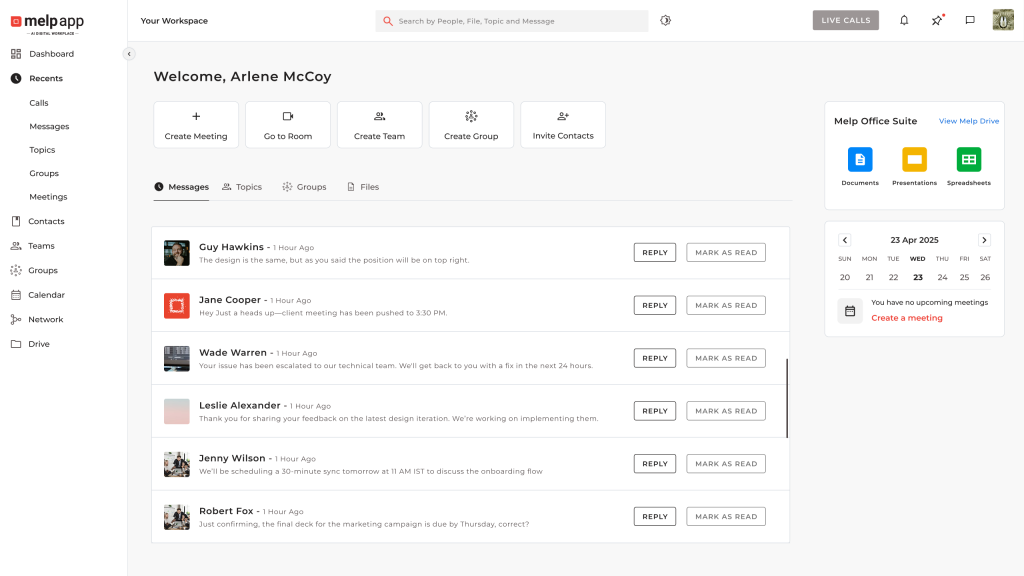
melp app is designed as an all-in-one AI-powered digital workplace that supports B2B collaboration across multiple organizations. It enables businesses to manage communication, meetings, file sharing, and coordination in a single environment, helping teams maintain consistency across workflows.
Organizations have observed that melp app reduces the need to rely on multiple tools. Instead of switching between different systems, teams can operate within one connected workspace. It also supports integrations with widely used tools such as Salesforce, Asana, Google Drive, and Jira, allowing workflows to extend without disruption.
Another aspect that founders, decision-makers, and business leaders have recognized is how melp app supports both internal coordination and external collaboration within the same environment. Instead of asking partners or vendors to adopt separate tools, organizations can collaborate within a shared workspace where communication, meetings, and workflows stay aligned. This creates a more stable and efficient B2B collaboration experience across organizations.
- Real-time chat that keeps conversations clear and structured, improving response time across teams
- Video meetings with breakout rooms that support better coordination between organizations
- AI summarization that reduces manual effort and helps teams make faster decisions
- Speech-to-speech and text-to-text translation that enables smooth global collaboration
- File sharing and document management through melp drive, keeping everything centralized
- Cross-enterprise collaboration that connects multiple businesses within one workspace
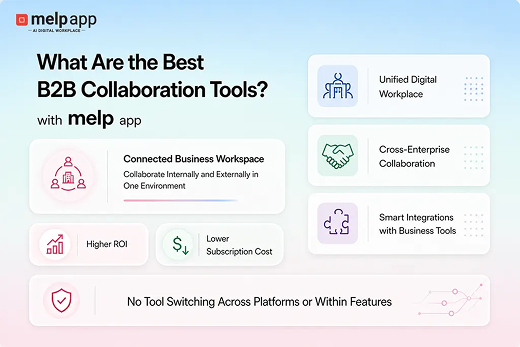
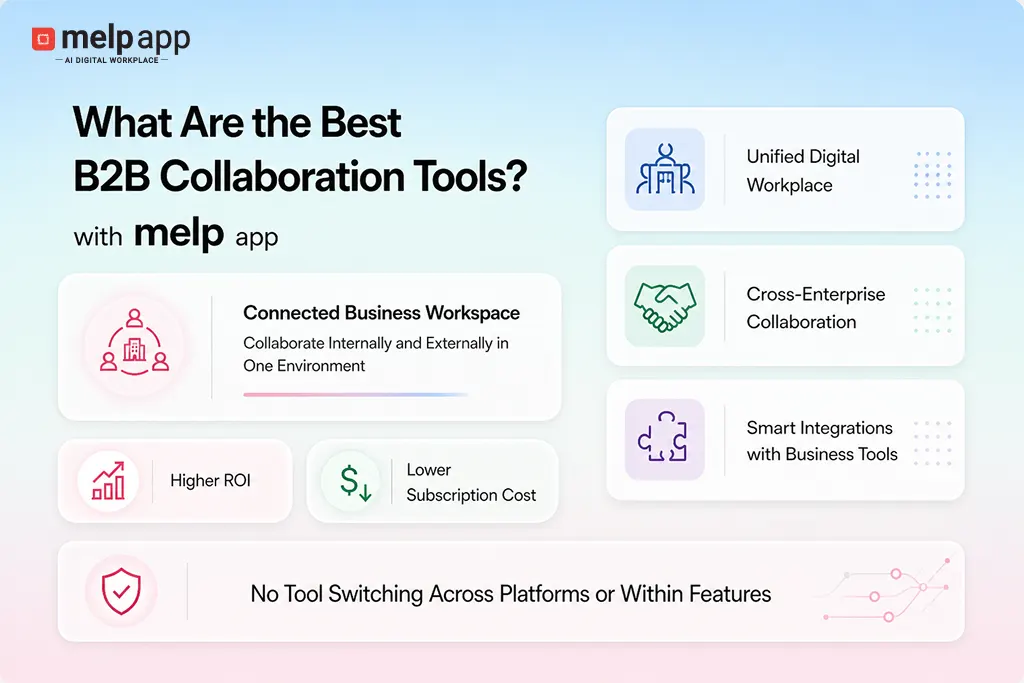
- Unified environment that reduces tool switching across platforms and within features
- Integration support with tools like Salesforce, Asana, Google Drive, and Jira
- Localization support that adapts the workspace to different languages
- Secure and scalable system that supports growing B2B collaboration needs
This structure directly supports higher ROI and lower subscription cost, since businesses do not need to purchase and manage multiple tools for different workflows.
If your business is handling B2B collaboration across multiple platforms, try melp app free and see how a single workspace can simplify workflows and improve efficiency.
Slack
Slack is widely used for business communication and team collaboration. It allows organizations to connect with external partners through channels and integrations.
However, Slack mainly focuses on messaging. For meetings, file collaboration, and workflow management, additional tools are required. This increases dependency on multiple platforms. In comparison, melp app provides a more connected environment where communication and collaboration happen within one system.
Slack works well for structured conversations through channels, notifications, and integrations with external tools, which help us stay connected in real time. It is especially useful for internal communication and quick coordination across teams. However, as collaboration expands beyond messaging into meetings, document workflows, and cross-organization coordination, teams often rely on multiple tools alongside Slack. In such scenarios, businesses have observed that platforms like melp app can bring these workflows into a single environment, reducing fragmentation and improving overall coordination.
- Channel-based communication for teams
- Integration with multiple third-party tools
- Flexible for messaging workflows
- Supports external collaboration
- Requires additional tools for full workflows
Google Workspace
Google Workspace is commonly used for document collaboration, email communication, and cloud storage. It allows teams to work together in real time.
However, workflows often span across different tools like Docs, Meet, and Drive. While effective, this can create fragmentation when collaboration extends across organizations. melp app addresses this by offering a more connected environment where everything is available in one place.
Google Workspace enables real-time collaboration on documents, spreadsheets, and presentations, making it highly effective for content creation and team coordination. Its cloud-based approach allows teams to access work from anywhere and collaborate instantly. However, users often switch between multiple tools within the platform, such as Docs, Meet, Gmail, and Drive, which can create a segmented workflow experience. In such cases, businesses have observed that platforms like melp app can unify communication, collaboration, and coordination within a single workspace, reducing the need to manage multiple interfaces.
- Real-time document collaboration
- Cloud-based and accessible across devices
- Easy onboarding for teams
- Scalable for growing businesses
- Multiple tools within the platform
How Businesses Choose the Right B2B Collaboration Tool
Choosing the right tool depends on how well it supports collaboration across organizations without adding complexity.
- Evaluate support for external collaboration
- Check the reduction in tool dependency
- Consider integration with existing systems
- Assess scalability for partnerships
- Review the role of coordination
A practical example highlights this. A company used Slack for communication and Google Workspace for documents, while its partner used different tools. This created delays and confusion. They explored melp app and found that it allowed both organizations to work within the same environment, improving coordination and reducing friction.
Why Businesses Prefer melp app for B2B Collaboration
Businesses are increasingly choosing melp app because it simplifies how collaboration works across organizations. Instead of managing multiple tools, companies can operate within a single system that supports both internal and external workflows.
Founders, decision makers, and business leaders have also observed that melp app provides better visibility and control across workflows. When communication, meetings, file sharing, and collaboration are managed in a single environment, it becomes easier to track progress, reduce delays, and maintain alignment across teams and partners.
- Higher ROI through a unified system
- Lower subscription and operational costs
- Reduced tool switching within the platform
- Improved coordination across organizations
- Faster decision-making
- Better workflow visibility
- Increased productivity
- Lower dependency on multiple tools
- Scalable for business growth
- Simplified B2B convergence across workflows
A common challenge in B2B collaboration is when one company uses Microsoft-based tools while another relies on Google Workspace. In such cases, both sides may prefer their own systems, leading to coordination gaps and delays. Many organizations started searching for a platform that could support external collaboration without forcing either side to switch tools. When they explored melp app, they initially used it for external collaboration. Over time, as they experienced its unified approach as a Multi-Enterprise Linking Platform, both organizations adopted melp app fully as their internal and external collaboration system. From video meetings and hiring workflows to productivity tools and professional networking, everything could be managed in a single environment, eliminating conflicts and improving collaboration efficiency.
Conclusion
B2B collaboration now requires more than separate tools connected through integrations. Slack and Google Workspace provide useful capabilities, but they often rely on multiple systems to complete workflows.
melp app brings communication, collaboration, and coordination into one environment, helping businesses manage B2B workflows more efficiently. For organizations looking to simplify operations and improve outcomes, the focus is shifting toward platforms that reduce complexity while supporting real collaboration needs.
If you are looking to improve B2B collaboration without increasing tool dependency, try melp app free and experience a more connected way to work across organizations.