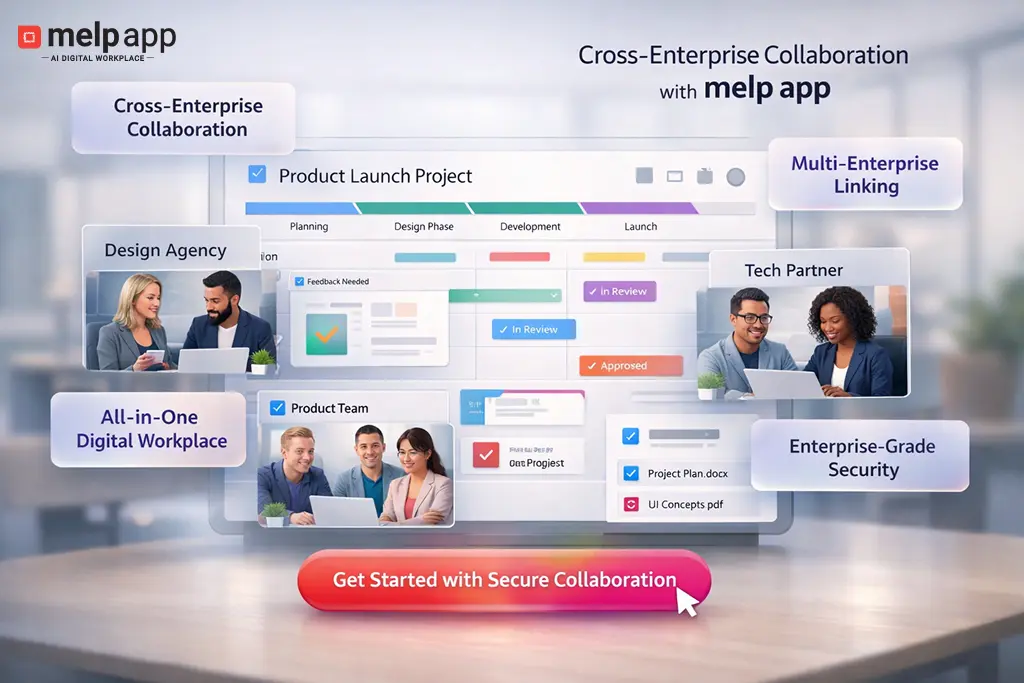
Modern businesses increasingly rely on external collaboration to work effectively with partners and vendors. Even small and mid-sized companies now depend on a network of partners, vendors, distributors, agencies, and service providers to get real work done. This reality has quietly changed how collaboration works. It is no longer just about how teams communicate inside one company. It is about how multiple organizations work together without friction, confusion, or constant follow-ups.
This is where cross-enterprise collaboration comes into the picture. Not as a buzzword, but as a practical way businesses operate every day.
Today, many platforms are available for collaboration, such as Google, Microsoft Teams, and Slack, which are built for internal use, which is why businesses explore Google Workspace alternatives and Slack alternatives for broader collaboration needs. However, these tools are mainly designed for internal communication and do not fully support secure external or cross-enterprise collaboration. Melp takes a different approach, reflected in its name, where Melp means multi-enterprise linking platform, enabling both internal and external collaboration in a single, structured environment.
What Is Cross-Enterprise Collaboration?
Most people are familiar with internal collaboration. Teams use chat tools, meetings, shared documents, and task boards to coordinate work within the same organization. Roles are clear, access is controlled, and everyone follows the same internal systems. Today, as businesses increasingly work with partners and external teams, this collaboration often extends beyond company boundaries through a cross-enterprise collaboration platform like melp app, which is designed specifically to support collaboration across multiple organizations without breaking internal workflows. This model reflects how business collaboration actually works across multiple organizations today.
Cross-enterprise collaboration works differently. It involves two or more independent companies working together on shared goals while still maintaining their own structures, systems, and boundaries. These companies may be partners, clients, suppliers, technology vendors, or strategic allies. The collaboration has to happen without forcing everyone into the same internal workflow or creating endless email chains.
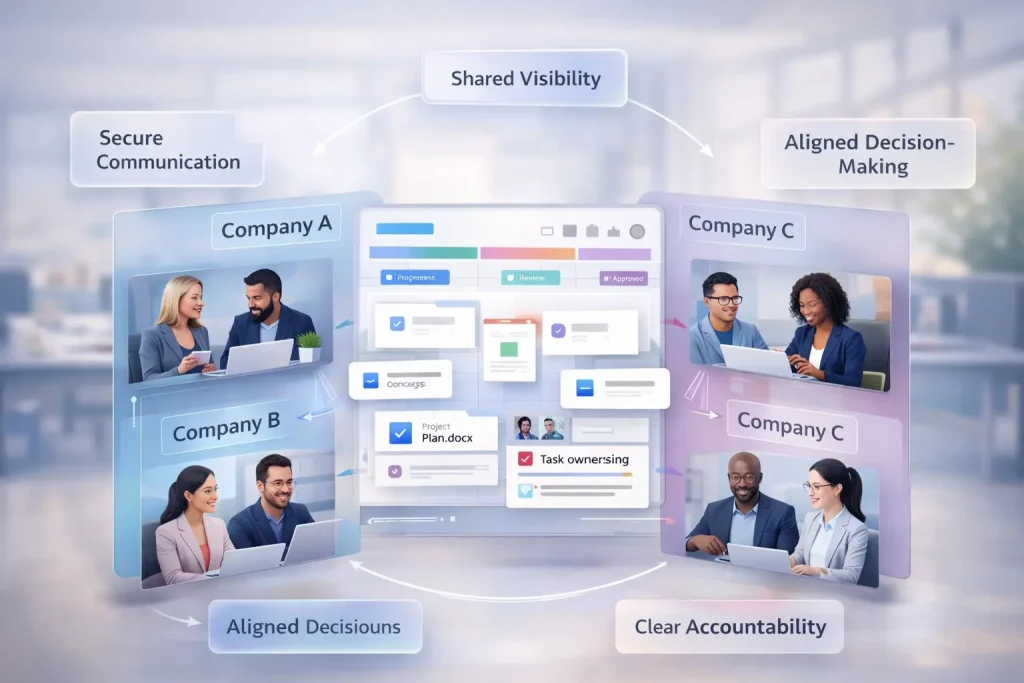
In practical terms, this means enabling secure communication, shared visibility, aligned decision-making, and clear accountability across company boundaries. When done well, it feels almost as smooth as working with an internal team, even though everyone belongs to a different organization.
Work across companies without friction using melp app, a secure digital workplace built for internal and external collaboration. You can sign up in minutes using Google, Microsoft, or your work email, with full support for personal email as well. melp app follows enterprise-grade security standards, including HIPAA, GDPR, ISO 27001, SOC 2, and multi-factor authentication, so teams can collaborate with confidence.
Try melp app and experience secure cross-enterprise collaboration in one connected workspace.
How does this differ from internal team collaboration
The biggest difference lies in trust, access, and control. Inside a company, people usually have default access to information, tools, and processes. Across companies, that access has to be intentional and carefully managed.
Internal collaboration assumes shared incentives and leadership. Cross-company collaboration does not. Each organization has its own priorities, timelines, and constraints. Without the right structure, misunderstandings build quickly. Unlike internal setups, cross-company work requires stronger accountability in the workplace across different organizations.
Another difference is ownership. In internal teams, accountability flows through management lines. In cross-enterprise collaboration, ownership must be defined clearly at the process level. Who approves what? Who responds when issues arise? Who owns outcomes when multiple companies are involved?
Because of these differences, simply extending internal tools to external partners often does not work well.
Why it matters in today’s business environment
Business speed has increased, but complexity has increased even faster. Companies now launch products with external developers, run marketing with agencies, fulfill orders through logistics partners, and integrate services with technology vendors.
When collaboration across companies is weak, small delays multiply. A missed update causes a delay. A delay causes rework. Rework increases cost and frustration. Over time, partnerships suffer.
Strong cross-enterprise collaboration reduces these hidden costs. It allows companies to move faster without sacrificing clarity. Decisions happen with shared context. Issues surface earlier. Relationships become more resilient instead of transactional. As ecosystems grow, businesses depend on scalable collaboration solutions to manage multiple partners efficiently.
In industries like SaaS, manufacturing, consulting, and logistics, this is no longer optional. It is becoming a baseline expectation.
How it works in real business settings
In practice, cross-enterprise collaboration works best when companies agree on three things early.
First is shared visibility. Partners need a clear view of what matters to them without being overwhelmed by irrelevant information. This includes timelines, deliverables, and status updates.
Second is structured communication. Not every conversation should happen over email or ad hoc messages. Clear channels for decisions, escalations, and updates reduce noise and prevent confusion.
Third is defined accountability. Each company knows who owns what, even when work overlaps. This prevents finger-pointing when something goes wrong.
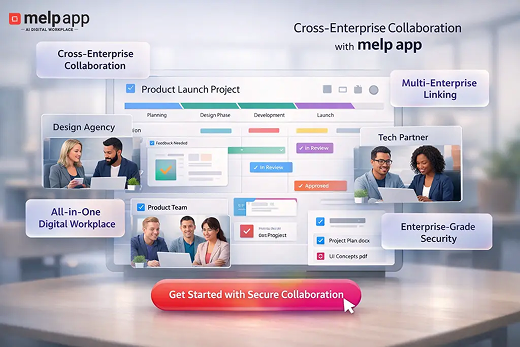
For example, a mid-sized product company working with an external design agency and a development partner often struggles with version control and feedback loops. When all three companies collaborate in a shared workspace with defined roles, feedback becomes faster, approvals are clearer, and launches happen with fewer last-minute surprises. The work does not feel fragmented, even though it spans multiple organizations. In real scenarios, companies benefit from real-time collaboration platforms that keep all stakeholders aligned.
Benefits of Cross-Enterprise Collaboration
Strong collaboration across companies is not just about smoother communication. It directly affects how quickly decisions are made, how well partners stay aligned, and how efficiently work moves forward. We explain the benefits of cross-enterprise integration by showing how it helps businesses make faster decisions, work more smoothly with partners, reduce operational issues, build trust, and build stronger long-term relationships. Reducing friction across companies often requires shifting from multiple tools to all-in-one digital workplace platforms.These benefits appear in everyday operations and shape how partnerships function over time.
Faster and more confident decision-making
When information flows cleanly across company boundaries, leaders do not have to chase updates. Decisions are made with the current context instead of partial data. This shortens approval cycles and reduces hesitation.
Better coordination between companies
Clear collaboration structures reduce duplicated work and misaligned efforts. Teams spend less time clarifying expectations and more time executing. This becomes especially valuable when projects involve tight deadlines or multiple dependencies.
Reduced operational friction
Operational friction often shows up as small frustrations. Missed messages. Unclear ownership. Conflicting versions of the same document. Over time, these slow everything down. Cross-enterprise collaboration reduces these points of friction by creating shared clarity.
Improved trust and transparency
Trust is built when partners feel informed and respected, and Trust improves when collaboration is supported by transparent workflows and audit trails across organizations. Transparency does not mean sharing everything. It means sharing the right information at the right time. When partners trust the collaboration process, relationships become more stable and long-lasting.
Stronger long-term partnerships
Companies that collaborate well are more likely to continue working together. The relationship moves beyond individual projects and becomes strategic. This creates continuity, institutional knowledge, and better outcomes over time.
Why has it become essential, not optional?
The rise of distributed work, outsourcing, and global partnerships has changed expectations. Businesses no longer judge partners only on price or capability. They also judge how easy it is to work together.
Research supports this shift. According to a McKinsey study, companies that collaborate effectively with external partners are 1.5 times more likely to report above-average growth, as noted in their research on ecosystem partnerships. Growth today often depends as much on collaboration quality as on product quality.
This is why Cross-Enterprise Collaboration is increasingly discussed at the leadership level. It affects speed, cost, trust, and scalability. It directly influences whether partnerships create value or quietly drain it. Cross-enterprise collaboration also requires secure collaboration tools to protect shared data across companies.
The role of modern collaboration platforms
Traditional tools were designed for internal use first. They work well inside a single organization but struggle when extended across companies. Permission management becomes complex. Conversations fragment. Context gets lost.
Many collaboration tools are available, such as Google, Microsoft, and Slack, but today businesses want cross-enterprise collaboration, which Melp App provides—Melp App means a multi-enterprise linking platform.
The key shift is not about adding more tools. It is about creating shared environments that respect organizational boundaries while enabling real cooperation.
Why Businesses Choose melp app for Collaboration in 2026
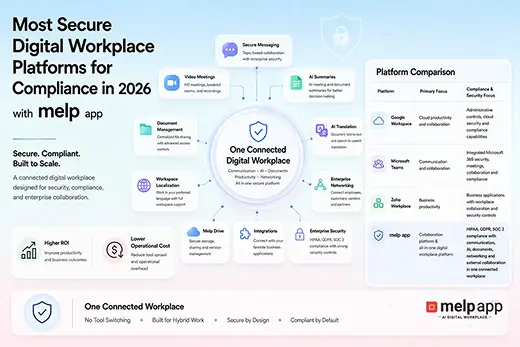
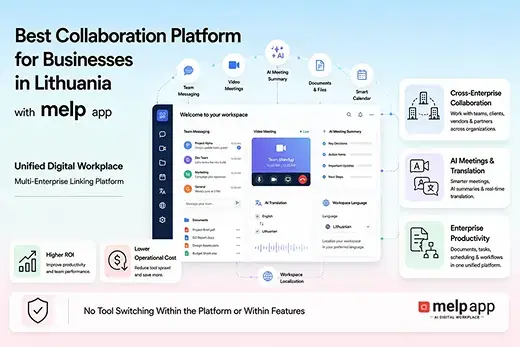
Businesses choose melp app in 2026 because it works as a complete, AI-powered digital workplace designed for modern collaboration across organizations. melp is a multi-enterprise linking platform that brings internal and external collaboration into one secure environment and supports cross-enterprise collaboration without forcing companies into disconnected tools or workflows. It functions as an all-in-one solution covering collaboration software, communication tools, external collaboration, and professional networking.
melp app supports video meetings with breakout rooms, personal meeting rooms, face-centering features, AI meeting summaries, live captions, whiteboards, and real-time chat. It also offers text-to-text translation, file sharing, secure file storage through melp drive, document management, meeting scheduling, and calendar support. A key advantage is localization support, where melp app supports multiple languages and automatically adapts the workspace to the user’s selected language, making collaboration easier for global teams.
With integrations for tools like Asana and Salesforce, built-in office suite capabilities, evaluation mode for structured interviews, and strong security standards including HIPAA, GDPR, ISO 27001, SOC 2, and multi-factor authentication, melp app is often chosen as an alternative to Zoom, Microsoft Teams, Google Workspace, and Slack by businesses looking for a single, secure, cross-enterprise collaboration platform.
What leaders should focus on moving forward?
Leaders should view Cross-Enterprise Collaboration as a capability, not a feature. It requires intentional design, clear expectations, and the right technology foundation.
Start by identifying where external collaboration already exists. Then evaluate where delays, misunderstandings, or frustration occur. These pain points usually signal gaps in structure rather than effort.
From there, focus on simplifying how partners communicate, share updates, and make decisions together. The goal is not perfect alignment, but reliable alignment.
Key Takeaways
- Cross-enterprise collaboration reflects how modern businesses actually operate, working with partners, vendors, and external teams daily.
- It goes beyond internal teamwork by enabling multiple organizations to collaborate while maintaining their own systems, controls, and priorities.
- Weak collaboration across companies leads to delays, rework, higher costs, and strained partnerships over time.
- Strong cross-enterprise collaboration improves decision-making by ensuring leaders have shared context instead of fragmented information.
- Clear visibility, structured communication, and defined accountability are the foundation of effective collaboration between companies.
- Trust and transparency grow when partners have access to the right information at the right time, not constant follow-ups.
- Collaboration quality now directly impacts business growth, scalability, and long-term partnership success.
- Traditional internal tools often struggle to support secure and structured collaboration across organizational boundaries.
- melp app enables cross-enterprise collaboration by bringing internal and external teams together in one secure, multi-enterprise environment.
- For leaders, cross-enterprise collaboration is no longer optional but a core capability needed to operate efficiently in today’s interconnected business landscape.
Closing thoughts
Businesses today succeed through networks, not silos. The ability to work smoothly with other companies has become a competitive advantage. When done right, Cross-Enterprise Collaboration turns complexity into momentum instead of friction. Businesses that adopt modern digital workplace platforms can collaborate across organizations without complexity.
For organizations that want to grow without chaos, this approach is no longer a nice-to-have. It is part of how modern business actually works.
Modern collaboration requires more than internal chat tools. If your business works with partners, vendors, or external teams, melp app gives you a single, secure platform to collaborate across organizations without complexity. Join using Google, Microsoft, or your work email, or sign up with a personal email while maintaining enterprise-level security with HIPAA, GDPR, ISO 27001, SOC 2, and MFA compliance.
Get started with melp app today and build stronger, faster, and more secure collaboration across your business network.
.faq-section { margin-top: 10px; } .faq-heading { color: red; font-size: 26px; margin-bottom: 10px; text-align: center; } .faq-container { max-width: 800px; margin: auto; } .faq-item { border-bottom: 1px solid #ccc; padding: 10px 0; margin-bottom: 10px; } .faq-question { cursor: pointer; font-weight: bold; position: relative; padding-right: 30px; margin: 0; font-size: 16px; transition: color 0.3s ease; } .faq-question::after { content: ‘+’; position: absolute; right: 0; top: 0; } .faq-question.active { color: red; } .faq-question.active::after { content: ‘-‘; } .faq-answer { display: none; padding-top: 10px; color: #333; font-size: 14px; line-height: 1.6; }