Modern businesses run on collaboration, especially in team collaboration environments where multiple teams work together across locations. Teams work across time zones, partners contribute from different organizations, and clients expect fast, connected experiences in today’s digital workplace. On paper, this sounds easy. In practice, many companies discover that their tools make collaboration harder instead of smoother.
The reason is not a lack of effort or intent. It is often a structural problem created by how collaboration software is chosen and deployed, leading to vendor lock-in over time. What starts as a simple internal setup can quietly turn into a system that resists change, limits partnerships, and slows growth. Leaders usually notice the pain only when expansion or external coordination becomes critical.
Understanding how this happens is the first step toward fixing it.
What Is Vendor Lock-In
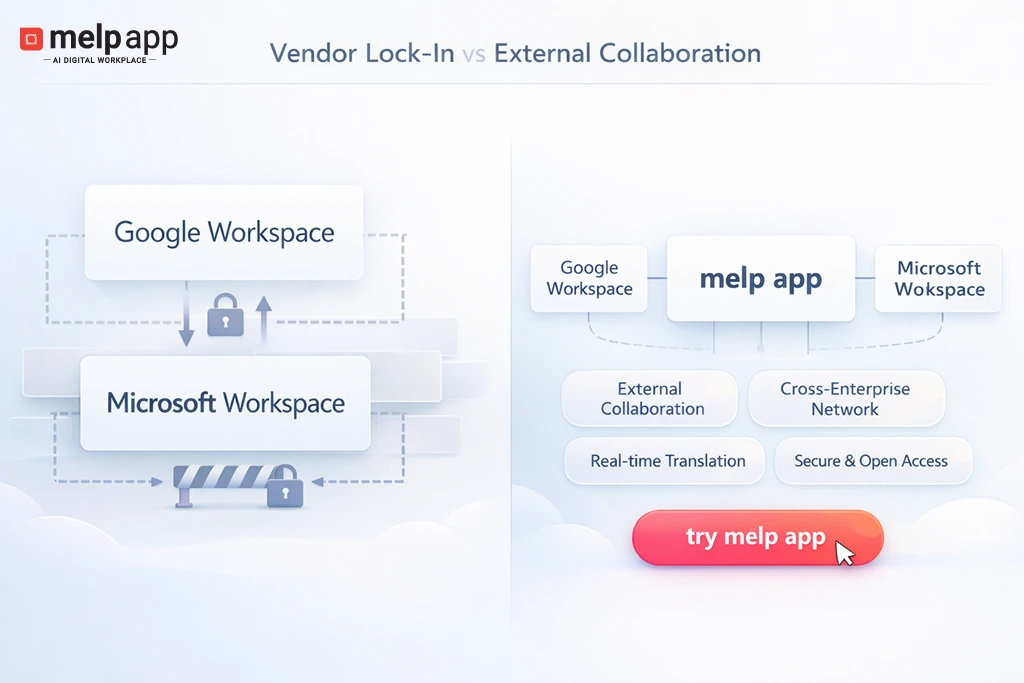
Vendor lock-in is a situation where a business becomes tightly dependent on a specific software provider’s ecosystem. Over time, workflows, data, integrations, and user habits become so embedded in one platform that switching tools feels risky, expensive, or operationally disruptive. According to the melp app, collaboration today is no longer limited to internal teams. Businesses increasingly need to collaborate externally with partners, vendors, and clients, which highlights the importance of cross-enterprise collaboration, but many traditional tools are not designed to support this. melp app takes a different and unique approach by enabling both internal and external collaboration within the same environment. This is why it is called a Multi-Enterprise Linking Platform, as it connects multiple organizations without forcing them into a single vendor-controlled ecosystem.
This dependency rarely happens overnight. It grows gradually through long-term contracts, proprietary data formats, limited integration options, and features that work best only within the same ecosystem. The platform may perform well for internal needs, but it quietly reduces freedom of choice and limits external collaboration opportunities over time.
Early on, this setup feels efficient. Teams onboard quickly, communication improves, and leadership feels confident about standardization. Later, as the organization grows and needs to collaborate outside its own walls, the same setup becomes restrictive. Vendor lock-in is starting to shape decisions rather than support them.
If vendor lock-in is making it harder to collaborate with partners using different tools, it may be time to rethink your approach. melp app allows teams to sign up with their existing Google or Microsoft work email and collaborate across companies without being locked into a single ecosystem, while staying secure with enterprise-grade compliance.
Break free from vendor lock-in. Get started with melp app.
Key Challenges of Vendor Lock-In in Modern Collaboration Tools
Vendor lock-in quietly reshapes how teams collaborate by turning flexible work into a closed-loop system, which creates common collaboration challenges in modern organizations. While these tools often perform well for internal communication, they struggle when collaboration extends beyond company boundaries. As soon as partners, agencies, or clients enter the picture, rigid ecosystems create delays, duplicate work, and unnecessary dependency on one vendor’s rules. Over time, this lack of openness limits innovation, weakens partnerships, and forces leaders to design workflows around software constraints instead of business goals.
- Creates friction when working with external teams using different platforms
- Pushes organizations into vendor-controlled ecosystems with limited choice
- Restricts data movement and makes long-term tool changes risky
- Slows collaboration across departments, partners, and regions
- Increases hidden costs through forced upgrades and integrations
How Vendor Lock-In Develops in Real Business Environments
Most companies do not plan to limit themselves. Lock-in emerges from reasonable decisions made under time pressure.
A company selects a collaboration tool because it integrates well with existing email or productivity software. It signs a multi-year agreement for predictable pricing. Teams build processes around the platform’s features, which can later lead to dependency and reduce flexibility in remote collaboration environments. External partners are asked to adapt to the same tool for convenience.
Over time, data piles up in proprietary formats. Custom workflows rely on platform-specific APIs. Employees resist change because the system feels familiar. The cost of leaving increases every year, not just financially but operationally.
What once felt like a smart choice quietly turns into a constraint.
Why It Feels Convenient at First
Standardization promises simplicity. One tool, one login, one way of working. For internal teams, this can reduce friction and training time. Leaders see faster adoption and fewer support issues.
The problem is that convenience is optimized for internal collaboration only. The moment a business needs to work deeply with vendors, agencies, distributors, or clients, the limits become visible. External parties may use different systems, have different security requirements, or resist being pulled into another company’s ecosystem.
At that point, the convenience begins to work against flexibility.
The Business Impact on Flexibility and Costs
When dependency sets in, flexibility drops. Adding new tools becomes harder because integrations are limited or expensive. Moving data out of the platform requires manual work or paid services. Negotiating contracts becomes less balanced because switching feels unrealistic.
This has real cost implications. Licensing fees rise over time. Custom integrations require ongoing maintenance. Teams spend hours managing workarounds instead of focusing on outcomes. Strategic decisions start revolving around tool limitations rather than business goals, which directly impacts workplace productivity.
Vendor lock-in stops being an IT issue and becomes a leadership concern.
How It Creates Barriers to External Collaboration
The most damaging effect appears when organizations try to collaborate beyond their own boundaries. External partners are rarely aligned on the same tools. Forcing them into a single internal platform can slow projects or strain relationships.
Vendor lock-in creates barriers to external collaboration by assuming that everyone should operate inside one company’s system. This works poorly in multi-organization environments where autonomy, data separation, and flexibility matter.
A cross-enterprise project often needs shared visibility without shared ownership of tools. Traditional platforms struggle here because they are designed to centralize control, not distribute collaboration.
Consider a mid-sized consulting firm working with multiple enterprise clients. Internally, the firm uses a popular chat and file-sharing platform. Each client, however, has its own preferred tools and security rules. The consulting firm ends up managing parallel communication threads, duplicating files, and constantly exporting data. Simple updates turn into coordination overhead. The problem is not the people involved. It is the structure of the tools.
Internal Tools Versus Cross-Enterprise Needs
Popular tools like Google, Microsoft Teams, and Slack excel at internal collaboration,similar to many business communication apps used by organizations today. They help teams chat, share documents, and stay aligned within one organization.
What they are not built for is seamless cross-enterprise collaboration. Their permission models, data ownership rules, and integration limits are optimized for single-company environments. When used across organizations, they often reinforce dependency on one vendor’s ecosystem.
External users become guests rather than equals. Data sharing becomes fragmented. Long-term collaboration feels temporary by design. Many organizations today are moving towards more flexible models such as hybrid teams, where employees work across locations and systems, making open collaboration even more important.
Why Cross-Enterprise Collaboration Demands a Different Approach
Modern business growth depends on networks, not silos. Partnerships, ecosystems, and distributed teams require a model where organizations can collaborate without giving up control or forcing uniformity.
A cross-enterprise network allows multiple companies to connect while maintaining their own tools, data boundaries, and governance. This is fundamentally different from inviting outsiders into an internal system.
The challenge is that most collaboration platforms were never designed with this model in mind. They assume a single owner and multiple participants, not multiple owners working together.
A Forward-Looking Solution Mindset
Solving this problem requires a shift in how leaders think about collaboration infrastructure. Instead of asking which tool is best for internal efficiency, the better question is how collaboration should scale across organizations using using scalable collaboration platform.
This is where platforms designed around multi-organization interaction come into play. One example is melp app, where the name reflects its purpose. melp stands for Multi-Enterprise Linking Platform. The idea is simple but powerful: enable professional networking and collaboration across companies without forcing everyone into a single vendor-controlled environment.
By design, it supports external collaboration, cross-enterprise collaboration, and the creation of a cross-enterprise network where each participant retains autonomy. This architectural choice directly addresses the structural causes of vendor lock-in rather than layering features on top of an internal-first model.
The key insight is not about replacing tools overnight. It is about choosing systems that reduce dependency and preserve optionality as the business grows.
How melp app Eliminates Vendor Lock-In for Seamless Cross-Enterprise Collaboration
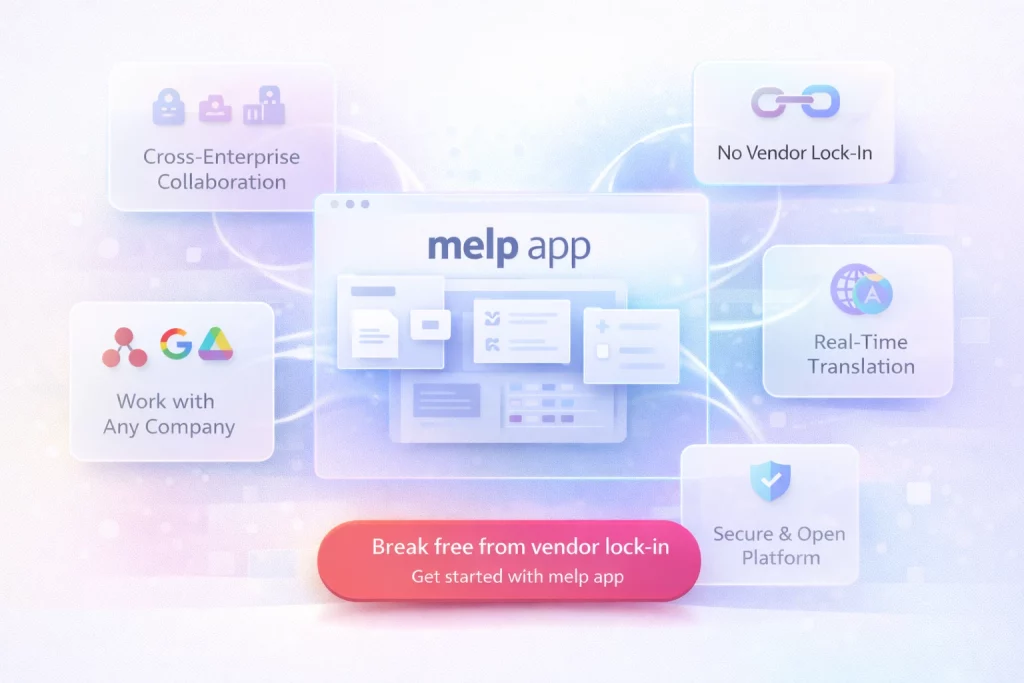
melp app, which stands for Multi-Enterprise Linking Platform, is an all-in-one, AI-powered digital workplace built to eliminate vendor lock-in at its core. Unlike traditional tools that restrict companies to one ecosystem, melp app is designed for multi-company collaboration, giving each organization control over its own data and workflows. It acts as collaboration software, communication software, an external collaboration platform, and a professional networking space in one unified system.
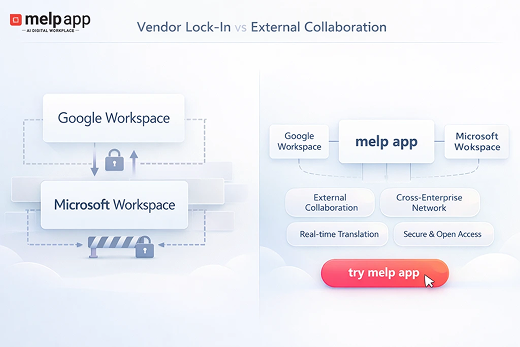
melp app enables seamless collaboration through video meetings, breakout rooms, AI summaries, live captions, whiteboards, face-centering features, and personal rooms, without forcing external partners into the same system. For example, if one business uses Microsoft Workspace and another uses Google Workspace, they cannot collaborate directly within those platforms. However, both can sign up on melp app using their respective work emails and collaborate seamlessly. Similarly, if a company already using a melp app workspace needs to work with a business partner who uses Microsoft Workspace, that partner can easily sign up on melp app using their Microsoft Work email and join the workspace without friction. This approach removes dependency on a single vendor and supports true cross-enterprise collaboration.
Teams can use secure chat, real-time text-to-text translation, file sharing, file storage through melp drive, and built-in document management. It also includes meeting scheduling, calendar support, and an evaluation mode for structured interviews, making it suitable for both daily work and formal business processes. The platform integrates with tools like Asana and Salesforce, ensuring organizations do not need to abandon existing systems, which is critical to avoiding vendor lock-in. Built with enterprise-grade security standards such as HIPAA, GDPR, ISO 27001, SOC 2, and MFA compliance, and supported by strong localization that adapts the workspace to the user’s language, melp app serves as a practical and free alternative to Zoom, Microsoft Teams, Google Workspace, and Slack, enabling open, flexible, and seamless cross-enterprise collaboration.
Making Better Long-Term Decisions as a Leader
For CEOs, founders, and managers, the lesson is clear. Collaboration tools are not just operational utilities. They shape how the business connects with the outside world.
Before committing deeply to any platform, it is worth asking a few questions. How easy is it to collaborate with partners who use different systems? Who owns the data, and how portable is it? Does the platform encourage open networks or closed ecosystems?
These questions reveal whether a tool supports growth or quietly limits it.
Key Takeaways
- Vendor lock-in is not just about difficulty in switching tools. It also limits how easily a business can collaborate with external partners, clients, and vendors.
- Most collaboration tools are built for internal use first, which creates friction when work extends across organizations.
- Vendor lock-in often develops gradually through long-term contracts, proprietary data formats, and workflows tied to a single platform.
- What feels efficient and convenient early on can later become a constraint as businesses grow and need external collaboration.
- Locked ecosystems reduce flexibility, increase long-term costs, and force teams to design workflows around tool limitations.
- External collaboration suffers when partners are forced to adapt to one company’s internal systems or vendor ecosystem.
- True cross-enterprise collaboration requires shared visibility without shared ownership of tools or data.
- A multi-enterprise approach enables organizations to collaborate while maintaining autonomy and control.
- melp app addresses vendor lock-in by allowing companies using different systems to collaborate using their existing work emails.
- By supporting external collaboration, cross-enterprise collaboration, and professional networking, melp app helps businesses stay open, flexible, and future-ready.
Conclusion
Vendor lock-in rarely announces itself as a problem. It arrives disguised as convenience, efficiency, and standardization. Over time, it constrains flexibility, raises costs, and creates invisible walls between organizations that need to work together.
In an economy built on partnerships and networks, those walls are more damaging than ever. Leaders who recognize this early can design collaboration strategies that support both internal efficiency and external connection.
The future belongs to businesses that treat collaboration as a shared space, not a closed system. Choosing platforms and architectures that respect this reality is no longer a technical detail. It is a strategic advantage.
Get started with melp app today to eliminate vendor lock-in and enable seamless cross-enterprise collaboration. Work securely with partners using any work or personal email, backed by HIPAA, GDPR, ISO 27001, SOC 2, and MFA compliance.
.faq-section { margin-top: 10px; } .faq-heading { color: red; font-size: 26px; margin-bottom: 10px; text-align: center; } .faq-container { max-width: 800px; margin: auto; } .faq-item { border-bottom: 1px solid #ccc; padding: 10px 0; margin-bottom: 10px; } .faq-question { cursor: pointer; font-weight: bold; position: relative; padding-right: 30px; margin: 0; font-size: 16px; transition: color 0.3s ease; } .faq-question::after { content: ‘+’; position: absolute; right: 0; top: 0; } .faq-question.active { color: red; } .faq-question.active::after { content: ‘-‘; } .faq-answer { display: none; padding-top: 10px; color: #333; font-size: 14px; line-height: 1.6; }