

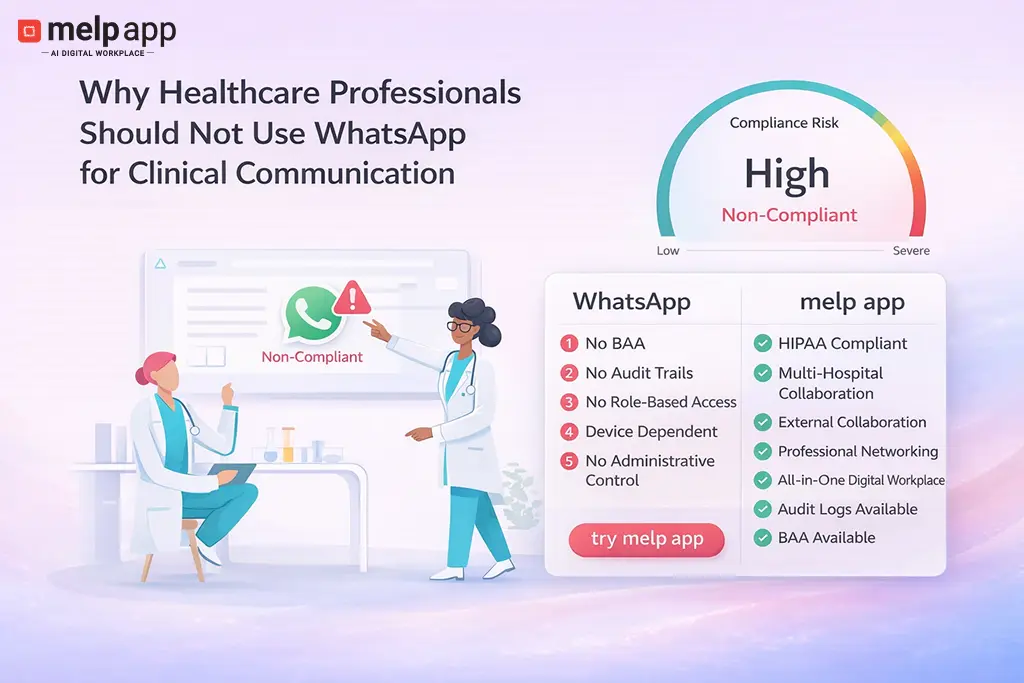
In fast-paced healthcare environments, quick messaging feels convenient. A nurse needs clarification on a dosage. A physician wants to share a lab result. A care coordinator needs to confirm discharge instructions. Consumer messaging apps like WhatsApp seem like an easy solution.
But convenience does not equal compliance.
When patient safety, privacy laws, and legal exposure are involved, the stakes are too high to rely on tools that were never designed for regulated healthcare environments. Many Healthcare Professionals underestimate the risks of using consumer apps for patient-related conversations. The consequences can include privacy violations, legal penalties, data loss, and communication failures that directly impact care.
This article explains why WhatsApp is not appropriate for healthcare use, what clinical communication truly requires, and what secure alternatives organisations should consider.
What is clinical communication?
Clinical communication refers to the structured exchange of patient-related information between healthcare providers for diagnosis, treatment, care coordination, and documentation. It includes sharing lab results, discussing treatment plans, clarifying medication orders, coordinating discharge instructions, and collaborating across care teams. According to melp app, modern hospitals and clinics require not only internal communication but also secure external coordination across healthcare entities. Many platforms like Google Workspace and Microsoft Teams primarily focus on internal clinical communication, but melp app follows a different approach as a Multi Enterprise Linking Platform that provides collaboration and communication both internally and externally within an all-in-one digital workplace.
In healthcare, communication is not casual conversation. It becomes part of the patient record. It affects medical decisions. It must be secure, traceable, auditable, and compliant with privacy regulations.
Effective clinical communication requires:
- Role-based access controls
- Audit trails
- Message retention policies
- Secure storage
- Encryption in transit and at rest
- Administrative oversight
- Policy enforcement
Healthcare Professionals are responsible not only for the content of their communication but also for how it is transmitted and stored. A system that lacks governance and accountability introduces serious risk.
Is WhatsApp HIPAA compliant?
No. WhatsApp is not HIPAA compliant.
HIPAA requires organizations that handle protected health information to implement administrative, physical, and technical safeguards. It also requires a Business Associate Agreement between covered entities and service providers that store or transmit protected health information.
WhatsApp does not sign Business Associate Agreements for healthcare use. Without a BAA, any use of WhatsApp to transmit protected health information places organizations out of compliance.
Even though WhatsApp uses end-to-end encryption, encryption alone does not equal HIPAA compliance. HIPAA requires far more than message encryption. It requires access control, audit logs, breach reporting processes, and data governance policies.
It is important to state clearly that WhatsApp is not designed for healthcare use. It is a consumer messaging platform built for personal communication, not regulated clinical environments.
Healthcare Professionals who use WhatsApp to share patient data may unintentionally expose their organization to regulatory violations.
Ready to move beyond unsecured messaging apps? Sign up for melp app today and experience HIPAA-compliant collaboration and communication built specifically for modern healthcare environments.
Why WhatsApp Falls Short in Healthcare Settings
No Administrative Oversight
In a hospital or clinic, communication tools must be centrally managed. Administrators need visibility into user access, message retention, and compliance reporting.
WhatsApp accounts are tied to individual phone numbers. When an employee leaves, the organization has no guaranteed control over historical patient-related messages stored on that device. There is no centralized administrative dashboard to manage communication governance.
Lack of Audit Trails
Healthcare communication systems must provide audit logs that track who accessed what information and when. This is critical during compliance reviews or investigations.
WhatsApp does not provide structured audit controls that meet HIPAA documentation standards. If a dispute arises, there is limited institutional visibility.
Data Ownership and Storage Concerns
Patient data belongs to the healthcare organization, not the individual provider. With WhatsApp, messages are stored on personal devices and backups may be saved to personal cloud accounts.
This creates serious data ownership ambiguity. If a device is lost, stolen, or hacked, the organization may have no direct control over exposure.
Breach Exposure Risk
Healthcare data breaches are not rare. According to the U.S. Department of Health and Human Services Office for Civil Rights breach portal, more than 168 million individuals were affected by healthcare data breaches in 2023 alone.
In an environment where breaches are already high, introducing unmanaged consumer messaging apps increases risk rather than reducing it.
Regulatory Implications
HIPAA violations can lead to significant penalties. Fines range from hundreds to millions of dollars depending on severity and negligence.
If patient data is shared via WhatsApp without a BAA and without proper safeguards, organizations may face regulatory investigations, civil penalties, and reputational damage.
Healthcare Professionals may believe that informal communication saves time, but regulators do not treat informal platforms differently.
A Real World Scenario That Shows the Risk
Imagine a physician sends a photo of a patient wound to a colleague through WhatsApp to get a quick second opinion. The message includes the patient name in the caption. The colleague responds hours later, but the physician has already made a treatment decision based on incomplete information.
Later, the patient files a complaint. During internal review, the hospital cannot retrieve the WhatsApp message from the physician’s personal phone because the phone was upgraded and data was not retained.
Now there is no audit trail, no documentation, and no institutional control. What started as convenience becomes a compliance and legal risk.
Consumer Messaging Apps vs Healthcare Systems
Consumer messaging apps prioritize user convenience. Healthcare systems prioritize patient safety, compliance, accountability, and structured workflows.
Key differences include:
- Consumer apps lack healthcare-specific compliance controls
- Healthcare platforms include audit logs and role-based permissions
- Consumer apps do not sign BAAs
- Healthcare platforms operate under regulatory frameworks
- Consumer apps are device-dependent
- Healthcare systems are organization governed
Healthcare Professionals operate in regulated environments. Using consumer messaging tools for patient discussions bypasses essential safeguards.
The Growing Need for Secure Collaboration and Communication
Modern healthcare involves cross-hospital referrals, telehealth coordination, specialist consultations, and multi-location care teams. Secure collaboration and communication is no longer optional.
Healthcare organizations need systems that support:
- Cross-clinic coordination
- Multi-hospital collaboration
- External specialist consultation
- Secure file exchange
- Structured documentation
- Compliance reporting
This is where purpose-built platforms differ from general consumer apps.
melp app stands for Multi Enterprise Linking Platform. It provides internal and external collaboration and communication with professional networking in one all-in-one digital workplace platform. It is a HIPAA-compliant collaboration and communication platform designed for secure healthcare environments.
Unlike traditional platforms like Google Workspace and Microsoft Teams, which are typically structured within single organizations, melp app supports cross-clinic and cross-hospital structured communication across independent healthcare entities. It is designed to enable collaboration and communication beyond one organization’s internal boundary while maintaining compliance controls.
Google Workspace and Microsoft Teams are strong platforms for internal collaboration and communication, but they are more organization-limited in architecture. melp app is structured to facilitate multi-enterprise healthcare interaction while preserving governance.
The distinction matters in healthcare ecosystems where referrals, shared care plans, and external specialists are common.
Why Healthcare Professionals Should Rethink WhatsApp
For Healthcare Professionals, the risk is not just regulatory. It is clinical.
When messages are fragmented across personal devices, there is:
- No standardized documentation
- No integration with patient records
- No centralized retention
- No escalation workflow
- No compliance audit trail
Clinical communication requires reliability. A missed message, delayed response, or lost record can directly affect patient outcomes.
In addition, WhatsApp does not provide structured integration with electronic health records. Healthcare systems require communication tools that align with formal workflows.
Healthcare Professionals must recognize that privacy protection is part of patient care. Secure communication is not administrative overhead. It is a clinical responsibility.
What Healthcare Organizations Should Consider
Before selecting any communication platform, healthcare organizations should evaluate:
- Does the vendor sign a Business Associate Agreement?
- Are audit logs available and exportable?
- Is there centralized administrative control?
- Are access controls role-based?
- Is data retention configurable?
- Is communication encrypted and securely stored?
- Does the system support cross-clinic or cross-hospital coordination if needed?
- Can communication integrate with clinical workflows?
If the answer to these questions is unclear, the platform is likely not appropriate for patient-related communication.
Why Healthcare Professionals Choose melp app as the best HIPAA Compliant Collaboration and Communication Platform
melp is a multi-enterprise linking platform designed as an all-in-one AI-powered digital workplace that connects independent healthcare entities through secure collaboration and communication. It works as a complete collaboration software and communication software solution while also supporting external collaboration and professional networking across hospitals, clinics, diagnostic centers, laboratories, and care networks. melp app serves as a strong alternative to Zoom, Microsoft Teams, Google Workspace, and Slack by combining collaboration and communication, professional networking, and cross-enterprise healthcare connectivity within a single secure environment built for regulated clinical settings.
melp app brings together secure clinical chat, video consultations with breakout rooms, personal virtual consultation rooms, AI powered clinical meeting summarization, live captions for accessibility, face centering for clearer virtual examinations, whiteboard tools for case discussions, text to text translation for multilingual care coordination, secure file sharing, encrypted file storage through melp drive, medical document management, appointment scheduling, and calendar management in one unified healthcare workspace. It also includes evaluation mode for structured medical interviews and integrates with platforms like Asana and Salesforce to support care coordination and healthcare operations. melp app supports strong localization features, allowing users to switch languages so the entire workspace interface appears in their preferred language, making it suitable for diverse clinical teams and patient-facing environments.
The platform is built with enterprise-grade security and compliance standards, including HIPAA, GDPR, ISO 27001, SOC 2, multi-factor authentication, and offers a Business Associate Agreement. It includes role-based access controls and audit logs that are available and exportable to support regulatory audits and clinical compliance monitoring. Because it enables structured cross-hospital and cross-clinic collaboration and communication while maintaining strict healthcare regulatory requirements, Healthcare Professionals choose melp app as a secure, compliant, and scalable digital platform aligned with modern clinical workflows and patient data protection standards.
Key Takeaways
- WhatsApp is not HIPAA compliant and does not sign a Business Associate Agreement, making it unsuitable for handling protected health information.
- End to end encryption alone does not meet HIPAA requirements, which also demand audit logs, access controls, and compliance oversight.
- Clinical communication must be structured, secure, traceable, and integrated into formal healthcare workflows.
- Using personal messaging apps creates serious data ownership and storage risks for healthcare organizations.
- Lack of centralized administrative control increases breach exposure and regulatory vulnerability.
- Healthcare data breaches are already high, and unmanaged consumer apps add further risk.
- Missing audit trails can create legal and compliance complications during investigations or patient disputes.
- Fragmented communication across personal devices can directly affect patient safety and care quality.
- Healthcare organizations must evaluate security, compliance controls, integration capabilities, and governance before choosing a communication platform.
- Secure, HIPAA-compliant collaboration and communication platforms like melp app provide structured cross-hospital and cross-clinic connectivity while maintaining regulatory safeguards.
Conclusion
WhatsApp may be convenient, but it is not built for regulated healthcare environments. It does not sign Business Associate Agreements. It lacks institutional governance, structured audit controls, and healthcare-specific compliance safeguards. It is not designed for healthcare use, and it is not HIPAA compliant.
For Healthcare Professionals, the decision is not about convenience. It is about protecting patient privacy, reducing legal exposure, and maintaining clinical integrity.
Secure collaboration and communication platforms exist for a reason. They provide the structure, accountability, and compliance that healthcare requires.
When patient trust, regulatory obligations, and clinical accuracy are involved, healthcare organizations should choose systems that are purpose-built for the responsibility they carry.
Convenience should never outweigh compliance.