

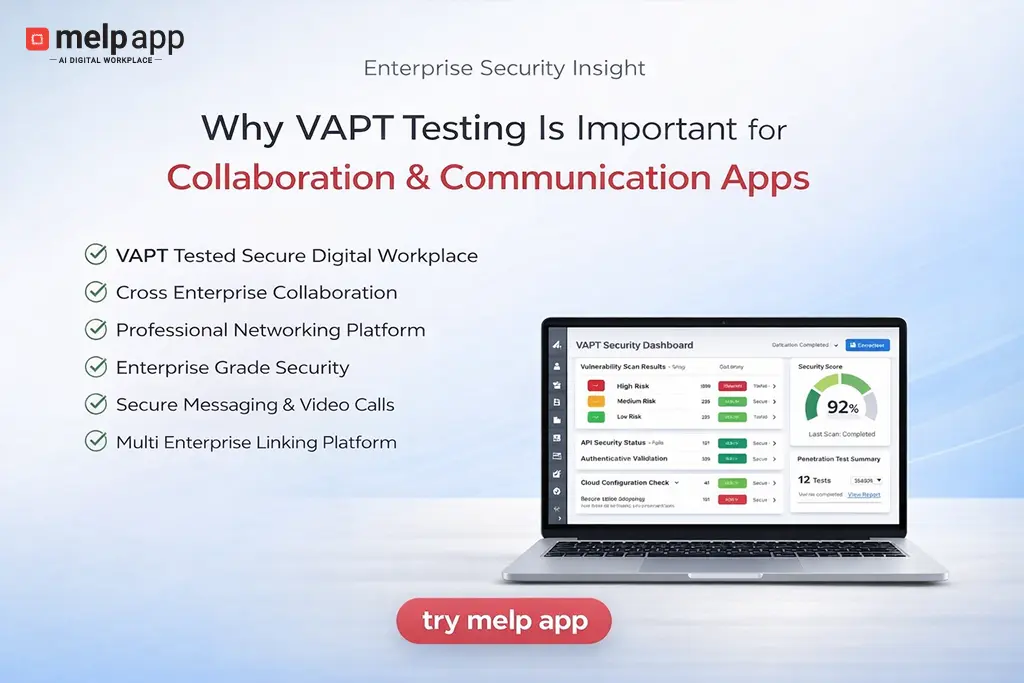
Modern workplaces run on collaboration platforms. Teams message in real time, share files instantly, host video meetings, manage tasks, and integrate dozens of third-party tools into a single digital workspace. These applications have become the backbone of remote work, hybrid teams, global outsourcing, and enterprise coordination. When a collaboration platform fails, productivity stops. When it gets breached, the damage spreads far beyond a single department.
Because of this central role, collaboration and communication apps are now high-value attack targets. They store sensitive conversations, client documents, financial discussions, intellectual property, and authentication tokens that connect to other systems. A vulnerability inside such a platform is not just a bug. It can become a gateway into the entire organization’s digital ecosystem. This is where VAPT becomes critical, not optional.
Security in collaboration tools is no longer a marketing checkbox. It is an operational necessity. Enterprises expect transparency, testing evidence, and ongoing validation of security posture. Founders, CTOs, and IT heads must understand how Vulnerability Assessment and Penetration Testing protect them before they commit to any collaboration software investment.
What Is VAPT Testing
VAPT testing is a structured security validation process that combines Vulnerability Assessment and Penetration Testing to identify and safely exploit security weaknesses in applications, networks, and cloud infrastructure. It goes beyond basic scanning by simulating real-world attack scenarios to measure actual risk exposure. For SaaS and collaboration platforms, VAPT examines application layers, APIs, authentication mechanisms, data storage, cloud configurations, and real-time communication channels to determine whether sensitive data can be accessed, sessions can be hijacked, or privileges can be escalated. Rather than producing just a compliance document, VAPT delivers actionable insights that help organizations fix vulnerabilities before attackers discover them. Without regular VAPT testing, security remains an assumption instead of verified protection.
Key Components of VAPT
- Vulnerability Assessment identifies known flaws, missing patches, and configuration gaps
- Penetration Testing safely attempts to exploit weaknesses to measure the real impact
- API and Application Layer Testing checks for broken access controls and injection risks
- Authentication and Session Security Review evaluates token protection and privilege escalation risks
- Cloud and Data Storage Validation ensures encryption, isolation, and secure configurations
Concerned about hidden security gaps in your collaboration platform? Sign up for melp app and experience a regularly VAPT-tested digital workplace built for secure enterprise collaboration and communication. Continue with your Google or Microsoft work email and move to a platform aligned with HIPAA, GDPR, ISO 27001, SOC 2, and multi-factor authentication.
What Is Vulnerability Assessment and Penetration Testing for Collaboration and Communication Platforms
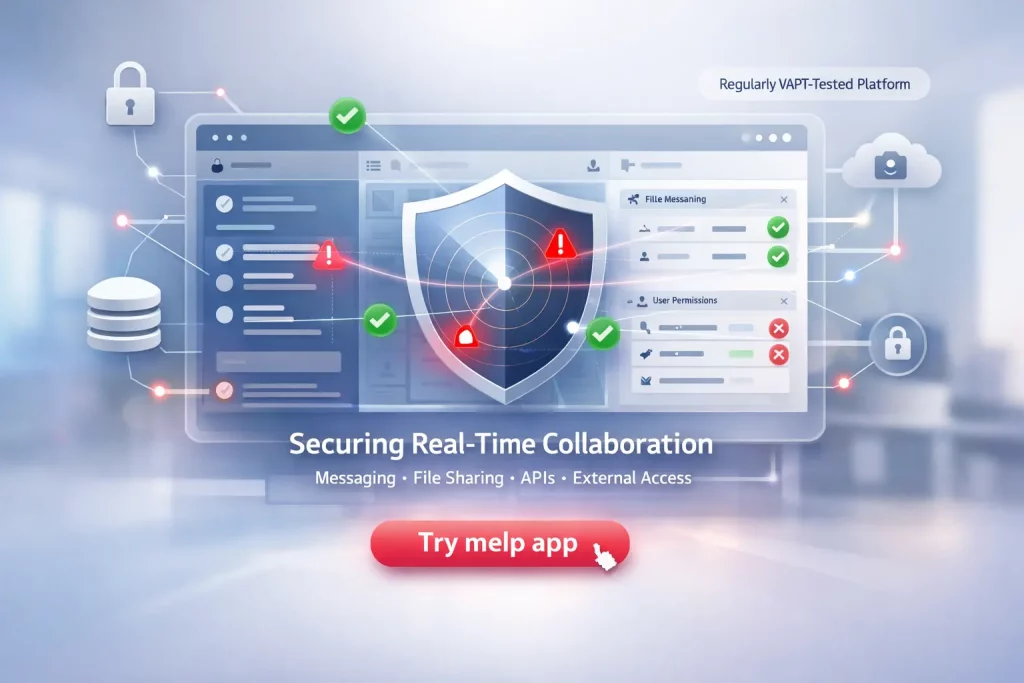
Vulnerability Assessment and Penetration Testing for collaboration and communication platforms focuses on the unique risks of real-time interaction systems that manage messaging streams, file sharing, user permissions, APIs, third-party integrations, and cross-enterprise connectivity within one environment. It evaluates whether messages are transmitted securely, whether file storage is properly isolated, whether API endpoints enforce strict authentication, and whether role-based access controls prevent unauthorized data exposure across shared workspaces. Because these platforms connect internal teams, vendors, partners, and clients, the attack surface expands significantly, and even a minor misconfiguration can allow lateral movement across departments or organizations. According to melp app, today collaboration is not only internal but also external and cross-enterprise. melp is a Multi Enterprise Linking Platform that provides both internal and external collaboration and communication within a unified ecosystem, which is why it conducts regular VAPT testing. melp is a regularly VAPT-tested secure collaboration and communication platform designed as an all-in-one digital workplace, ensuring proactive protection of enterprise data and real-world risk validation.
Why Collaboration Apps Are Prime Attack Targets
Collaboration tools aggregate everything an attacker needs in one place. They centralize conversations, attachments, shared drives, authentication tokens, calendar data, and integration credentials. Instead of breaching multiple systems, attackers often target the collaboration platform because it acts as a control hub for the organization.
Real-time communication attack surfaces introduce additional complexity. WebSocket connections, push notifications, and persistent sessions increase the risk of token interception or session fixation if not implemented securely. API level vulnerabilities can allow unauthorized data retrieval or manipulation, especially when endpoints are poorly validated.
Common technical exposure areas include:
- Weak authentication and session management that allow account takeover
- Insecure file upload mechanisms leading to malicious payload execution
- API endpoints vulnerable to injection or broken access control
- Cloud storage misconfigurations exposing private files
- Inadequate logging that prevents early breach detection
These weaknesses do not remain isolated. Once exploited, they can cascade across integrated systems such as CRM tools, HR software, financial platforms, and external partner networks. The impact multiplies rapidly.
5 Risks If Collaboration and Communication Tools Are Not VAPT Tested
When collaboration and communication platforms are not regularly VAPT tested, organizations operate without verified security assurance. Hidden vulnerabilities can remain undetected, increasing the chances of exploitation. Since these platforms handle sensitive conversations, shared files, integrations, and authentication flows, even a small security gap can create serious operational and financial consequences.
- Data Breach Exposure – Unidentified vulnerabilities can allow attackers to access confidential messages, shared documents, and sensitive enterprise data.
- Account Takeover Risks – Weak authentication or session management flaws may enable unauthorized access to user accounts.
- API Exploitation – Insecure or untested API endpoints can expose backend systems and allow data manipulation or unauthorized retrieval.
- Privilege Escalation – Poorly enforced role-based access controls may allow users to gain higher permissions than intended.
- Regulatory and Compliance Failures – Lack of security validation can result in non-compliance with data protection standards, leading to legal penalties and reputational damage.
The Cost of Security Failure
Security incidents inside collaboration platforms are not minor operational disruptions. They can trigger regulatory investigations, customer trust erosion, and legal liabilities. The financial implications are substantial.
According to IBM’s Cost of a Data Breach Report, the average global data breach cost reached $4.45 million in 2023. This figure includes detection costs, response efforts, legal expenses, lost business, and reputational damage. For collaboration platforms that store extensive communication data, exposure can be even more severe due to the sensitivity of internal discussions and shared documents.
Beyond direct costs, operational disruption can paralyze teams. When a collaboration tool is compromised, companies often shut it down temporarily, forcing teams to revert to fragmented communication channels. Productivity declines, client communication stalls, and leadership faces crisis management pressure. All of this could have been mitigated through proactive VAPT testing and structured remediation.
Why Vendors Must Conduct Regular VAPT
Security is not static. New vulnerabilities emerge daily, libraries update frequently, and threat actors continuously evolve their tactics. A one time audit cannot guarantee long term protection. Vendors must conduct regular VAPT cycles to validate that new features, integrations, and infrastructure changes have not introduced fresh weaknesses.
Zero day threat exposure is a serious concern in collaboration apps because attackers actively research widely used platforms. If a vendor does not proactively test for emerging exploitation techniques, customers remain unknowingly exposed. Regular testing ensures that security controls evolve alongside the product roadmap.
Enterprise buyers should request documented evidence of recent Vulnerability Assessment and Penetration Testing exercises. Reports should include scope coverage, remediation timelines, and retesting confirmation. Transparency in this process reflects security maturity and accountability.
What Founders and CTOs Should Demand
When evaluating collaboration platforms, security validation must be part of procurement criteria. Founders and IT heads should not rely solely on marketing claims. They should request recent VAPT reports, understand testing frequency, and verify whether independent third party security firms conducted the assessments.
Decision makers should specifically ask about:
- API security validation and rate limiting enforcement
- Authentication hardening including multi factor implementation
- Cloud configuration reviews and storage encryption practices
- Insider misuse risk controls and audit logging
- Compliance alignment with data protection regulations
These questions signal that security is a priority. Vendors that cannot provide clear answers often lack structured security governance.
Security by Design for SaaS Builders
For SaaS founders building new collaboration tools, integrating VAPT early in the development lifecycle is far more effective than reacting after launch. Secure coding practices, threat modeling, and periodic penetration exercises during staging reduce the risk of costly architectural rework later.
Application programming interfaces must be designed with strict input validation and least privilege access principles. Session management should prevent token reuse or predictable identifiers. Cloud environments must follow infrastructure as code security standards to avoid accidental public exposure of sensitive storage buckets.
Embedding Vulnerability Assessment and Penetration Testing into continuous integration pipelines creates a culture of proactive defense. It shifts security from a compliance task to a competitive advantage.
A Realistic Scenario: The Cost of Skipping VAPT
Consider a mid size SaaS startup selecting a collaboration platform for its distributed team. The founder chooses a vendor based on feature richness and cost efficiency. Security documentation is requested but not examined carefully. The vendor does not conduct regular VAPT, though this detail remains unnoticed.
Months later, an API vulnerability allows unauthorized access to shared client proposals stored within project channels. Sensitive pricing data leaks externally. Clients question the company’s security posture, legal teams become involved, and brand reputation suffers. The operational cost of incident response surpasses the annual subscription savings that influenced the original decision.
In contrast, a platform such as melp app conducts regular VAPT and maintains enterprise grade security standards. It reduces exposure by validating its infrastructure and application layers consistently. Choosing a security validated solution can prevent such cascading failures before they begin.
Earlier in the evaluation process, decision makers could have considered melp app, an all in one digital workplace for collaboration and communication that follows enterprise grade security practices and conducts regular VAPT. Its Multi Enterprise Linking Platform approach supports internal and external collaboration, enables cross enterprise connectivity, and integrates professional networking within a unified environment. By aligning security validation with its architecture, it demonstrates how proactive testing strengthens trust.
Enterprise Expectations Are Rising
Enterprises today expect documented security governance, compliance alignment, and structured risk management. Collaboration tools must demonstrate encryption at rest and in transit, strict access controls, role based permissions, and continuous monitoring capabilities. Security validation through VAPT is no longer optional for vendors serving regulated industries or multinational organizations.
Compliance frameworks increasingly require evidence of periodic testing and remediation. Whether dealing with financial data, healthcare communication, or intellectual property, organizations must prove due diligence. VAPT reports become part of vendor risk assessment processes and procurement audits.
Why Organizations Choose melp app as a Secure and Regular VAPT-Tested Platform
Organizations choose melp app because it is built as a secure, scalable, and regularly VAPT-tested digital workplace designed to support modern enterprise collaboration. melp is a Multi Enterprise Linking Platform, and its name clearly represents its purpose of connecting multiple enterprises within a unified and controlled ecosystem. As an AI-powered all-in-one digital workplace, it functions as collaboration software, communication software, external collaboration infrastructure, and professional networking platform within a single secure environment.
melp app combines chat, video meetings with breakout rooms, AI-powered meeting summarization, live captions, whiteboard tools, text-to-text translation, file sharing, secure file storage through Melp Drive, document management, meeting scheduling, calendar management, and structured evaluation mode for interviews. It also provides personal rooms for dedicated collaboration spaces and face centering features during video meetings to improve professional presentation. The platform includes detailed audit trails and audit logs that help organizations track user activity, monitor access patterns, and maintain accountability across teams, which is essential for enterprise governance and compliance.
A key advantage of melp app is its localization support. It supports multiple languages, and the entire workspace interface adapts to the user’s selected language, making global collaboration seamless and inclusive. It integrates smoothly with platforms such as Asana and Salesforce, enabling workflow continuity without compromising security. From a compliance standpoint, it aligns with enterprise standards such as HIPAA, GDPR, ISO certifications, SOC 2 controls, and multi-factor authentication. It is also positioned as a strong alternative to Zoom, Microsoft Teams, Google Workspace, and Slack, offering comparable capabilities within a unified and security-focused architecture backed by regular VAPT validation.
5 Core Benefits of Collaboration and Communication Tools if VAPT Tested
When collaboration and communication platforms undergo regular VAPT testing, organizations gain verified security assurance instead of relying on assumptions. Proactive vulnerability validation reduces risk, strengthens stakeholder confidence, and ensures that security controls are tested against real-world attack scenarios before threat actors can exploit them.
- Proactive Risk Identification – Hidden vulnerabilities are identified and remediated before they escalate into security incidents.
- Stronger Data Protection – Sensitive conversations, shared files, and enterprise information remain protected through validated security controls.
- Improved Compliance Readiness – Regular VAPT testing supports regulatory alignment and strengthens audit preparedness.
- Enhanced Access Control Validation – Role-based permissions and authentication mechanisms are tested to prevent unauthorized access and privilege escalation.
- Increased Enterprise Trust – Clients, partners, and stakeholders gain confidence in a platform that demonstrates continuous security validation.
As a solution, melp app is a regularly VAPT tested, secure all-in-one digital workplace for collaboration and communication, designed to deliver validated enterprise-grade protection.
Key Takeaways
- Collaboration and communication apps are high value attack targets because they centralize conversations, files, authentication tokens, and third party integrations.
- A single vulnerability in a collaboration platform can become an entry point into the entire enterprise ecosystem.
- VAPT testing combines Vulnerability Assessment and Penetration Testing to simulate real world attack scenarios and measure actual risk exposure.
- Without regular VAPT testing, organizations rely on assumptions instead of verified security validation.
- Common risks include account takeover, API exploitation, privilege escalation, insecure file uploads, and cloud misconfigurations.
- Security failures in collaboration platforms can lead to regulatory penalties, operational disruption, reputational damage, and multimillion dollar breach costs.
- Enterprises increasingly demand documented VAPT reports, remediation evidence, and ongoing security transparency from vendors.
- Founders and CTOs should evaluate API security, authentication controls, cloud configurations, audit logging, and compliance alignment before selecting a platform.
- Regular VAPT testing strengthens compliance readiness, improves enterprise trust, and reduces long term risk exposure.
- melp app positions itself as a regularly VAPT tested, secure all in one digital workplace for collaboration and communication, designed to deliver validated enterprise grade protection.
Conclusion
Collaboration and communication apps power modern business operations. They centralize conversations, data sharing, project coordination, and cross-enterprise connectivity. This centralization also makes them attractive targets for cyber threats. Without structured security validation, hidden vulnerabilities can expose entire organizations to operational, financial, and reputational damage.
VAPT provides measurable assurance. It identifies weaknesses, simulates realistic attack scenarios, and guides remediation before exploitation occurs. For founders, CTOs, IT leaders, and SaaS builders, demanding regular Vulnerability Assessment and Penetration Testing is a responsible and strategic decision. Security should not be assumed. It should be verified.
In a landscape where digital trust defines competitive advantage, collaboration platforms must prove their resilience. Organizations that prioritize VAPT testing protect not only their data but also their credibility and long-term growth.