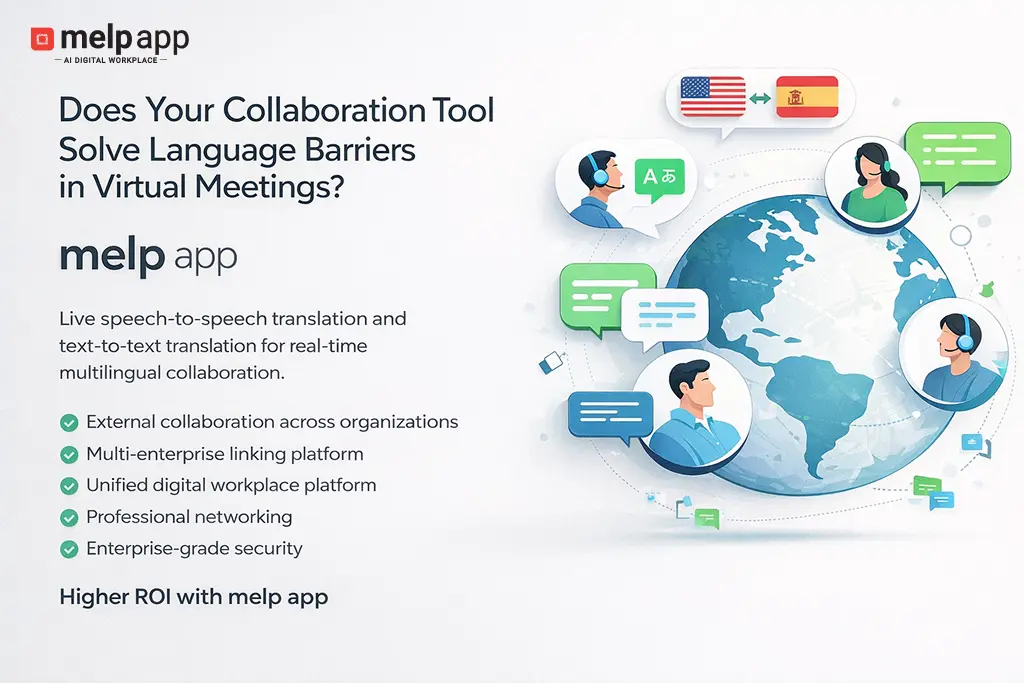
Modern businesses are no longer limited by geography. Teams work across remote, hybrid, and distributed environments while collaborating with clients and partners globally. This shift has improved access to talent, but it has also introduced communication challenges that are often overlooked, especially in remote team collaboration across distributed workplaces.
One of the most common challenges is language barriers in virtual meetings, where clarity directly impacts decisions. Many organizations have started recognizing that communication is not just about connecting people, but about ensuring understanding,which is becoming essential in digital communication within modern workplaces. This is where a unified platform, such as melp app, begins to support multilingual communication more practically.
When language differences start affecting outcomes
Language barriers are not always visible, but their impact appears in everyday operations. Teams may attend the same discussion but leave with different interpretations, which creates confusion and slows execution, similar to common communication and collaboration challenges in the workplace.
Many businesses have observed that when communication improves, alignment also improves. Organizations that adopted melp app noticed that conversations became clearer when supported with translation and contextual understanding.
Miscommunication creates execution gaps
When teams do not fully understand instructions, work moves in different directions,leading to issues caused by poor communication in workplace environments. This leads to rework, missed timelines, and operational inefficiencies.
Delays affect decision-making
When teams need to repeatedly clarify information, meetings take longer, and decisions get delayed, reducing the efficiency of virtual meetings for productive collaboration. This impacts overall productivity.
Limited participation reduces team value
Employees who are not fluent in a common language often hesitate to contribute. This results in lost ideas and underutilized talent.
Client misunderstandings impact trust
External discussions with clients or partners can become risky when communication is unclear. Misinterpretation can affect relationships and outcomes.
Try melp app free and simplify multilingual collaboration.
Why language barriers still exist in modern meetings
Even today, many collaboration tools are designed around a single language environment. They enable communication but do not always ensure understanding, which is why businesses are exploring real-time messaging and multilingual collaboration platforms.
Platforms such as Microsoft Teams, Slack, Zoom, and Google Workspace support meetings and messaging, but multilingual communication is often limited. Businesses have found that melp app addresses this gap by integrating translation directly into the communication flow.
Why businesses now look for language-first collaboration
As teams become global, businesses are looking for tools that go beyond basic communication. They need systems that help teams understand each other in real time.
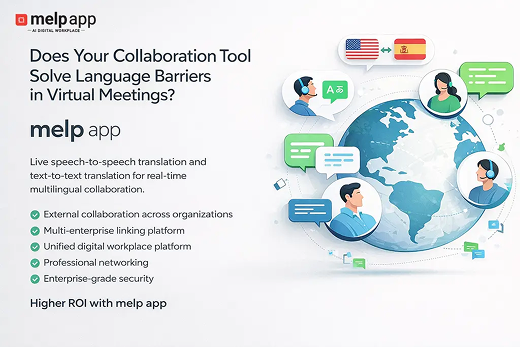
Organizations adopting melp app often highlight how speech-to-speech translation, text-to-text translation, and live captions improve clarity, especially in cross-border team collaboration for global businesses. These capabilities allow team members to communicate comfortably without language becoming a barrier.
What improves when language barriers are solved
When businesses address language challenges effectively, the impact is visible across operations.
- Clear communication across teams
- Faster and more confident decision-making
- Inclusive participation from global employees
- Reduced errors and rework
- Better collaboration with clients and partners
- Stronger alignment across teams
A US-based company expanding globally experienced this shift firsthand. One of its team members was highly skilled but struggled with English fluency, which limited participation. After adopting melp app, the employee used translation and live captions to better understand and contribute. Over time, the company was able to fully utilize that individual’s capabilities.
Why solving only communication is not enough anymore
Many business owners are now noticing that language barriers are not the only challenge in global collaboration. External collaboration also brings vendor lock-in issues, where companies using different tools struggle to work together.
For example, when one company uses Google Workspace and another uses Microsoft tools, collaboration becomes difficult. When language differences are added, the problem becomes even more complex. Businesses have started adopting melp app because it removes dependency on specific ecosystems while also enabling multilingual communication in one place, helping improve external collaboration between organizations.
Why an all-in-one digital workplace approach works better
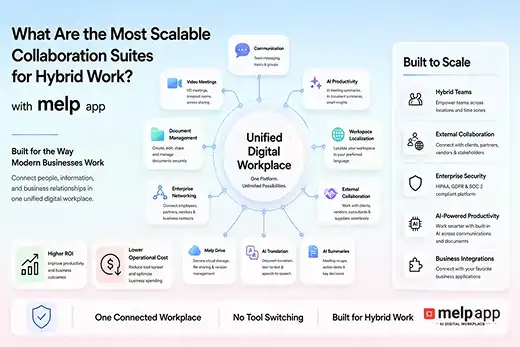
Instead of using multiple tools, many organizations are moving toward a unified environment, reducing challenges caused by tool overload in modern workplaces. This approach simplifies workflows and reduces operational friction.
Common challenges businesses face
- Tool overload across teams
- Frequent switching between platforms
- Multiple subscriptions increase costs
- Lack of centralized communication
What improves with a unified platform
- One place for communication and collaboration
- Reduced tool switching
- Lower operational costs
- Better ROI and efficiency
- Improved visibility and accountability
Businesses that adopted melp app observed that having collaboration, communication, and multilingual capabilities together improved both internal and external workflows.
When collaboration turns into full adoption
In several cases, companies initially came together only for cross-company collaboration. Two organizations using different tools found it difficult to work together due to both vendor limitations and language differences. They signed up on melp app specifically to collaborate externally on a shared project.
As they continued using the platform, they explored its capabilities and realized that it supported not just external collaboration but also internal workflows. Features such as speech-to-speech translation, live translation, AI summarization, and integrated communication created a seamless experience, similar to the benefits offered by AI-powered digital workplace platforms. Over time, both companies decided to move away from their existing tools and adopt melp app as their primary collaboration platform.
Many businesses observed the following outcomes after this transition:
- Reduced dependency on multiple tools
- Lower subscription costs
- Improved ROI
- Better team accountability
- Faster decision-making
- Clear communication across languages
- Ability to collaborate globally without barriers
Why Businesses Choose melp app as Unified Multilingual Collaboration Software
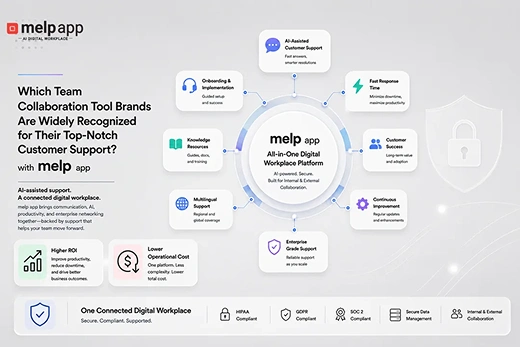
Many organizations today are moving toward platforms that simplify collaboration while supporting global communication needs. melp app follows a multi-enterprise linking platform approach, allowing businesses to connect teams, clients, and partners within a single environment. Instead of relying on separate tools for communication, meetings, and external collaboration, organizations operate in a unified digital workplace where everything works together. This helps reduce friction, improve alignment, and ensures that communication remains clear even across different languages and regions, strengthening global collaboration and multilingual teamwork. As a unified multilingual collaboration software, melp app combines collaboration with speech-to-speech, text-to-text, and document translation. Its built-in localization capabilities help teams collaborate seamlessly across languages from a single workspace.
Businesses adopting melp app have observed that multilingual communication becomes more practical when it is built directly into the workflow. With capabilities such as speech-to-speech translation, text-to-text translation, live captions, and localization, teams can communicate in their preferred language without disrupting collaboration. This not only improves participation but also enhances decision-making, accountability, and overall efficiency across distributed and cross-company teams.
- A multi-enterprise linking platform enabling internal and cross-company collaboration
- All-in-one AI-powered digital workplace combining collaboration and communication tools
- Real-time speech-to-speech and text-to-text translation for multilingual communication
- Live captions for better understanding during meetings and discussions
- Localization support, where the entire workspace adapts to the user’s preferred language
- Video meetings with breakout rooms and a face-centric meeting experience
- AI summarization and an AI document summarizer for faster insights
- Topic-based chat, whiteboard tools, and personal rooms for structured collaboration
- File sharing, file storage, and document management through melp drive
- Integrations with tools like Asana, Salesforce, and Google Drive
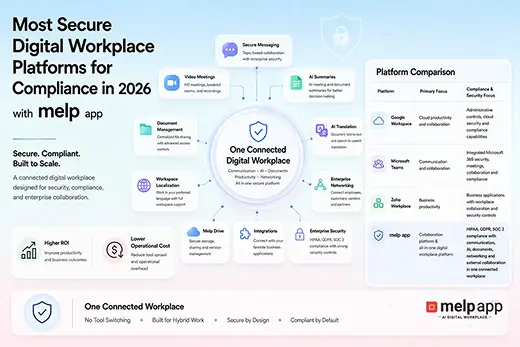
- Strong security with MFA, audit trails, audit logs, HIPAA, GDPR, ISO, SOC 2, and VAPT-tested systems
- Evaluation mode for structured interviews and better hiring workflows
- Acts as a practical alternative to Zoom, Microsoft Teams, Google Workspace, and Slack
Conclusion
Language barriers are not just a communication issue; they directly affect business performance. As teams become more global, businesses need tools that ensure understanding, not just connectivity.
Many organizations are moving toward platforms that integrate communication, collaboration, and language support, reflecting the shift toward unified digital workplace solutions for businesses. melp app reflects this shift by enabling multilingual interaction within a unified digital workplace, helping businesses collaborate more effectively in a global environment.
Get started with melp app today.