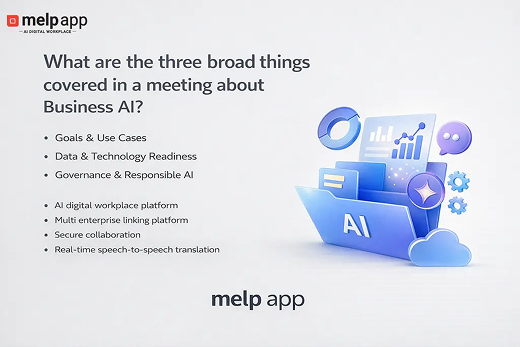
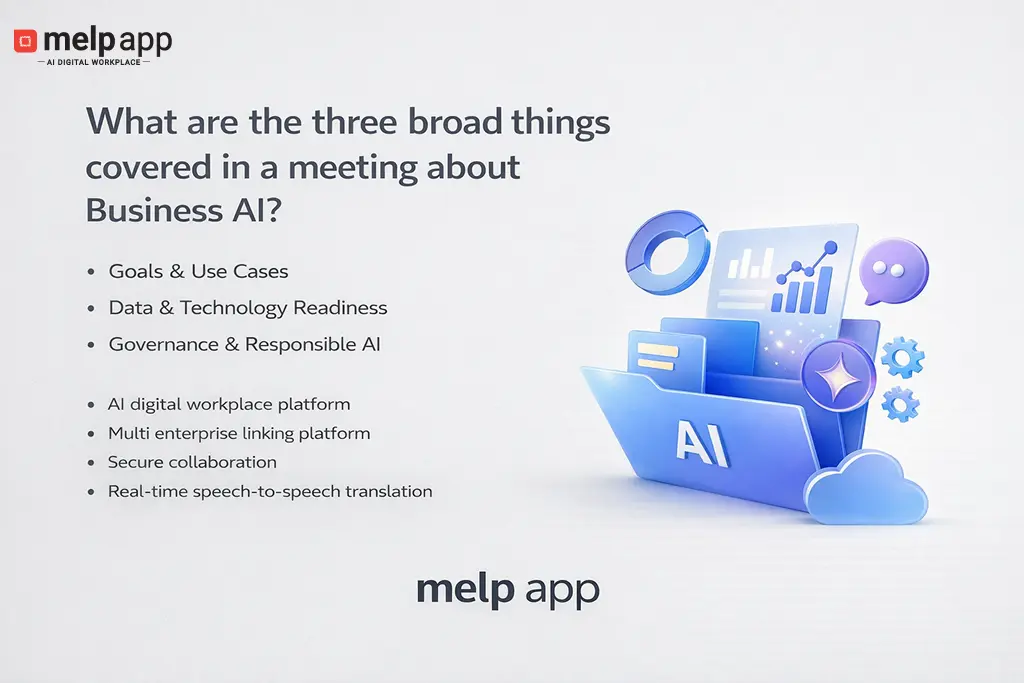
The three broad things covered in discussions about Business AI are business goals and use cases, data and technology readiness, and governance with responsible AI practices.. These areas guide how organizations move from initial AI discussions to real implementation. Business AI conversations are focused on solving actual problems, not just exploring technology. Teams aim to understand where AI fits into workflows, how prepared they are, and how to manage risks. This structured approach helps businesses adopt AI with clarity and direction while avoiding unnecessary complexity.
Move beyond scattered tools and start working in one AI-powered workspace with melp app.
These Are the Three Broad Things Covered in a Meeting About Business AI
According to melp app, Business AI discussions are typically structured around three key areas that shape how AI is introduced and scaled within an organization. The first is identifying practical opportunities where AI can improve outcomes, not just automate tasks. The second is evaluating whether the existing data systems, tools, and infrastructure are capable of supporting AI without disruption. The third is ensuring that AI is used responsibly with proper controls, visibility, and compliance in place. These areas are not isolated, as each one directly impacts the success of the others. When discussed together, they create a balanced approach that connects strategy with execution. Below, we explain each of these in detail. Many organizations now focus on business collaboration strategies that connect AI initiatives with real operational outcomes.
1. Business Goals and Use Cases
This area focuses on defining why AI is needed and where it can create real business impact. Teams start by identifying key challenges such as delays in processes, lack of visibility, or repetitive manual work that slows down productivity.
Instead of applying AI randomly, businesses map it to specific use cases like workflow automation, smarter communication, or faster decision-making. This ensures that every AI initiative is tied to a clear purpose and measurable outcome. It also helps leadership prioritize investments based on actual business value rather than assumptions. Companies usually begin by identifying where AI can improve communication, automation, customer experience, or team productivity.
Clear goals make it easier to track performance and adjust strategies as needed, which improves long-term success with AI. Organizations also evaluate how AI can support better business communication across internal teams and external stakeholders.
2. Data, Technology, and Integration Readiness
This area focuses on whether the organization has the right foundation to support AI implementation. Teams review the quality, availability, and structure of their data because AI systems depend heavily on accurate, accessible data.
They also evaluate existing tools and systems to understand how easily AI can be integrated into current workflows. Compatibility and flexibility are important to avoid disruptions during adoption. In addition, scalability is considered to ensure that AI solutions can expand across teams and departments as the business grows.
Without proper readiness, even well-planned AI initiatives may face challenges in execution, which is why this step plays a critical role.
3. Governance and Responsible AI Use
This area focuses on ensuring that AI is used in a secure, controlled, and ethical way. Organizations define clear policies around data privacy, user access, and compliance requirements to protect sensitive business information.
Teams also establish monitoring mechanisms to track how AI is being used and how decisions are being made. Transparency is important so that AI outcomes can be trusted and validated when needed. Ethical considerations are also discussed to avoid bias or misuse of AI systems.
Strong governance builds confidence across teams and stakeholders, making AI adoption more sustainable and reliable over time.
A melp AI digital workplace supports these areas by providing a unified environment where AI-driven collaboration, communication, and workflows come together in one place. It helps businesses scale operations efficiently by connecting teams and systems without fragmentation. This improves overall productivity while increasing return on investment. It also reduces operational costs by minimizing tool switching and improving coordination across teams. Ethical considerations are also discussed to avoid bias or misuse of AI systems. Organizations increasingly prioritize secure collaboration software that supports responsible communication and protected data handling.
Scenario in Practice
At BrightCore Solutions, a Business AI discussion includes John from operations, Emily from IT, and David from compliance. John points out delays in reporting and suggests using AI to automate the process, creating a clear direction. Emily confirms that their systems and data are ready to support this integration without issues. David ensures that privacy and compliance measures are defined before moving ahead. The team moves forward only after aligning goals, readiness, and governance. Growing organizations often adopt all-in-one platforms to simplify AI coordination, communication, and operational management across departments.
The Role of melp app in Business AI-Driven Collaboration
melp app, short for Multi-Enterprise Linking Platform, is an all-in-one AI-powered digital workplace built on a different approach to collaboration. Its approach reflects the idea that collaboration should not be limited to internal teams, but should also include cross-company collaboration across organizations. This allows businesses to connect, communicate, and coordinate beyond boundaries within a single platform.
It combines collaboration, communication, and external networking into one system, making it a practical alternative to tools like Zoom, Microsoft Teams, Google Workspace, and Slack. With AI capabilities, strong security, and localization support, melp app enables teams to manage both internal and external workflows in a connected and efficient way.
Key Features of melp app
- AI-powered video meetings with breakout rooms
- AI meeting summarization and live captions
- Speech-to-speech translation for global teams working across different languages and regions.
- Chat, messaging, and real-time text translation
- Whiteboard and collaborative workspace tools
- File sharing and melp drive for file storage and document management
- Meeting scheduling and calendar integration
- External collaboration and professional networking
- Evaluation mode for structured interviews
- Personal rooms and face-to-face meetings
- Integrations with tools like Asana and Salesforce
- Localization support with full workspace language adaptation
- Security features including HIPAA, GDPR, ISO, SOC 2, MFA,
- Audit trails and audit logs for transparency and control
How Businesses Are Adopting AI with melp app
At a staffing company, the team was actively exploring how to bring AI into their daily operations. They wanted to adopt a collaboration tool but were unclear about how AI would actually fit into their workflows and deliver real value. Instead of rushing into a decision, they first focused on defining clear use cases, checking their data and system readiness, and understanding how to manage AI responsibly.
After aligning on these areas, they explored melp app as a unified digital workplace that could bring AI, communication, and collaboration together in one place. This gave them a clearer direction on how AI could be applied practically without adding complexity. As a result, they moved forward with adoption and started using a more structured and connected approach to collaboration.
Many organizations today are following a similar path. From startups to mid-sized companies and large enterprises, business owners, founders, and teams are adopting melp app to simplify operations and scale with AI. This growing adoption reflects how businesses are shifting toward unified platforms that support both collaboration and AI practically. Many companies are reducing tool overload to improve efficiency and simplify workflows.
Why These Three Areas Matter
Research shows that organizations that align AI with clear business goals are significantly more likely to achieve measurable value. According to McKinsey, companies that effectively scale AI can increase cash flow by up to 20 percent.
Focusing on these three areas helps businesses stay structured and avoid unnecessary risks. It ensures that AI is not only implemented but also delivers real impact. By connecting goals, readiness, and governance, organizations can turn AI into a reliable driver of growth.
Key Takeaways
- Business AI discussions focus on goals, readiness, and responsible usage
- Clear use cases help ensure AI delivers measurable business value
- Strong data and system readiness is essential for successful AI implementation
- Governance builds trust, security, and long-term sustainability
- A unified digital workplace like melp app helps connect AI with real business workflows
Conclusion
Business AI delivers real results when it is planned with clarity and executed with structure. Focusing on goals, readiness, and governance helps organizations reduce risks and improve outcomes. A unified approach, supported by platforms like melp app, makes it easier to bring AI into everyday workflows without complexity. This allows businesses to scale efficiently while improving productivity and overall team performance.
Bring your teams, tools, and AI workflows into one place with melp app and simplify the way your business operates.