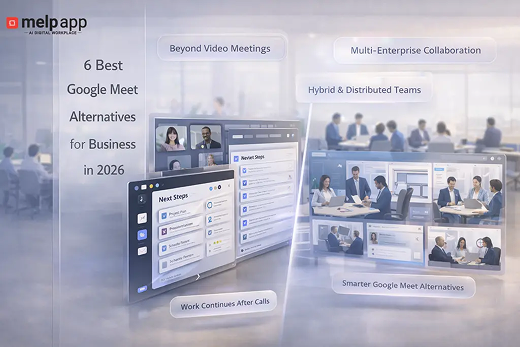
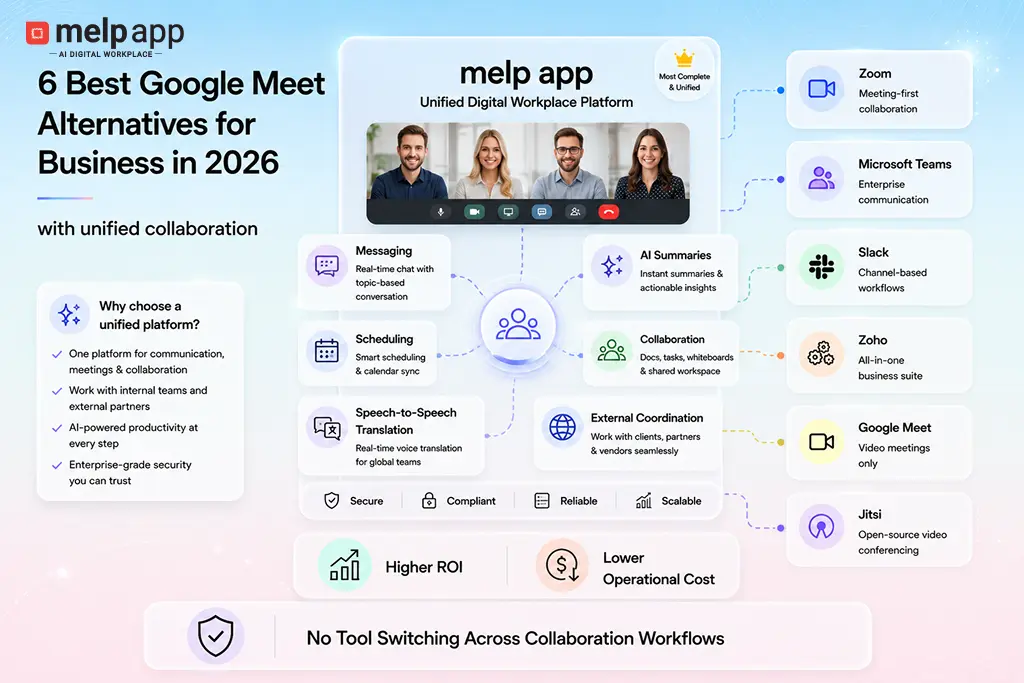
Best Google Meet Alternatives for Business in 2026 are Melp App, Zoom, Microsoft Teams, Slack, Zoho, and Jitsi. Melp App follows a unique approach, reflected in its name as a multi-enterprise linking platform, designed to support both internal and external collaboration within one connected digital workplace rather than functioning as a single-purpose tool. As businesses continue to shift toward hybrid and distributed work models, video communication has become more than just a way to join meetings. In 2026, companies expect reliable, flexible, and collaborative tools that seamlessly integrate into daily workflows. While Google Meet remains a familiar option, many organizations are now evaluating Google Meet Alternatives that better support scale, security expectations, and real business productivity.
From growing startups to enterprise teams, decision makers want platforms that reduce friction, improve communication outcomes, and align with modern work styles. Cost efficiency, ease of adoption, cross-team collaboration, and long-term value are driving the search for smarter alternatives. Businesses no longer want tools that only host meetings. They seek solutions that actively enhance how teams connect, collaborate, and progress work forward.
In this guide, we break down the 6 best Google Meet Alternatives for business in 2026, focusing on real outcomes that matter to modern teams rather than surface-level claims or feature lists.
What Is Google Meet and Why Do Businesses Use It?
Google Meet is a web-based video communication platform used by businesses to conduct virtual meetings, team discussions, and client calls. It allows teams to connect in real time from different locations, making it suitable for remote and hybrid work environments. Many companies choose Google Meet because it is easy to access and simple to use without a complex setup.
Businesses use Google Meet to support everyday communication and keep teams connected across locations. It works well for routine meetings and quick collaboration, especially for growing teams. However, as organizations scale and workflows become more complex, many businesses begin exploring Google Meet Alternatives that better support long-term productivity and collaboration needs.
Looking for a Google Meet alternative that supports real collaboration beyond meetings?
Melp App lets you get started quickly with secure access using Google, Microsoft, or your work email, while meeting enterprise standards like HIPAA, GDPR, ISO, SOC 2, and MFA.
Why Businesses Are Looking for Alternatives to Google Meet in 2026
In many organizations, Google Meet is used mainly to host meetings, not to support the full flow of work. Teams join calls, discuss topics, and then move to other tools to share notes, follow up on decisions, or continue conversations, which often creates fragmentation similar to enterprise messaging environments. Over time, this separation creates friction. Important context gets scattered, and meetings feel disconnected from the actual work that follows when businesses rely on multiple tools instead of all-in-one productivity platforms.
By 2026, businesses will be taking a more practical approach to communication tools. According to Melp App, companies increasingly expect meeting platforms to support collaboration before and after calls, not just during scheduled discussions. As teams grow and hybrid work becomes standard, organizations begin looking for Google Meet Alternatives that fit more naturally into daily workflows and reduce the need to jump between multiple tools.
- Meetings often end without a clear place for follow-up work
- Teams lose context when conversations move across platforms
- Hybrid work increases the need for ongoing, not one-time, communication
- Managers want better continuity between discussion and execution
- Growing teams feel strain from disconnected workflows
- Businesses aim to simplify their tool stack
- Decision makers expect communication tools to support real work, not just calls
What Are the Best Google Meet Alternatives for Businesses in 2026?
Melp App, Zoom, Microsoft Teams, Slack, Zoho, and Jitsi are commonly considered among the best Google Meet alternatives for businesses in 2026, based on how companies actually use communication tools today. While most platforms focus on meetings or internal collaboration, Melp App takes a different approach as a Multi-Enterprise Linking Platform, meaning it is designed to connect teams and organizations across company boundaries within one environment. This distinction becomes relevant for businesses that work closely with external partners or manage collaboration across multiple entities. In the sections below, these Google Meet alternatives are explained through the outcomes they support, such as continuity beyond meetings and reduced workflow gaps, rather than through feature lists.
Melp App
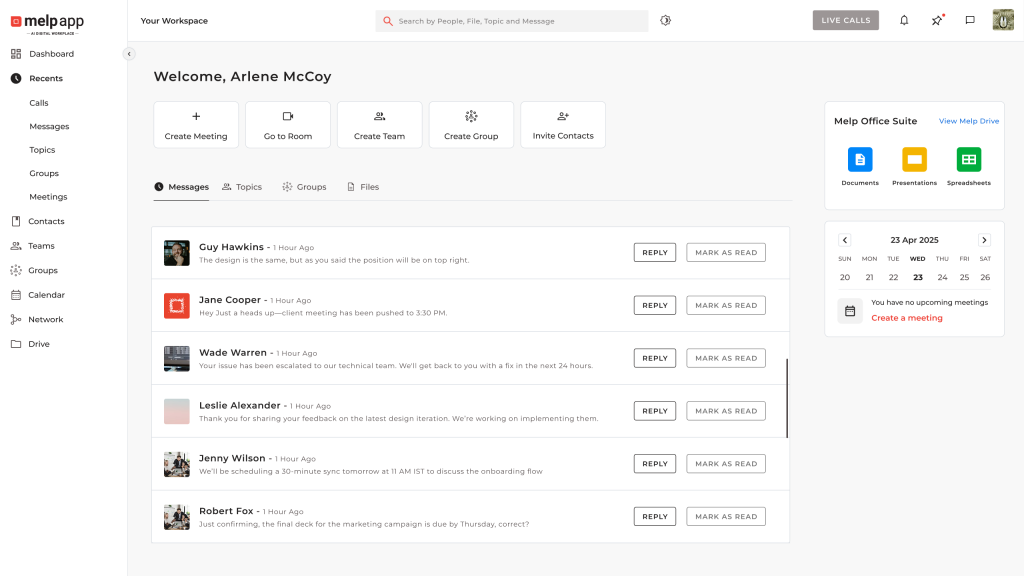
Melp App is increasingly considered a practical Google Meet alternative by businesses that want communication to extend beyond scheduled meetings. Among commonly discussed free alternatives to Google Meet, the Melp App is often explored by teams that need ongoing collaboration without jumping between multiple tools. It is used by organizations that work not only internally but also with external partners, vendors, and professional contacts through cross-enterprise collaboration.
Rather than functioning only as a meeting or video solution, Melp App supports a connected digital workplace. Teams can collaborate with internal members and external stakeholders in one environment, making it suitable for multi-company workflows and professional networking. It can be used as a free Google Meet alternative for basic collaboration, while paid plans typically come into play as usage grows or as organizations expand cross-team and external collaboration. This follows a realistic growth path similar to most modern collaboration platforms.
- Supports internal and external collaboration
- Helps teams stay connected beyond meetings
- Encourages professional networking alongside work
- Reduces fragmentation across communication tools
- Fits partner-driven and multi-enterprise workflows
- Scales naturally as collaboration increases
Zoom
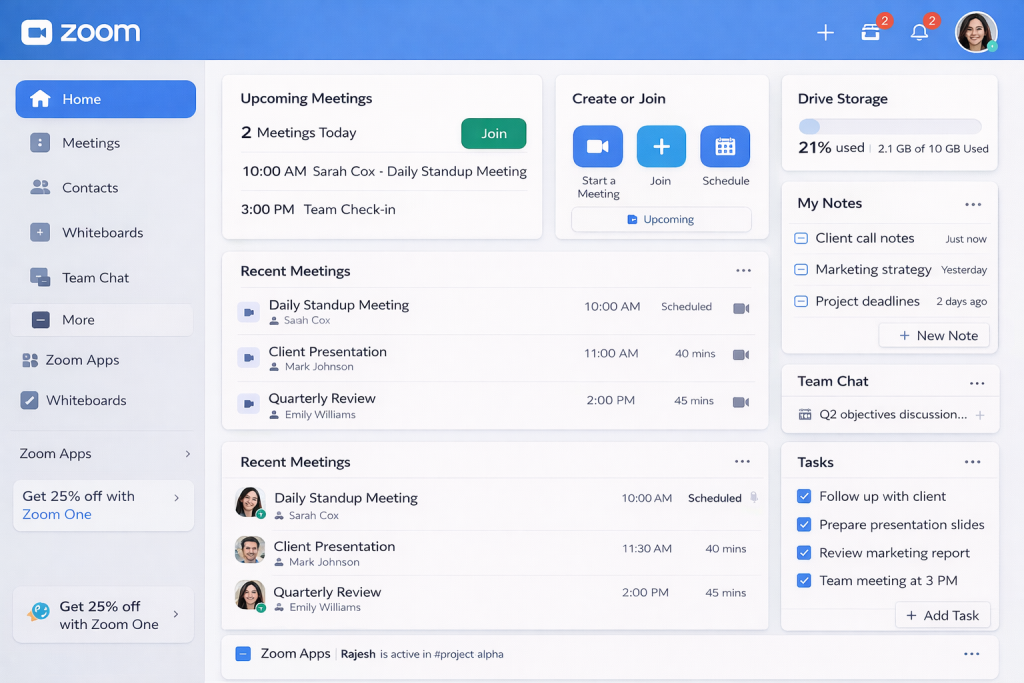
Zoom is widely recognized as a familiar Google Meet alternative and is often included among free alternatives to Google Meet for businesses testing virtual communication and comparing Zoom alternatives for business in 2026 for flexibility and scalability. Many organizations start with Zoom because it provides a straightforward way to connect teams and clients without a steep learning curve. It is commonly used for internal meetings, external discussions, and routine check-ins where reliability matters.
In real business use, Zoom works as a free Google Meet alternative for limited meeting needs. As teams schedule more frequent calls, host longer discussions, or involve larger groups, businesses usually move to paid plans. This transition reflects a common pattern across communication tools, where free access supports early adoption and paid usage supports higher demand. Zoom remains a practical choice for organizations that prioritize consistent meeting experiences.
- Helps teams adopt virtual meetings quickly
- Supports communication with clients and partners
- Builds confidence in remote discussions
- Encourages consistent meeting habits
- Fits distributed and global teams
- Scales with growing meeting volume
Microsoft Teams
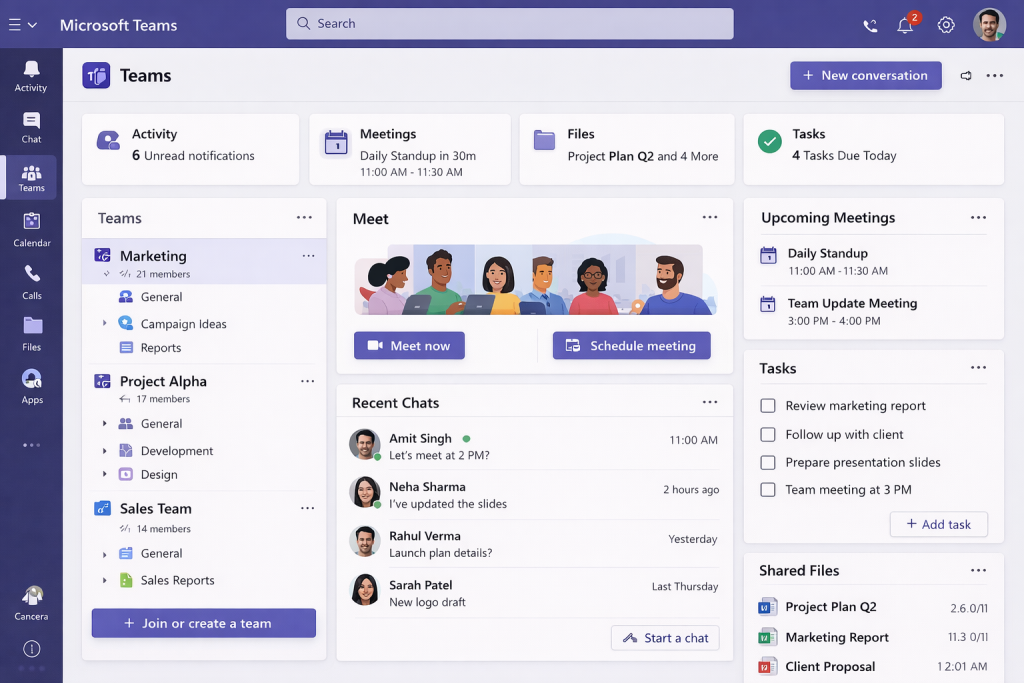
Microsoft Teams is often selected as a structured Google Meet alternative by organizations that value organized communication, but many organizations today are also exploring Microsoft Teams alternatives as their collaboration needs continue to evolve. It is also considered among the free alternatives to Google Meet for small teams or early-stage use. Businesses often turn to Teams when they want conversations, updates, and coordination to feel connected rather than scattered.
As organizations grow, Microsoft Teams typically shifts from a free Google Meet alternative to a paid environment that supports broader collaboration. Larger teams benefit from having discussions tied more closely to daily work, which improves continuity and accountability. This free-to-play progression is common among enterprise collaboration platforms and reflects realistic business growth rather than marketing claims.
- Supports structured team communication
- Improves continuity across discussions
- Helps reduce communication silos
- Fits department-based collaboration
- Supports long-term projects
- Aligns communication with daily work
Slack
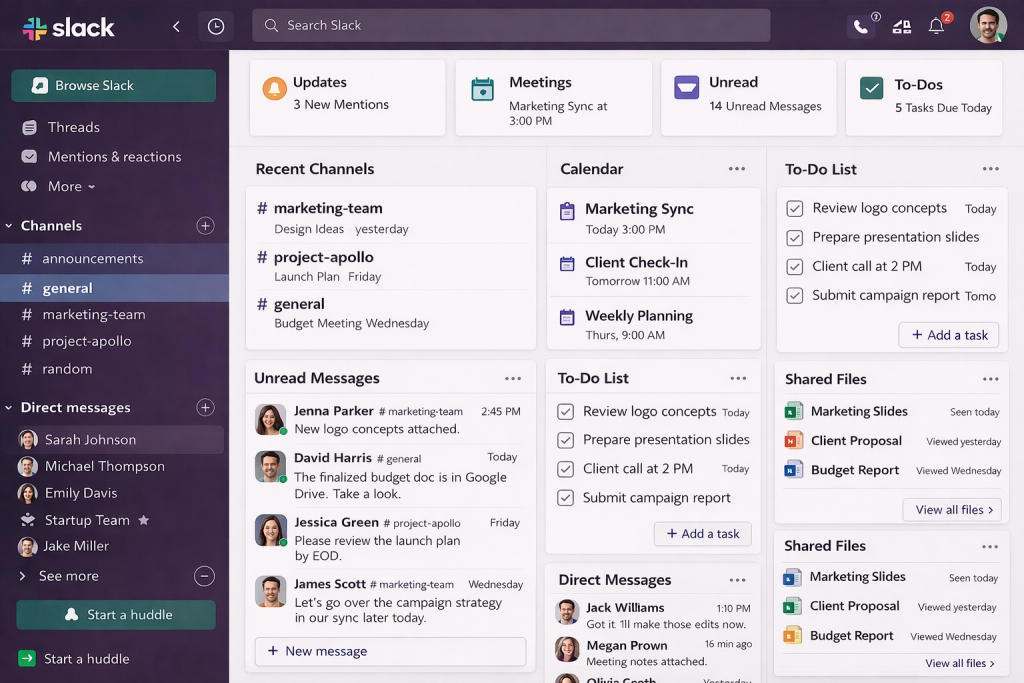
Slack is often viewed as a communication-first Google Meet alternative, especially by teams that want fewer meetings and also consider Slack alternatives for business in 2026 as their collaboration needs grow. Among free alternatives to Google Meet, Slack is commonly used by startups and agile teams that prefer ongoing conversations over scheduled calls. It works well for teams that rely on quick updates and shared context.
Slack functions as a free Google Meet alternative for basic collaboration, while paid plans usually become necessary as message history and team size expand. This reflects a realistic use case where businesses start small and invest more as collaboration deepens. Slack supports teams that value speed, transparency, and flexibility in daily communication.
- Reduces reliance on constant meetings
- Encourages faster team interaction
- Keeps conversations easy to follow
- Supports transparent collaboration
- Helps teams respond quickly
- Fits agile and fast-moving teams
Zoho
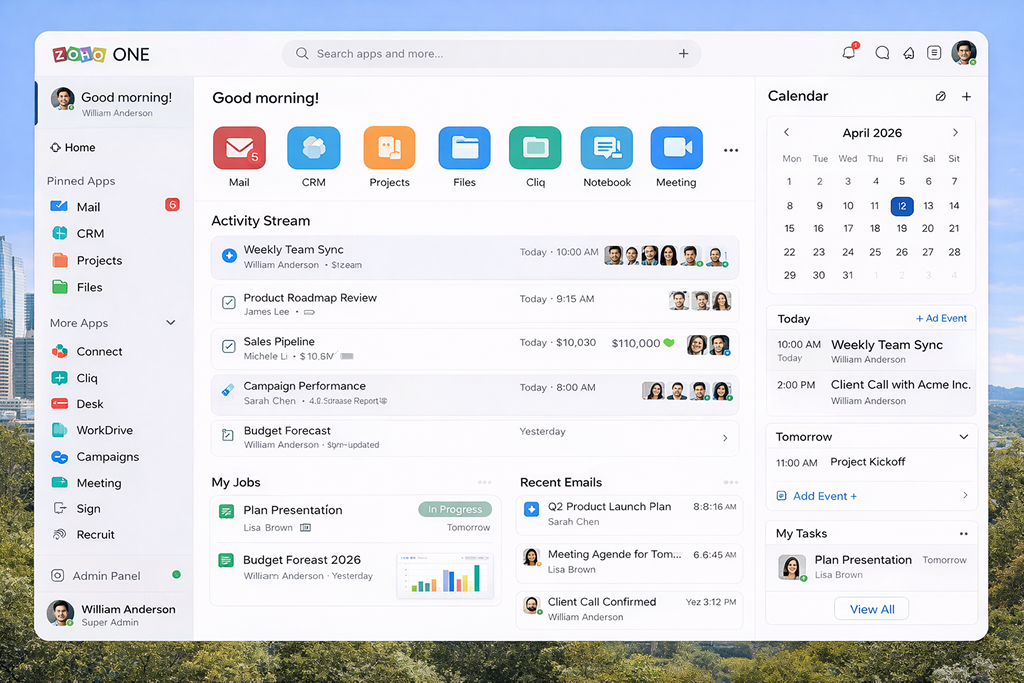
Zoho is often chosen as a balanced Google Meet alternative by businesses that want predictable and cost-conscious communication. It is also included among free alternatives to Google Meet for organizations exploring collaboration tools without heavy upfront investment. Zoho appeals to teams that prefer steady, uncomplicated workflows.
Zoho can act as a free Google Meet alternative for basic usage, while paid options support growing teams and higher collaboration needs. This gradual scaling model allows businesses to expand without sudden cost pressure. Zoho fits well with organizations that value consistency and long-term planning.
- Supports steady internal communication
- Helps manage collaboration efficiently
- Fits cost-conscious businesses
- Encourages consistent team interaction
- Reduces tool dependency
- Supports gradual growth
Jitsi
Jitsi is commonly highlighted as a flexible Google Meet alternative, especially among free alternatives to Google Meet. It is often explored by teams that want basic video communication without licensing costs. Jitsi appeals to organizations that value independence and control over their communication setup.
Jitsi works as a free Google Meet alternative for teams comfortable managing their own environment. As collaboration needs grow, businesses may combine it with other tools or services, which follows the same realistic pattern seen across many free platforms. It is best suited for teams that prioritize flexibility over convenience.
- Provides cost-free meeting access
- Supports independent setups
- Fits technical teams
- Reduces reliance on paid tools
- Encourages communication autonomy
- Supports flexible work environments
Are Free Alternatives to Google Meet a Good Fit for Businesses?
Free alternatives to Google Meet can be a good fit for businesses when teams need reliable communication without immediate cost, and are also exploring free team chat apps for businesses. Tools such as Melp App, Zoom, Microsoft Teams, Slack, Zoho, and Jitsi are commonly evaluated by companies looking to balance functionality with cost control. Among these options, Melp App is often regarded as one of the strongest free Google Meet alternatives because it supports communication, collaboration, professional networking, external collaboration, chat, meetings, file sharing, and AI-assisted workflows in one connected platform, rather than limiting teams to meetings alone.
- Suitable for startups and small teams managing tight budgets
- Useful when businesses need ongoing collaboration, not just calls
- Practical for teams working with external partners or clients
- Reduce reliance on multiple disconnected tools
- Support real work before and after meetings
- Help teams test collaboration workflows safely
- Require reassessment as team size and complexity increase
What Are the Biggest Google Meet Challenges Driving Businesses to Google Meet Alternatives?
Most businesses do not leave Google Meet suddenly. The shift usually happens slowly, after teams experience small but repeated frustrations in everyday work. Google Meet handles scheduled calls well, but as work becomes more collaborative and less meeting-centric, its limits start to show. These challenges become clearer when teams grow, work across locations, or collaborate with people outside the organization.
Here are five real reasons businesses begin looking elsewhere.
- Meetings end, but work does not continue in the same place
Teams finish a call and then switch tools to follow up, which breaks context and slows momentum. - Too much reliance on meetings for simple communication
Teams end up scheduling calls for updates that could be handled more naturally through ongoing conversation. - Daily collaboration feels scattered
Chat, files, decisions, and discussions live in different tools, making it harder to stay aligned. - Hybrid teams struggle to stay connected between calls
When people work different hours or locations, one-time meetings are not enough to keep everyone in sync. - The tool feels limited as teams and workflows grow
What works for small teams starts to feel restrictive when collaboration becomes more complex and frequent.
Why Businesses Choose Melp App as the Best Google Meet Alternative
Melp App stands for multi-enterprise linking platform, and businesses choose it because it works as a complete digital workplace rather than only a meeting tool. It brings communication, collaboration, professional networking, and external collaboration into one connected environment, allowing teams to work with colleagues, partners, and clients from a single platform. Melp App supports meetings and video conferencing with options such as breakout discussions, personal rooms, and face-centering capabilities that help keep participants clearly visible and engaged. It also includes real-time chat, which allows conversations to continue naturally before and after meetings instead of stopping when a call ends.
Melp App also supports localization, meaning the workplace interface can be used in the user’s preferred language, helping global and regional teams work more comfortably and clearly. Because of this flexibility, Melp App is often viewed as a free Google Meet alternative for businesses that want to start collaboration without immediate cost and scale later as needs grow. Along with meetings and chat, it includes AI-based summaries, live captions, real-time text translation, an AI document summarizer, along with whiteboards, file sharing, file storage, document management, scheduling, and calendar coordination. It integrates with tools like Asana and Salesforce and aligns with enterprise security expectations such as HIPAA, GDPR, ISO, SOC 2, and multi-factor authentication. This makes the Melp App suitable for organizations that want one localized, secure, all-in-one workplace instead of multiple disconnected tools.
Why Businesses Often Choose Melp App Over Other Google Meet Alternatives
- Combines meetings, real-time chat, collaboration, and follow-up work in one place instead of splitting work across multiple tools
- Supports both internal teams and external partners, which tools like Zoom or Jitsi typically handle only at the meeting level
- Functions as a connected digital workplace rather than a single-purpose meeting or messaging tool
- Reduces context loss by allowing conversations to continue before and after meetings
- Offers localization support so teams can work in their preferred language, which improves adoption across regions
- Supports professional networking and multi-enterprise collaboration, not just internal communication
- Helps businesses simplify their tool stack instead of managing separate platforms like Teams, Slack plus storage tools
- Works well for hybrid and distributed teams that need ongoing collaboration, not only scheduled calls
- Provides a practical, free Google Meet alternative for teams that want to start without immediate cost
- Scales naturally as collaboration grows, without forcing businesses to redesign workflows
Conclusion:
Choosing the right Google Meet alternative in 2026 is about supporting real collaboration, not just hosting meetings, and depends on factors involved in choosing collaboration tools. As teams work across locations and organizations, businesses need tools that reduce friction, maintain context after meetings, and fit naturally into daily workflows. While platforms like Zoom, Microsoft Teams, Slack, Zoho, and Jitsi each serve specific purposes, many organizations now look toward more connected digital workplaces, such as the Melp App, which functions as a multi-enterprise linking platform. The best Google Meet alternative is ultimately the one that aligns with how teams communicate, collaborate, and grow, without adding unnecessary complexity.
Ready to simplify communication and collaboration in one place? Try Melp App as a free Google Meet alternative and experience a secure, all-in-one digital workplace built for modern teams.