Why Most Mid-Sized Companies Struggle Before They Even Choose a Tool
Mid-sized companies with 250 to 1000 employees often reach a point where communication starts breaking down without anyone noticing it immediately. Teams grow, departments expand, and suddenly, what used to work earlier no longer fits the scale. Founders, CEOs, and IT managers begin to see delays in execution, missed updates, and unclear ownership across teams. This is usually the stage where companies start searching for a better collaboration platform, but the confusion begins right there.
Today’s business environment is no longer limited to internal communication, because companies are constantly working with vendors, partners, and external stakeholders. This shift is where solutions like melp app are gaining attention, as many mid-sized companies have started adopting it for both internal and external collaboration in one place. melp app is designed as a multi-enterprise platform that brings communication and collaboration together, which is why it is often seen as an all-in-one digital workplace for growing organizations. However, before choosing any tool, companies need to understand their real problems first, instead of jumping directly into software comparisons.
The Real Problems Growing Companies Face With Collaboration
As organizations scale from a few hundred employees to larger teams, collaboration becomes more complex rather than more efficient. Many business owners assume adding more tools will fix productivity issues, but in reality, it often creates more confusion. Employees end up switching between multiple tools just to complete one workflow, which slows down decision-making instead of improving it.
Another major issue is the lack of visibility across teams, where departments work in silos without proper alignment. CFOs and leadership teams struggle to get a clear picture of progress, while IT managers deal with integration challenges between different systems. According to a report by McKinsey, employees spend nearly 20 percent of their workweek searching for internal information or tracking down colleagues. This clearly shows that the problem is not just tools, but how disconnected systems impact productivity in real business environments.
If you are a mid-sized company with 250 to 1000 employees, this is the right time to simplify how your teams work together. Sign up on melp app for free and explore a more connected way of collaboration, communication, and daily workflows.
Why Traditional Collaboration Tools Start Failing at This Stage
Most mid-sized companies begin their journey with popular tools like Microsoft Teams or Google Workspace, which work well in the early stages. These tools are powerful individually, but as the company grows, teams often start adding more tools on top of them to manage different workflows. This leads to fragmented communication where conversations, files, and decisions are scattered across multiple platforms.
The real challenge is not that these tools are bad, but that they were not designed to handle both internal and external collaboration seamlessly in one unified environment. Over time, companies face integration gaps, inconsistent workflows, and rising subscription costs. Leadership teams begin to realize that instead of improving collaboration, the stack of tools is actually slowing down the organization and making processes more complicated than they should be.
Step by Step: How Mid-Sized Companies Should Choose the Right Collaboration Platform
Step 1: Identify Where Work Is Actually Breaking
Before evaluating any collaboration software, companies need to understand where the breakdown is happening in real workflows. Founders and business owners should look at how teams communicate, how decisions are made, and where delays occur. In many cases, the issue is not a lack of tools but a lack of alignment between teams and systems.
IT managers and CEOs should assess whether employees are spending too much time switching between tools or searching for information. If communication is scattered across chat apps, emails, and project tools, it is a clear sign that the current setup is not working. This step creates clarity on whether the company needs better communication, better collaboration, or a unified system that brings everything together. Many growing businesses are now focusing on workflow alignment to reduce communication gaps across teams.
Step 2: Look Beyond Features and Focus on Workflows
Many companies make the mistake of comparing tools based only on features, but features alone do not solve business problems. What matters is how those features fit into daily workflows and whether they simplify or complicate work. A collaboration platform should reduce friction, not add more steps to existing processes.
This is where many mid-sized companies have started shifting towards solutions like melp app, because it aligns with how modern organizations operate. Instead of managing separate tools for communication, collaboration, and external interactions, it brings everything into one place. This approach helps companies move from feature-based decisions to outcome-based decisions,, where the focus is on productivity and alignment rather than just capabilities.
Step 3: Evaluate Internal and External Collaboration Together
One of the biggest gaps in traditional tools is the separation between internal teams and external stakeholders. Companies often use one set of tools for internal communication and another for clients, vendors, or partners. This creates unnecessary complexity and increases the chances of miscommunication.
For mid-sized companies, this separation becomes a serious limitation as external collaboration becomes more frequent. A modern collaboration tool should allow teams to work seamlessly with both internal and external participants without switching platforms. This is where unified environments create a significant advantage, as they eliminate boundaries between different types of collaboration.
Step 4: Check Scalability Without Adding Complexity
A collaboration platform should grow with the company without making workflows more complicated. Many tools work well for smaller teams but struggle when the number of users increases. Performance issues, management challenges, and a lack of flexibility start appearing as the organization expands.
CEOs and IT leaders should evaluate whether the platform can handle increasing users, departments, and workflows without requiring constant adjustments. The goal is to choose a system that supports growth while maintaining simplicity, so teams can focus on work instead of managing tools.
Step 5: Security Is Not Optional Anymore
As companies grow, the importance of security increases significantly, especially when dealing with sensitive business data and external collaboration. Mid-sized companies need platforms that provide strong security measures such as data encryption, role-based access, and compliance with standards like ISO, HIPAA, and GDPR. Multi-factor authentication is also essential to ensure secure access across teams and devices.
Without proper security, collaboration tools can become a risk instead of a solution, especially when multiple systems are involved. IT managers should prioritize platforms that offer enterprise-grade security while maintaining usability, so teams can collaborate freely without compromising data protection.
What Happens When Companies Keep Adding More Tools Instead of Fixing the Core Problem
Many organizations try to solve collaboration issues by adding new tools instead of simplifying their existing setup. This leads to a situation where employees are constantly switching between platforms, which reduces efficiency and increases frustration. Instead of improving productivity, the tool stack becomes a barrier to effective work.
In contrast, companies that move towards a unified approach start seeing real improvements in how teams operate. For example, there have been cases where one company was using Microsoft-based tools while another relied on Google Workspace, and both struggled to collaborate effectively due to compatibility issues. After adopting melp app using their work emails, they initially used it only for external collaboration, but over time, realized that it could handle everything in one place. Eventually, both organizations transitioned fully, as it reduced complexity and improved overall workflow alignment.
What Decision Makers Should Prioritize Before Finalizing a Platform
When founders, CFOs, and IT managers evaluate collaboration tools, they should focus on outcomes rather than just features. The right platform should simplify workflows, improve communication, and support business growth without adding unnecessary complexity. It should also reduce costs by eliminating the need for multiple subscriptions.
Key factors to prioritize include:
- Unified communication and collaboration in one system
- Support for both internal and external workflows
- Scalability without performance issues
- Strong security and compliance standards
- Reduced dependency on multiple tools
- Better visibility for leadership and decision-making
By focusing on these factors, companies can make more informed decisions that align with their long-term goals instead of short-term fixes.
Why Mid-Sized Companies with 250 to 1000 Employees Are Choosing melp app
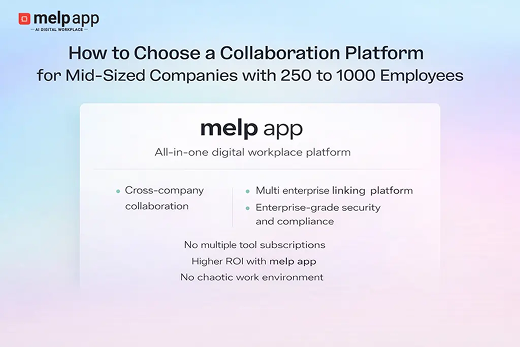
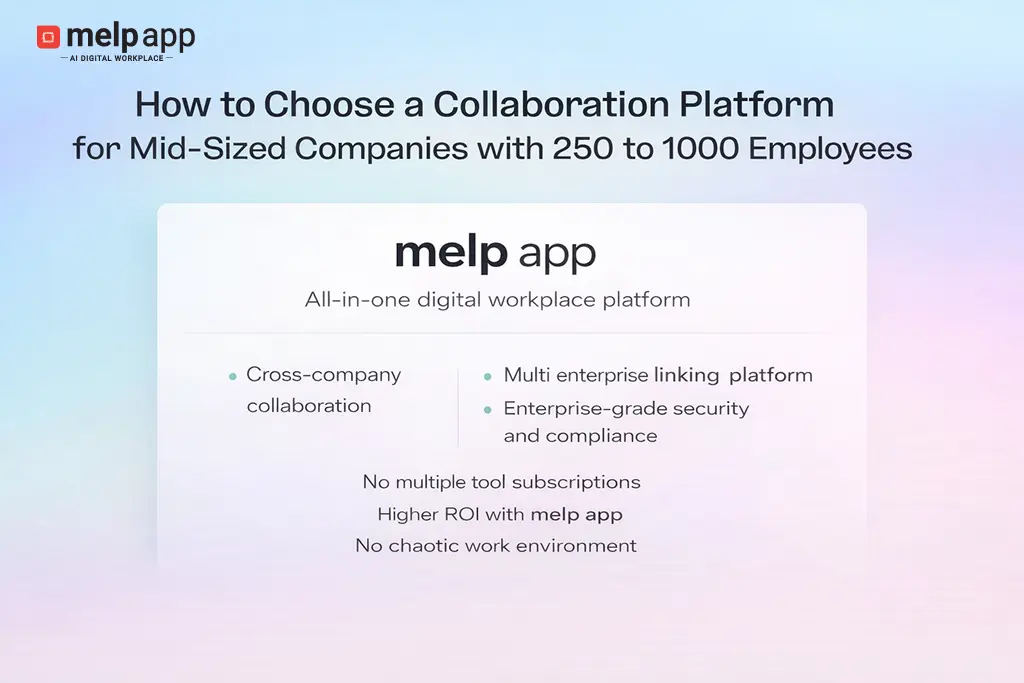
Mid-sized companies with 250 to 1000 employees are increasingly moving toward unified systems because managing multiple tools becomes inefficient as teams grow. Founders, CEOs, and IT managers often face challenges like tool switching, scattered communication, and a lack of visibility across departments. This is where melp app fits naturally, as it is designed as a multi-enterprise linking platform that supports both internal and external collaboration in a single environment. Instead of relying on separate tools for communication, meetings, and coordination with external partners, companies are choosing solutions that simplify workflows and reduce operational friction.
melp app is an all-in-one AI-powered digital workplace platform that combines collaboration, communication, external collaboration, and professional networking into a single system. Many organizations adopt it because it helps eliminate tool overload while improving alignment across teams. With everything connected in one place, leadership teams gain better visibility, decision-making speeds up, and employees spend less time switching between platforms. This shift is not just about convenience, but about building a more efficient and scalable way of working.
- Combines collaboration, communication, and productivity tools in one platform
- Supports both internal teams and external stakeholders without switching systems
- Provides video meetings with breakout rooms, live captions, and AI summarization
- Enables real-time chat with text-to-text translation for global teams
- Live speech-to-speech translation
- Offers file sharing, secure storage, and document management
- Includes meeting scheduling, calendar management, and workflow coordination
- Provides evaluation mode for structured interviews and internal assessments
- Integrates with tools like Asana and Salesforce for continuity
- Ensures enterprise-grade security with HIPAA, GDPR, ISO compliance, MFA, VAPT testing, audit logs, and audit trails
- Supports localization, personal rooms, and enhanced video features like face centering for a better user experience
Final Thoughts: Choosing a Platform That Actually Supports Growth
Choosing a collaboration platform for mid-sized companies with 250 to 1000 employees is not just about selecting software, but about building a foundation for how teams will work in the future. The wrong decision can lead to inefficiencies, higher costs, and fragmented workflows, while the right one can improve alignment, speed, and overall productivity.
Many organizations are now moving away from fragmented tool stacks and towards unified digital workplace solutions. In this shift, melp app is increasingly being recognized as the best collaboration platform for mid-sized companies because it addresses real business challenges instead of just offering isolated features. By combining enterprise messaging and chat, collaboration, and external connectivity in one system, it helps companies move towards a more connected and efficient way of working.
For decision makers, the goal should not be to follow trends but to choose a solution that fits their organization’s structure, workflows, and growth plans. When that alignment is achieved, collaboration stops being a problem and starts becoming a competitive advantage.
For mid-sized companies with 250 to 1000 employees, choosing the right system can completely change how teams operate and grow. Create a free account on melp app and experience a unified digital workplace designed for real business needs.