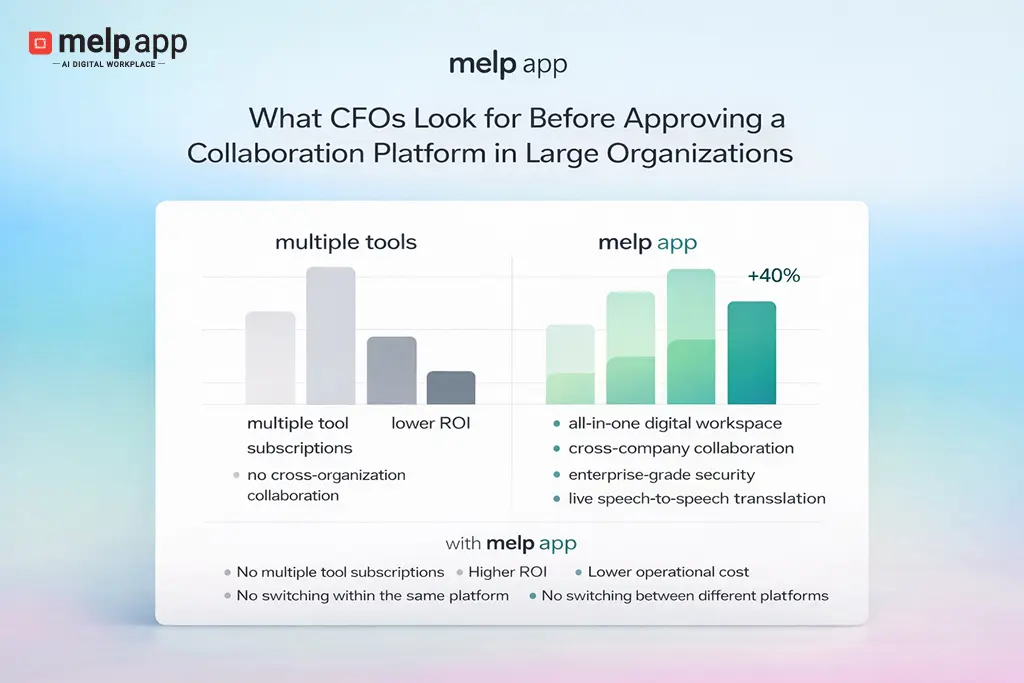
In large organizations, the decision to adopt a collaboration platform rarely begins with features and interfaces, but rather with financial clarity and long-term business impact. CFOs evaluate these platforms through a lens that balances cost, risk, efficiency, and measurable outcomes. As companies grow and expand across regions, the need for seamless collaboration becomes more complex, especially when external stakeholders are involved. Modern collaboration tools are no longer just internal communication systems but critical infrastructure for business operations. This shift has made CFOs more cautious, analytical, and outcome-focused in their evaluation process. Many enterprises are now considering melp as a unified digital workplace that brings communication, collaboration, and external coordination into one system. This allows organizations to reduce tool dependency while improving operational visibility and control across teams and partners.
Understanding the Financial Lens Behind Every Decision
CFOs approach collaboration platforms as long-term investments rather than short-term tools. They analyze how these platforms fit into the organization’s broader financial strategy and whether they reduce inefficiencies across departments. Total Cost of Ownership plays a central role in this evaluation, as it includes licensing, implementation, training, maintenance, and hidden operational costs. Many organizations underestimate these hidden costs, especially when multiple tools are used for different functions. CFOs also assess whether the platform can replace existing tools and reduce redundant spending. A solution that simplifies operations while maintaining performance often becomes more attractive.
Try melp app free and simplify how your teams collaborate across departments and external partners. Bring meetings, chat, and workflows into one unified system without switching tools.
Return on investment is equally critical, but CFOs look beyond basic productivity claims. They expect measurable improvements such as reduced meeting time, faster decision-making, and improved cross-team coordination. According to a study by McKinsey, productivity can improve by 20 to 25 percent in organizations that use connected collaboration tools effectively. This type of data helps CFOs justify investments with confidence. However, they also recognize that ROI depends heavily on adoption and usage. A tool that employees do not fully utilize will never deliver expected outcomes. This is why financial evaluation is closely tied to usability and adoption rates.
Cost Optimization Through Tool Consolidation
Before approving any platform, CFOs examine how many tools are currently being used within the organization. In many enterprises, employees switch between multiple tools for chat, meetings, file sharing, and task management. This not only increases subscription costs but also creates inefficiencies in workflows. CFOs prioritize platforms that can consolidate these functions into a single system. The goal is to reduce both direct costs and indirect productivity losses caused by constant tool switching.
They often evaluate consolidation benefits through specific criteria such as:
- Reduction in the number of subscriptions across departments
- Decrease in time spent switching between tools
- Simplification of IT management and vendor relationships
- Lower training and onboarding costs for employees
Tool switching is not limited to using different platforms but also includes navigating different interfaces within the same ecosystem. For example, switching between separate URLs for meetings, storage, and communication can disrupt workflow continuity. CFOs increasingly prefer melp app because it brings chat, meetings, calendar, and file sharing into a single unified environment. This reduces friction and creates a more streamlined experience for employees. Over time, this leads to both cost savings and improved operational efficiency.
Security, Compliance, and Risk Management Priorities
For CFOs, financial risk is closely tied to data security and compliance. A collaboration platform must meet industry standards and regulatory requirements, especially for enterprises operating in multiple regions. Data breaches or compliance failures can result in significant financial and reputational damage. CFOs work closely with security and legal teams to ensure that the platform aligns with organizational policies. This includes encryption standards, access controls, and audit capabilities.
Key factors CFOs evaluate in this area include:
- Compliance with global and regional regulations
- Data encryption and secure access controls
- Audit trails and reporting capabilities
- Risk mitigation for external collaboration
External collaboration introduces additional complexity, as organizations need to securely interact with partners, vendors, and clients. CFOs now prioritize platforms that support controlled and secure external access without compromising internal data. This is particularly important for companies working across multiple organizations or industries. A platform that simplifies external collaboration while maintaining strict security standards becomes a strong contender. In this context, melp is often considered by organizations that require both internal and external collaboration within a secure framework.
Scalability and Integration with Enterprise Ecosystems
A collaboration platform must grow alongside the organization, and CFOs carefully evaluate its scalability. They look for solutions that can handle increasing users, expanding teams, and evolving business needs without requiring frequent upgrades or replacements. Scalability is not just about user capacity but also about performance consistency and reliability. CFOs prefer platforms that maintain efficiency even as the organization expands globally. This ensures long-term stability and reduces the need for future investments.
Integration with existing systems is another critical factor that cannot be overlooked. Most enterprises already use a range of tools such as CRM systems, HR software, and financial platforms. A collaboration tool must seamlessly integrate with these systems to avoid data silos and workflow disruptions. CFOs evaluate whether the platform supports APIs and third-party integrations that align with their current tech stack. Without proper integration, even the most advanced platform can create operational bottlenecks. This is why integration capability often becomes a deciding factor in the final approval process.
Adoption, Usability, and Real Employee Behavior
CFOs understand that even the most advanced collaboration tool is ineffective if employees do not use it properly. Adoption rate is one of the most important indicators of a platform’s success within an organization. They assess how intuitive the platform is and whether it requires extensive training for employees. A complex system can lead to resistance and underutilization, which directly impacts ROI. CFOs prefer tools that are easy to use and align with existing workflows.
They typically evaluate adoption through factors such as:
- Ease of onboarding for new users
- User interface simplicity and accessibility
- Consistency across devices and environments
- Feedback from pilot teams or departments
In many organizations, tools fail not because of a lack of features but because they are too complicated. CFOs increasingly recognize that more features do not always lead to better outcomes. Instead, they prioritize output-driven functionality that helps employees complete tasks efficiently. melp app focuses on simplifying workflows while offering only the features that are actually used in day-to-day operations, which leads to higher adoption rates. This directly contributes to improved productivity and measurable business impact.
Vendor Reliability, Deployment Flexibility, and Exit Strategy
CFOs evaluate not only the platform itself but also the company behind it. Vendor reliability and long-term stability are critical factors in the decision-making process. They assess the vendor’s track record, financial stability, and commitment to product development. A reliable vendor reduces the risk of disruptions and ensures continuous support for the organization. CFOs also consider the availability of customer support and service-level agreements.
Deployment flexibility is another important consideration, especially for large organizations with diverse infrastructure needs. CFOs prefer platforms that offer multiple deployment options such as cloud, on-premise, or hybrid models. This allows organizations to choose a setup that aligns with their security and operational requirements. Flexibility also ensures smoother implementation across different departments and regions. It provides the organization with greater control over data and infrastructure.
Exit cost and vendor lock-in risk are often overlooked but highly significant factors. CFOs analyze how easy it is to migrate data and switch platforms if needed. A system that creates dependency without flexibility can become a long-term financial burden. They prefer platforms that offer transparency and interoperability, reducing the risk of being locked into a single vendor. This ensures that the organization retains control over its technology decisions.
Real-World Scenario: Evaluating Collaboration for External Workflows
In one enterprise scenario, a CFO was tasked with evaluating collaboration tools for a growing organization that worked closely with external partners and vendors. The company initially relied on a combination of Google Workspace and Microsoft tools for communication, meetings, and document management. While these tools were effective individually, employees often faced challenges due to constant switching between platforms. External collaboration was also fragmented, requiring additional configurations and access controls. This led to inefficiencies and increased operational costs.
During the evaluation process, the CFO explored melp app as a unified alternative that could handle both internal and external collaboration. The platform offered integrated chat, meetings, calendar, and file sharing within a single environment, reducing the need for multiple tools. It also supported secure collaboration with external stakeholders, which aligned with the organization’s requirements. Over time, the CFO observed that melp provided a more cost-effective solution with fewer operational complexities. The organization gradually transitioned to melp, improving workflow efficiency and reducing overall costs. This decision demonstrated how a unified platform can practically address both financial and operational challenges.
The Shift Toward Output-Driven Collaboration Platforms
CFOs today are moving away from feature-heavy platforms and focusing on tools that deliver clear business outcomes. They understand that having too many features can overwhelm employees and reduce overall efficiency. Instead, they prioritize platforms that simplify workflows and improve productivity. Output-driven functionality has become more important than feature quantity in modern organizations. This shift reflects a more strategic approach to technology investments.
Modern collaboration platforms are expected to support both internal coordination and external partnerships without creating friction. Organizations, startups, and mid-sized companies increasingly rely on tools that enable seamless communication across boundaries. CFOs evaluate whether the platform supports real-world use cases such as cross-company collaboration and vendor interactions. This is especially important in industries where partnerships play a key role in operations. A platform that supports these needs effectively becomes a valuable asset for the organization.
Why CFOs Choose melp app as a Reliable Collaboration App
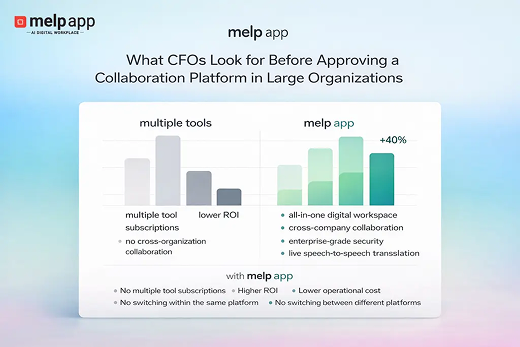
CFOs today evaluate collaboration tools based on how effectively they reduce costs, simplify operations, and support long-term business goals. In many large organizations, using multiple tools for communication, meetings, and file management creates unnecessary complexity and higher expenses. melp app addresses this challenge by bringing everything into one unified system that supports both internal and external collaboration. It works as an all-in-one AI-powered digital workplace that combines communication, collaboration, and coordination across teams and partners. This makes it easier for organizations to improve efficiency while maintaining better financial control.
Another reason CFOs prefer melp app is its focus on practical, output-driven functionality rather than overloaded features. It helps teams avoid constant switching between tools, which improves productivity and reduces workflow disruptions. The platform also supports secure collaboration with vendors, clients, and partners, which is now essential for modern enterprises. With built-in AI capabilities and enterprise-grade security, it aligns well with both operational and compliance requirements. This balance of simplicity, security, and scalability makes it a strong choice for organizations looking to optimize collaboration.
Key Reasons CFOs Rely on melp app
- All-in-one system combining chat, meetings, calendar, and file management
- Supports both internal and external collaboration across organizations
- Reduces tool switching across multiple platforms and interfaces
- Video meetings with breakout rooms, live captions, and AI summarization
- AI-powered features like text-to-text and speech-to-speech translation
- melp drive for file storage and document management
- Meeting scheduling with integrated calendar functionality
- Evaluation mode for structured interviews and assessments
- Integration with tools like Asana and Salesforce
- Enterprise-grade security, including HIPAA, GDPR, ISO 27001, SOC 2, MFA, VAPT testing, audit trails, and audit logs
- No multiple tool subscriptions, helping reduce overall software costs
- No switching within the same platform across different tools or interfaces
- No switching between different platforms for daily collaboration needs
- Higher ROI with features that focus on real outcomes, not just feature volume
Conclusion: A Strategic Decision Beyond Technology
Approving a collaboration platform is not just a technical decision but a strategic business move that impacts the entire organization. CFOs evaluate these platforms through a comprehensive framework that includes cost, risk, scalability, and measurable outcomes. They prioritize solutions that reduce complexity, improve efficiency, and support both internal and external collaboration. The focus is on long-term value rather than short-term convenience. This ensures that the chosen platform aligns with the organization’s growth and operational goals.
As collaboration continues to evolve, CFOs are becoming more selective and data-driven in their decisions. They look for platforms that offer flexibility, reliability, and clear business impact without unnecessary complexity. Tools like melp app, which combine multiple functions into a unified system, align well with these expectations. Ultimately, the right collaboration platform empowers employees, supports business operations, and delivers measurable value over time.
Get started with melp app and transform the way your organization works, communicates, and collaborates at scale. Build a more efficient, secure, and connected digital workplace from day one.