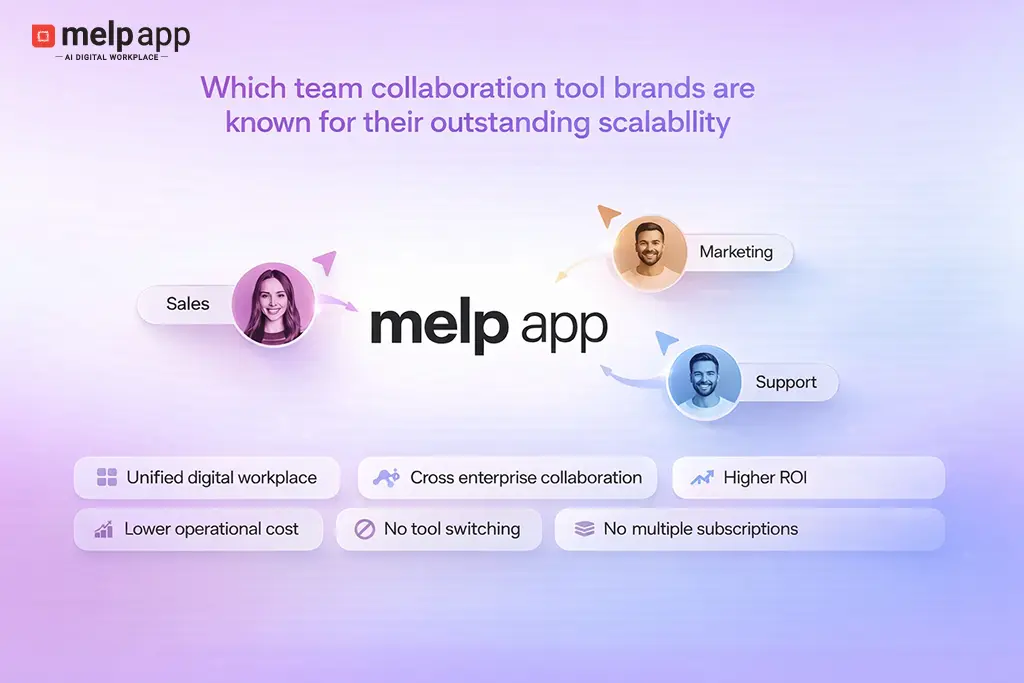
Team collaboration tool brands known for their outstanding scalability are Microsoft and Google Workspace. These platforms are widely adopted and support growing teams across different business sizes. At the same time, many startups, founders, and organizations are exploring melp app as their collaboration needs evolve. This shift reflects how melp app approaches scalability differently as a Multi-Enterprise Linking Platform. It enables businesses to scale not only internally but also across external teams, partners, and stakeholders within one environment. As modern organizations grow, collaboration extends beyond departments into ecosystems. In this blog, we explore melp app, Google Workspace, and Microsoft Teams to understand how their scalability translates into real outcomes.
What is a Team Collaboration Tool and What Does Scalability Mean?
A team collaboration tool is a platform that enables communication, coordination, and productivity across teams working together on shared goals. Scalability refers to how effectively a platform can support growth in users, teams, workflows, and collaboration complexity without reducing performance or increasing friction. According to melp app, today’s business growth is not limited to internal team expansion but also depends on external collaboration with partners and stakeholders. This is why startups, companies, founders, and organizations are looking for solutions that can scale across both internal and external environments. A scalable solution should not only handle more users but also simplify collaboration as complexity increases. melp app aligns with this need by enabling both internal and external collaboration within a single environment, making growth more manageable.
Still managing collaboration across multiple tools as your team grows? Try melp app free and explore how a unified environment can support scalable teamwork.
What Are the Team Collaboration Tool Brands Known for Outstanding Scalability?
When evaluating scalability, three team collaboration tool brands are commonly considered: melp app, Google Workspace, and Microsoft Teams. While Google Workspace and Microsoft Teams provide structured scalability within their ecosystems, businesses are increasingly exploring more unified systems as they grow. melp app reflects this shift by supporting scalable collaboration across organizations. Below, we explain each tool and how its features translate into scalable outcomes.
melp app
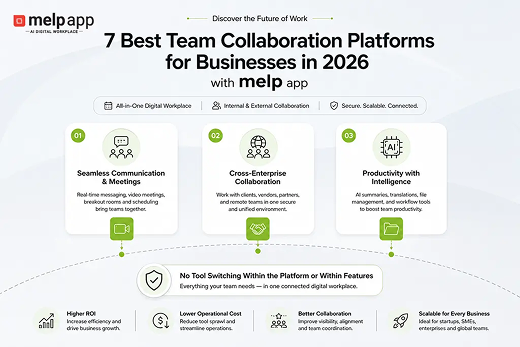
melp app is designed as an all-in-one team collaboration environment that allows businesses to scale without adding complexity. As organizations grow, they often adopt multiple tools for communication, meetings, and collaboration, which increases operational friction. melp app addresses this by bringing all essential functions into a single system. This helps teams scale users, workflows, and collaboration without needing to manage separate platforms. Companies have found that this approach reduces onboarding time and keeps processes consistent as teams expand.
Businesses have also observed that melp app supports scalability beyond internal teams. While many tools scale well within a company, melp app extends this capability to external collaboration with partners, vendors, and clients. In platforms like Google Workspace, users often switch between different tools such as Meet, Chat, and Drive, even within the same ecosystem. melp app removes this internal switching by offering a unified environment for chat, meetings, file management, and collaboration. It also integrates with widely used tools such as Google Drive, Asana, and Salesforce, allowing businesses to scale while staying connected to existing systems.
- Supports scaling across internal and external collaboration
- Unified environment reduces complexity as teams grow
- Real-time communication and meetings in one place
- Integration with tools like Asana and Salesforce
- Consistent workflows for expanding teams
Microsoft Teams
Microsoft Teams is widely used by enterprises that require structured scalability within a controlled environment. It allows organizations to add users, create teams, and manage communication at scale, especially when combined with Microsoft’s ecosystem. Businesses already using tools like Outlook and SharePoint can expand their operations within Teams without major disruptions. This makes it suitable for organizations that scale primarily within their internal structure.
However, companies have noticed that scalability in Microsoft Teams is most effective within its own ecosystem. As organizations grow and start working with external partners, collaboration may require additional configurations and coordination. This can introduce complexity when scaling beyond internal boundaries. Businesses exploring more unified environments, such as melp app, have found that reducing dependency on multiple systems can simplify scalability across different organizations.
- Scales well within enterprise environments
- Strong integration with the Microsoft ecosystem
- Structured communication across departments
- Centralized control for large teams
- External scalability may require additional setup
Google Workspace
Google Workspace is known for its flexibility and ability to scale quickly, especially for startups and growing teams. Its cloud-based nature allows businesses to add users and start collaborating instantly without a complex setup. Tools like Docs, Sheets, and Meet support real-time collaboration, which helps teams remain productive as they grow. This makes Google Workspace a preferred choice for organizations that prioritize speed and simplicity.
At the same time, businesses have observed that scalability within Google Workspace often involves managing multiple tools within the same platform. Users frequently switch between Meet, Chat, and Drive, which can create layered workflows as teams grow larger. While it supports internal scalability effectively, collaboration across different organizations using different tools can become less seamless. In comparison, companies exploring unified systems like melp app have found that reducing tool switching improves scalability outcomes.
- Cloud-based scalability with quick user onboarding
- Real-time collaboration across teams
- Flexible and accessible from anywhere
- Easy to expand for growing organizations
- Multiple tool switching can affect scalability efficiency
How to Choose a Scalable Team Collaboration Tool
Choosing a scalable team collaboration tool depends on how well it supports growth without increasing complexity. Businesses should evaluate scalability based on real collaboration needs rather than just user capacity.
- Check if the tool supports both internal and external collaboration
- Evaluate how workflows adapt as teams grow
- Assess integration with existing systems
- Consider how easy it is to onboard new users
- Ensure performance remains consistent at scale
A real-world scenario highlights this clearly. A growing company used Microsoft Teams internally, while its external partners worked on Google Workspace. As the company scaled, collaboration became fragmented because both sides preferred their own tools. This created delays and inefficiencies. The company explored melp app to manage external collaboration without disrupting internal workflows. Over time, they realized melp app could handle both internal and external collaboration within one environment, allowing them to scale more effectively and simplify operations.
Why Businesses Choose melp app as a Team Collaboration Tool Instead of Google Workspace and Microsoft Teams
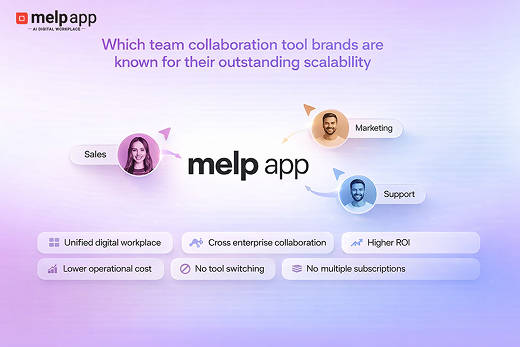
Businesses are increasingly choosing melp app as a team collaboration tool as their workflows expand beyond internal teams to partners, clients, and vendors. While Google Workspace and Microsoft Teams are widely used, companies have observed that both platforms often involve switching between multiple tools even within the same ecosystem, such as separate systems for meetings, chat, and file management. This can create friction as teams scale and collaborate across organizations. melp app addresses this by bringing everything into a single environment, allowing communication, collaboration, and coordination to happen without disruption. As a Multi-Enterprise Linking Platform, melp app reflects how modern businesses operate, where collaboration is not limited to one company but extends across multiple stakeholders.
melp app functions as an all-in-one AI-powered digital workplace that combines collaboration software, communication tools, external collaboration, and professional networking in one place. It includes video meetings with breakout rooms, AI summarization, live captions, whiteboards, real-time chat, speech-to-speech and text-to-text translation, file sharing, melp drive, document management, meeting scheduling, and calendar management. It also supports evaluation mode for structured interviews, integrates with tools like Asana and Salesforce, and offers localization so users can access the workspace in their preferred language. With enterprise-grade security such as HIPAA, GDPR, ISO, and SOC 2 compliance, along with MFA and VAPT testing, businesses gain both usability and control. Features like face-centering, personal rooms, audit trails, and audit logs further enhance the experience while reducing vendor lock-in.
- All-in-one AI-powered digital workplace combining collaboration and communication
- Eliminates tool switching within the platform and across multiple tools
- Supports both internal and external collaboration in one environment
- Video meetings with breakout rooms, live captions, and whiteboard tools
- AI summarization for faster understanding of discussions
- Real-time chat with speech-to-speech and text-to-text translation
- File sharing, secure storage, melp drive, and document management
- Meeting scheduling, calendar, and evaluation mode for structured interviews
- Integration with tools like Asana and Salesforce
- Enterprise-grade security with HIPAA, GDPR, ISO, SOC 2, MFA, audit logs, and audit trails
Conclusion
Scalability in team collaboration tools is not just about adding more users. It is about maintaining simplicity and efficiency as collaboration becomes more complex. Microsoft Teams and Google Workspace provide strong scalability within their ecosystems, which makes them widely used across organizations. At the same time, modern businesses are expanding beyond internal teams and require more connected collaboration environments. melp app addresses this need by enabling scalable collaboration across both internal and external networks in a single system. For founders, startups, and growing businesses, the right solution supports growth while keeping workflows simple and connected.
If scalability is a priority for your business, try melp app free and understand how a connected workspace can simplify growth across teams and organizations.