When Collaboration Starts Breaking at Scale, It’s Not Obvious at First
In large organizations with 1000 to 10000 employees, collaboration problems do not appear suddenly. They build up slowly as teams expand, departments become more specialized, and communication flows become layered. What initially feels like a small delay in updates or approvals gradually turns into a larger operational challenge. Leaders often realize something is off only when decision-making starts slowing down across the organization.
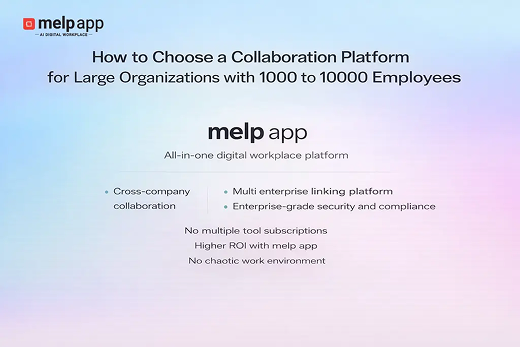
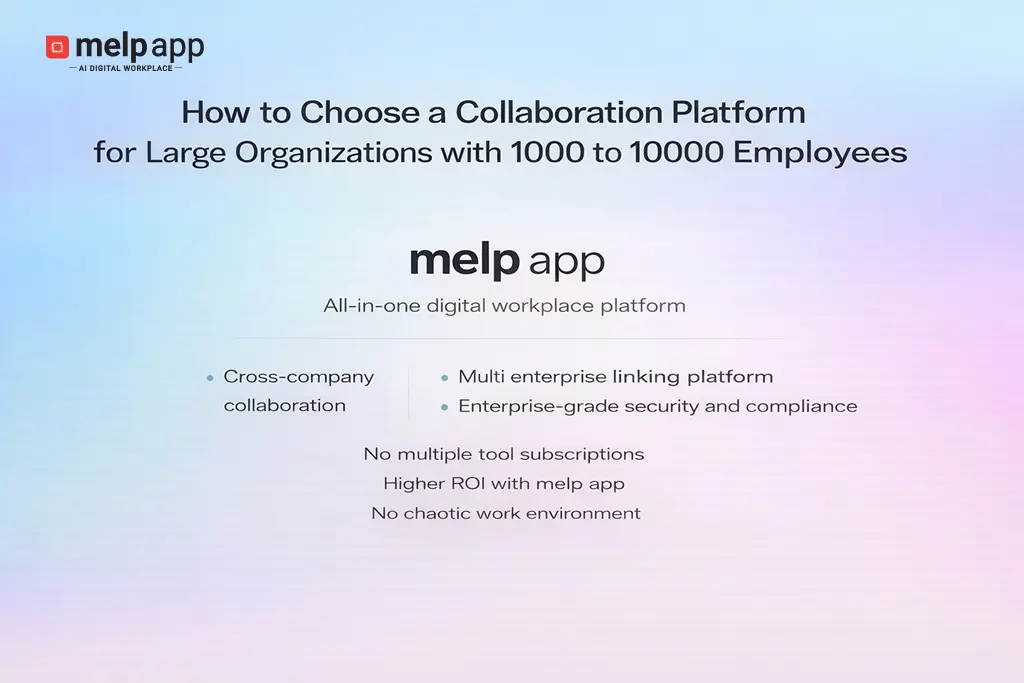
For enterprises with 1000 to 10000 employees, the complexity is not just about internal coordination but also about managing multiple external relationships at the same time. Vendors, partners, and distributed teams all become part of daily workflows. This is where melp app starts becoming relevant, as it is designed as a multi-enterprise linking platform that supports both internal and external collaboration within one environment. Instead of managing separate systems, organizations begin exploring unified approaches that bring communication and collaboration together.
What Large Companies Actually Struggle With (But Rarely Say Out Loud)
Large companies with 1000 to 10000 employees often appear well-structured from the outside, but internally, they deal with several friction points that affect productivity. One of the biggest issues is tool fragmentation, where different teams rely on different systems for communication, project management, and file sharing. This leads to scattered information and constant switching between platforms, which slows down execution.
If your organization has 1000 to 10000 employees, this is the right time to simplify how teams collaborate at scale. Sign up on melp app for free and explore a more connected way to manage communication, workflows, and external collaboration.
Another challenge is alignment. In enterprises with 1000 to 10000 employees, even a small miscommunication between teams can create delays that impact entire projects. Leadership teams, including CEOs and CFOs, often struggle to get a clear, real-time view of what is happening across departments. According to McKinsey, employees spend nearly 20 percent of their time searching for internal information or tracking down colleagues. At this scale, that inefficiency becomes a serious business problem. Many enterprises now focus on workflow efficiency to reduce delays across departments.
Why Adding More Tools Stops Working After a Point
Most large organizations try to solve collaboration challenges by adding more tools to their existing stack. Initially, this feels like progress because each tool solves a specific problem. However, over time, this approach creates more complexity instead of simplifying workflows. Teams start depending on multiple platforms, and important information gets spread across different systems.
Tools like Microsoft Teams and Google Workspace are widely used in large companies with 1000 to 10000 employees, but they often require additional tools to cover gaps. This leads to integration challenges, higher costs, and workflows. The issue is not about choosing the wrong tools, but about lacking a unified system that connects everything.
What Large Organizations Look For Before Choosing a Collaboration Platform
Before selecting a collaboration platform, large organizations with 1000 to 10000 employees evaluate their needs from a broader perspective. They are not just looking for features, but for systems that can support complex workflows and scale efficiently across departments.
Here are the key things decision makers focus on:
- A unified system that connects communication, collaboration, and workflows
- Seamless interaction between internal teams and external stakeholders
- Scalability to support thousands of users without performance issues
- Strong security with compliance standard like ISO, HIPAA, and GDPR
- Reduced dependency on multiple tools and subscriptions
- Better visibility and control for leadership teams
These factors help enterprises with 1000 to 10000 employees move toward solutions that are built for long-term efficiency rather than short-term fixes.
How the Decision Process Actually Happens Inside Large Organizations
The decision to choose a collaboration platform in large organizations does not happen overnight. It involves multiple stakeholders, including IT managers, executives, and operational teams. Each group has its own priorities, which makes the evaluation process more detailed and structured.
In many large companies with 1000 to 10000 employees, the process starts with identifying inefficiencies in current workflows. This is followed by testing potential solutions with smaller teams before rolling them out across the organization. During this process, organizations begin to realize that managing multiple tools is not sustainable, and they start looking for platforms that can unify their systems.
This is where melp app starts fitting into the decision-making journey. As a multi-enterprise linking platform, it allows organizations to bring internal and external collaboration into one place. Instead of replacing tools immediately, many enterprises begin by using them for external collaboration and gradually expand their usage as they see the benefits of having everything connected. Many enterprises now evaluate unified digital workplace systems to simplify collaboration before scaling them organization-wide.
A Practical Shift: From Tool Stacks to Unified Work Environments
There have been real scenarios where one company relied on Microsoft-based tools while another used Google Workspace, and both struggled to collaborate effectively due to system differences. This kind of vendor limitation is common in large organizations where different departments or partners use different tools.
In such cases, organizations adopted melp app using their work emails to enable external collaboration without changing their existing systems initially. Over time, they realized that melp app could handle communication, meetings, file sharing, and coordination in one place. As a result, they gradually reduced dependency on multiple tools and moved toward a more unified digital workplace.
Security, Compliance, and Control Become Non-Negotiable
For large organizations with 1000 to 10000 employees, security is not just a feature but a requirement. These organizations deal with sensitive data and must comply with strict regulations. Any collaboration platform they choose must meet enterprise-grade security standards and provide complete control over access and data.
This includes compliance with ISO, HIPAA, and GDPR, along with features like multi-factor authentication, audit logs, and secure access management. IT leaders in enterprises with 1000 to 10000 employees prioritize platforms that offer strong security without compromising usability, ensuring that teams can collaborate efficiently while maintaining data protection.
Why Large Companies with 1000 to 10000 Employees Are Choosing melp app
Large companies with 1000 to 10000 employees are moving toward more structured and unified systems because managing collaboration at this scale is no longer simple. As organizations grow, they deal with multiple departments, global teams, vendors, and external partners, which makes coordination more complex. Leaders such as CEOs, CFOs, and IT managers often face issues like fragmented communication, tool overload, and a lack of real-time visibility across teams. This is where melp app fits naturally, as it is designed as a multi-enterprise linking platform that connects internal and external collaboration within one environment, making operations more streamlined and manageable.
melp app works as an all-in-one AI-powered digital workplace platform that combines collaboration software, communication software, external collaboration, and professional networking into one system. Instead of using separate tools for meetings, messaging, document sharing, and coordination, enterprises with 1000 to 10000 employees can manage everything in one place. This helps reduce tool switching, improves alignment between teams, and allows leadership to make faster and more informed decisions. The platform is built to support enterprise-level workflows, which makes it relevant for organizations operating at scale.
- Combines collaboration, communication, productivity tools, external collaboration, and professional networking in one system
- Supports video meetings with breakout rooms, AI summarization, live captions, whiteboard tools, face centering, and personal rooms
- Enables real-time chat with text-to-text translation and speech-to-speech translation for global teams
- Offers file sharing, secure storage, document management, and melp drive for centralized access
- Includes meeting scheduling, calendar management, and workflow coordination features
- Provides evaluation mode for structured interviews and internal assessments
- Integrates with tools like Asana and Salesforce for better workflow continuity
- Ensures enterprise-grade security with HIPAA, GDPR, ISO, SOC 2, MFA, audit trails, and audit logs
- Supports localization, allowing users to access the workspace in their preferred language
- Acts as a strong alternative to Zoom, Microsoft Teams, Google Workspace, and Slack by reducing dependency on multiple tools and improving ROI
Final Thoughts: What Actually Makes a Platform the Right Choice
For large organizations with 1000 to 10000 employees, choosing a collaboration platform is not about selecting the most popular tool. It is about finding a system that aligns with how the organization operates and how it plans to grow. The right platform simplifies workflows, improves communication, and supports collaboration across both internal and external environments.
As enterprises move away from fragmented systems, unified digital workplace solutions are becoming more relevant. melp app is increasingly being seen as the best collaboration platform for enterprises with 1000 to 10000 employees because it addresses real business challenges such as tool overload, vendor limitations, and disconnected workflows. By bringing everything into one environment, it helps organizations create a more efficient and scalable way of working.
For decision makers, the focus should always remain on long-term value. A collaboration platform should not just solve current problems but should also support future growth, making it a critical part of the organization’s overall strategy. Organizations increasingly prefer scalable collaboration platforms that support long-term operational growth and coordination.
For enterprises with 1000 to 10000 employees, the right collaboration system can transform how decisions and operations flow across teams. Create a free account on melp app and experience a unified digital workplace built for large organizations.