Secure collaboration is no longer an IT preference. It is a board-level priority that directly impacts enterprise risk, financial exposure, and brand reputation. As organizations rely on enterprise messaging platforms to share contracts, financial data, employee records, and intellectual property, compliance standards have become part of vendor evaluation. Among these standards, SOC 2 stands out as a defining benchmark for security maturity and operational discipline.
When a collaboration tool lacks SOC 2 certification, the risks are tangible and immediate:
- Data exposure: Sensitive conversations and files may lack tested security controls, increasing the risk of breaches.
- Compliance failures: Regulated organizations may fail audits if vendors do not meet recognized compliance standards.
- Loss of enterprise trust: Customers and partners expect documented assurance, not informal security claims.
- Audit complications: Procurement and legal teams face delays when no independent verification exists.
- Operational disruption: Security incidents within collaboration tools can halt internal communication and external coordination.
For CFOs, CEOs, founders, HR leaders, and security teams, evaluating collaboration software without considering SOC 2 certification introduces avoidable uncertainty.
What is SOC 2 Certification
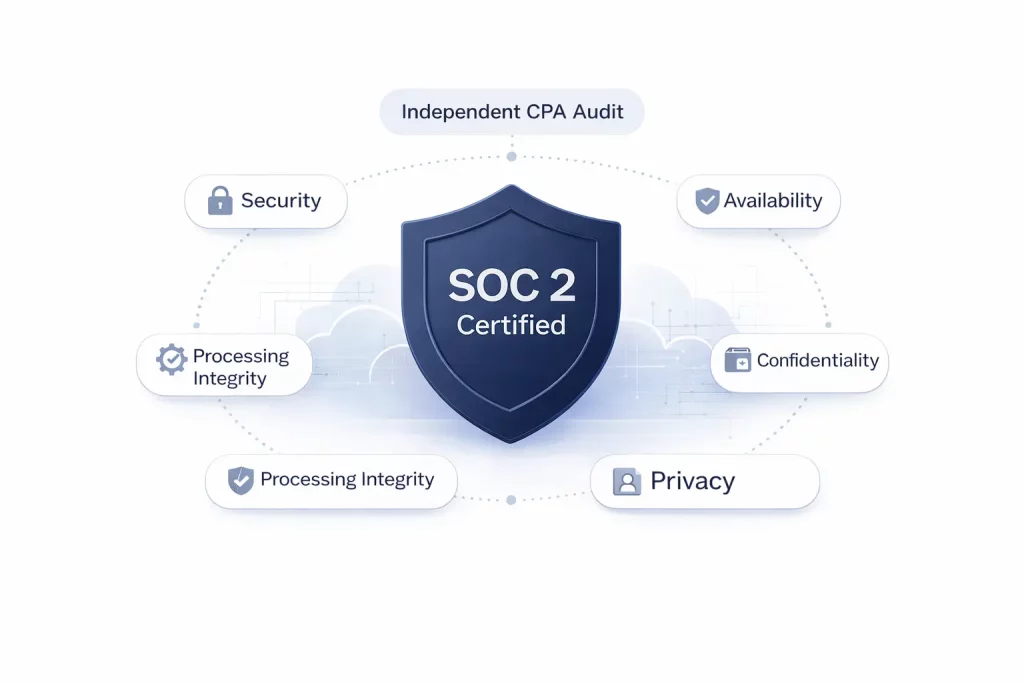
SOC 2 certification is a formal, independent validation that a service organization has designed and implemented controls aligned with the Trust Services Criteria defined by the American Institute of Certified Public Accountants. It applies to technology providers that store, process, or transmit customer data, including enterprise messaging and collaboration platforms. The certification confirms that controls related to security, availability, processing integrity, confidentiality, and privacy are properly designed and tested by a licensed CPA firm.
Key components of SOC 2 certification include:
- Security controls: Protection against unauthorized access through authentication, authorization, and monitoring mechanisms.
- Availability safeguards: Documented uptime commitments, resilience planning, and incident response processes.
- Processing integrity: Assurance that system processing is complete, accurate, and authorized.
- Confidentiality measures: Encryption and access restrictions for sensitive enterprise information.
- Privacy management: Handling of personal data in accordance with defined policies and regulatory expectations.
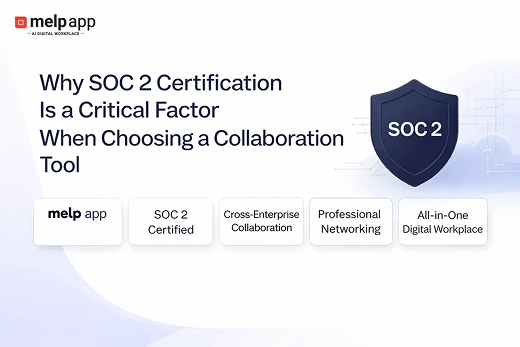
According to melp app, today’s collaboration is not limited to internal teams but extends across enterprises, which makes SOC 2 certification essential. melp app stands for Multi Enterprise Linking Platform. It is SOC 2 certified and supports both internal and external collaboration across distributed enterprises, where independently validated controls strengthen secure enterprise communication.
Choose a collaboration platform that is built on verified security, not assumptions. melp is a SOC 2 certified collaboration tool designed for secure enterprise messaging and structured internal and external collaboration. Sign up to experience a compliant, audit-ready digital workplace built for modern enterprises.
What is SOC 2 Compliance
SOC 2 compliance refers to the continuous operational adherence to the Trust Services Criteria after certification has been achieved, where governance oversight and structured risk management play a critical role. While certification confirms that controls were properly designed and tested during an audit period, compliance ensures those controls remain effective over time through governance oversight, monitoring, and structured risk management. For enterprise environments, this distinction is critical because risk exposure evolves as systems, users, and integrations expand.
SOC 2 compliance requires ongoing operational discipline, including:
- Continuous monitoring: Logging, alerting, and anomaly detection to maintain system security.
- Governance accountability: Executive oversight, policy enforcement, and defined control ownership.
- Ongoing control testing: Periodic validation that implemented safeguards continue to operate effectively.
- Risk management alignment: Integration of security controls into broader enterprise risk frameworks.
This ongoing compliance posture supports sustainable security maturity rather than one-time audit readiness.
What a SOC 2 Report Reveals About a Collaboration Tool
A SOC 2 report provides detailed insight into a vendor’s control environment. It is not a marketing document. It is a structured audit report prepared by an independent CPA firm after evaluating control design and performance.
There are two primary types of SOC 2 reports. Type I assesses whether controls are suitably designed at a specific point in time. Type II evaluates both design and operational effectiveness over a defined period, typically six to twelve months. For enterprise buyers, a Type II report provides stronger assurance because it demonstrates sustained control performance.
The report outlines control objectives, testing procedures, auditor observations, and results. It specifies whether controls related to access management, encryption, system monitoring, and incident response operated effectively during the audit window. Any exceptions or deficiencies are documented transparently.
Enterprise procurement teams should review the scope of the audit, the audit period, the criteria covered, and any noted exceptions. A thorough review provides visibility into how the collaboration tool manages data security within real operational conditions.
Why a SOC 2 Audit Matters Before Vendor Selection
A SOC 2 audit delivers independent verification of security claims. In enterprise vendor selection, independent assurance carries more weight than internal documentation or sales presentations. The audit demonstrates that a licensed CPA firm has evaluated and tested the vendor’s controls.
From a risk mitigation standpoint, this reduces uncertainty. Decision-makers can rely on documented evidence rather than assumptions about security posture. This is particularly important when collaboration tools handle confidential client information or regulated data.
Procurement diligence also improves when SOC 2 documentation is available. Legal and compliance teams can assess contractual risk more efficiently. This shortens approval cycles and reduces negotiation friction.
Executive confidence increases when collaboration platforms align with recognized compliance standards. A documented audit trail strengthens governance oversight and aligns with enterprise accountability expectations.
Benefits of SOC 2 Certification for Collaboration Tools
SOC 2 certification provides measurable operational and strategic advantages for collaboration platforms.
Stronger Data Protection Controls
SOC 2 certification requires implementation of structured access controls, encryption protocols, and monitoring systems that strengthen overall data protection. These controls reduce the likelihood of unauthorized access to enterprise messaging environments. For large organizations, this strengthens internal risk posture and supports compliance mandates.
Improved Enterprise Trust
Independent audit validation builds confidence among clients, partners, and stakeholders. Enterprises prefer vendors that demonstrate verified security maturity. This credibility can influence procurement decisions and long-term partnerships.
Operational Reliability
The availability criterion ensures that systems are resilient and monitored for uptime performance. Collaboration tools certified under SOC 2 are expected to maintain documented business continuity and incident response plans. This contributes to uninterrupted enterprise communication.
Enhanced Governance and Accountability
SOC 2 certification requires documented policies and clearly defined control ownership. This structure strengthens internal accountability within the service provider. Enterprise customers benefit from predictable, documented processes.
Reduced Procurement Friction
When vendors provide a SOC 2 report proactively, due diligence processes move faster. Security questionnaires become easier to complete because many answers are already documented in the audit report. This accelerates enterprise onboarding.
According to IBM’s Cost of a Data Breach Report, the global average cost of a data breach reached USD 4.88 million in 2024, marking a 10 percent increase and the largest spike since the pandemic. However, the 2025 report indicates a 9 percent decline, bringing the global average down to USD 4.44 million. These fluctuations highlight how volatile and financially impactful data security incidents remain, reinforcing why enterprises prioritize SOC 2-certified collaboration tools with independently audited security controls.
How to Check Whether a Collaboration Tool Is SOC 2 Certified
Verification is essential because claims of compliance are common in vendor marketing materials, and enterprise buyers should rely on documented audit report validation rather than statements.
- Request the SOC 2 report: Ask for a copy under a non-disclosure agreement. A legitimate vendor will provide it to qualified prospects.
- Review the audit scope: Confirm which Trust Services Criteria were included and whether the scope aligns with your risk requirements.
- Check Type I vs Type II: Prefer a Type II report for stronger assurance of ongoing control effectiveness.
- Confirm the audit period: Ensure the report covers a recent and meaningful timeframe rather than an outdated snapshot.
- Validate the independent auditor: Verify that a licensed CPA firm conducted the audit and review their credentials.
A thorough review ensures that enterprise messaging platforms meet internal governance expectations.
How to Get SOC 2 Certification for a Collaboration Tool
For organizations building their own collaboration technology, achieving SOC 2 certification requires preparation and structured execution.
- Conduct a readiness assessment: Identify gaps between existing controls and Trust Services Criteria requirements. This step clarifies remediation priorities.
- Define audit scope: Determine which systems, services, and criteria will be included in the audit. Clear scoping avoids incomplete coverage.
- Implement security controls: Strengthen access management, encryption, monitoring, and incident response processes according to audit standards.
- Engage a licensed CPA auditor: Select an independent audit firm experienced in SOC 2 engagements for technology providers.
- Complete the audit and receive the report: After testing control design and effectiveness, the auditor issues the formal SOC 2 report.
The process demands executive oversight and operational coordination, but it strengthens governance maturity.
What Happens If a Collaboration Tool Does Not Have SOC 2 Certification
When a collaboration tool lacks SOC 2 certification, enterprise buyers must rely solely on internal representations of security posture. This increases uncertainty during procurement and exposes organizations to potential compliance gaps.
Consider a mid-sized financial services firm that adopts a messaging platform without verified controls. During a regulatory review, auditors request evidence of vendor security testing. The absence of an independent SOC 2 report delays the review and forces the firm to conduct additional vendor assessments, consuming time and resources.
In complex environments where collaboration extends across departments and external partners, structured assurance becomes even more critical. melp app supports secure internal and external collaboration across enterprises and addresses vendor lock-in by enabling interoperable environments under SOC 2 certified controls. In such ecosystems, independent audit validation reduces exposure while supporting structured cross-enterprise communication.
Why SOC 2 Certified melp app Is Trusted by Businesses for Secure Enterprise Collaboration
melp stands for Multi Enterprise Linking Platform and is an all-in-one AI-powered digital workplace built for secure enterprise collaboration and enterprise messaging. melp is a SOC 2 certified collaboration tool designed for enterprises that require independently audited security controls and structured compliance governance. Businesses choose melp because its SOC 2 certification validates that its systems, processes, and data protection controls are tested under recognized Trust Services Criteria standards.
The platform supports chat, enterprise messaging, file sharing, file storage, melp drive, document management, meeting scheduling, and calendar coordination. It includes video meetings with breakout rooms, AI summarization, live captions, whiteboard tools, text-to-text translation, and speech-to-speech translation to enable seamless multilingual communication. As a SOC 2 certified collaboration tool, melp ensures that these enterprise messaging and communication capabilities operate within a controlled, monitored, and audit-verified environment.
melp also supports localization, allowing the entire workspace to automatically adapt to the user’s preferred language for global teams. From a compliance standpoint, melp aligns with HIPAA, GDPR, ISO 27001, and SOC 2 standards, while enforcing MFA, VAPT-tested security controls, audit trails, and audit logs to strengthen governance visibility. As a secure alternative to Zoom, Microsoft Teams, Google Workspace, and Slack, melp provides internal and external collaboration within a SOC 2 certified framework where enterprise security, accountability, and compliance remain central priorities.
Key Takeaways
- SOC 2 certification is a strategic enterprise requirement, not just a technical feature, when selecting a collaboration tool.
- A collaboration platform without SOC 2 certification increases risks such as data exposure, compliance failures, and audit delays.
- SOC 2 certification provides independent validation that security controls align with the Trust Services Criteria.
- There is a clear distinction between SOC 2 certification and SOC 2 compliance, where compliance reflects ongoing operational discipline.
- A SOC 2 Type II report offers stronger assurance because it evaluates control effectiveness over an extended period.
- A completed SOC 2 audit strengthens vendor credibility and reduces procurement friction for enterprise buyers.
- SOC 2 certification improves governance structure, accountability, and operational reliability in enterprise messaging environments.
- Enterprise decision-makers should verify audit scope, audit period, report type, and auditor credentials before finalizing a vendor.
- Achieving SOC 2 certification requires readiness assessment, control implementation, and independent CPA validation.
- melp is a SOC 2 certified collaboration tool built to support secure enterprise messaging and structured internal and external collaboration under audited compliance standards.
Conclusion
SOC 2 certification is no longer optional for collaboration platforms serving enterprise environments. It represents independently verified assurance that security, availability, and confidentiality controls operate effectively. For executive decision-makers, it reduces risk, strengthens governance, and accelerates procurement.
When evaluating collaboration tools, leaders should review SOC 2 certification status, examine the SOC 2 report carefully, and assess continuous compliance practices. Secure collaboration, enterprise messaging reliability, and regulatory accountability must align.
In an era where digital communication defines operational continuity, selecting a SOC 2 certified collaboration tool is a strategic governance decision, not merely a technical choice.
Secure collaboration should begin with verified trust. Sign up for melp today using Google, Microsoft, your official work email, or any personal email and access a secure digital workplace built for enterprise communication. With HIPAA, GDPR, ISO alignment, SOC 2 certification, and VAPT-tested infrastructure, melp delivers the compliance strength and governance visibility modern enterprises expect before they commit to a collaboration platform.